Budnikova Marianna, Habig Jeffrey W, Lobo Daniel, Cornia Nicolas, Levin Michael, Andersen Tim
Department of Computer Science, Boise State University, 1910 University Drive, Boise, ID 83725, USA.
BMC Bioinformatics. 2014 Jun 10;15:178. doi: 10.1186/1471-2105-15-178.
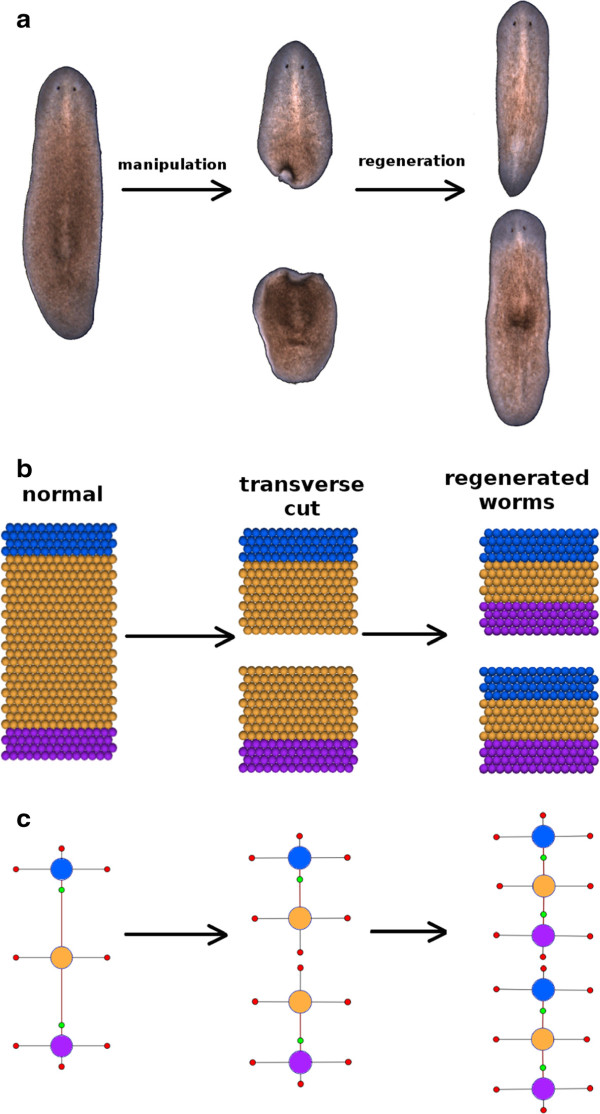
The ability of science to produce experimental data has outpaced the ability to effectively visualize and integrate the data into a conceptual framework that can further higher order understanding. Multidimensional and shape-based observational data of regenerative biology presents a particularly daunting challenge in this regard. Large amounts of data are available in regenerative biology, but little progress has been made in understanding how organisms such as planaria robustly achieve and maintain body form. An example of this kind of data can be found in a new repository (PlanformDB) that encodes descriptions of planaria experiments and morphological outcomes using a graph formalism.
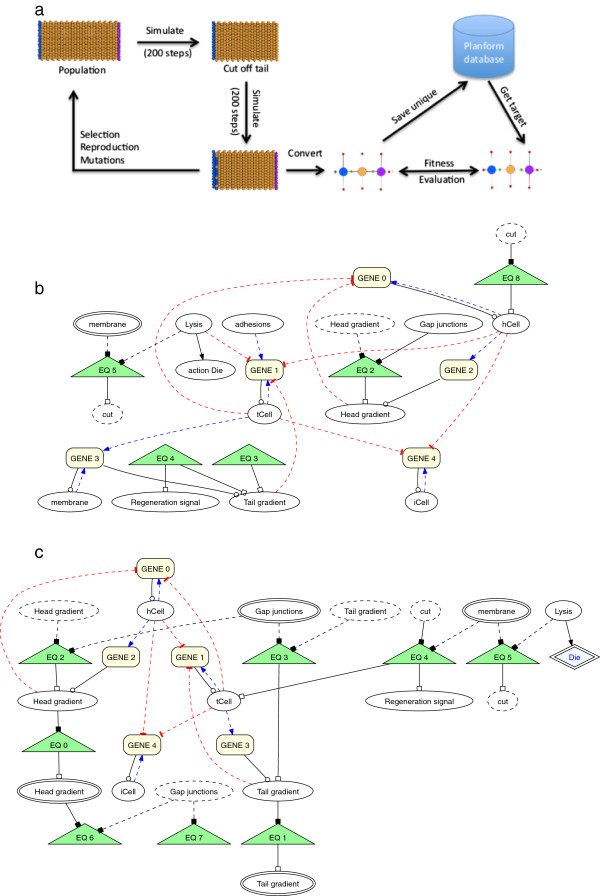
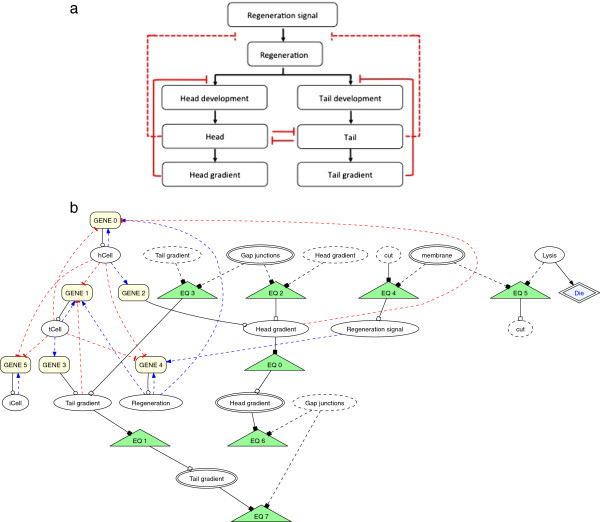
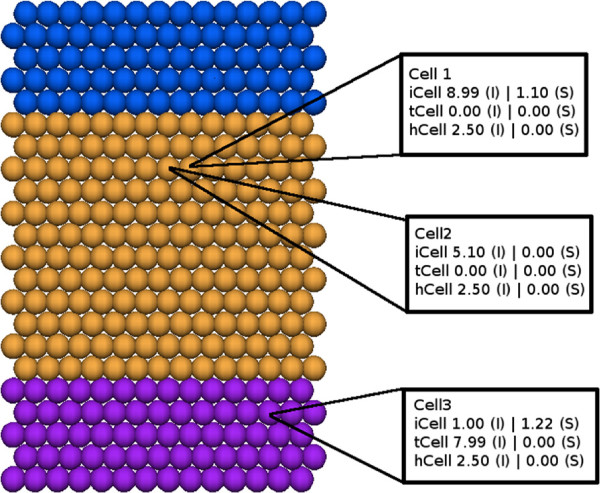
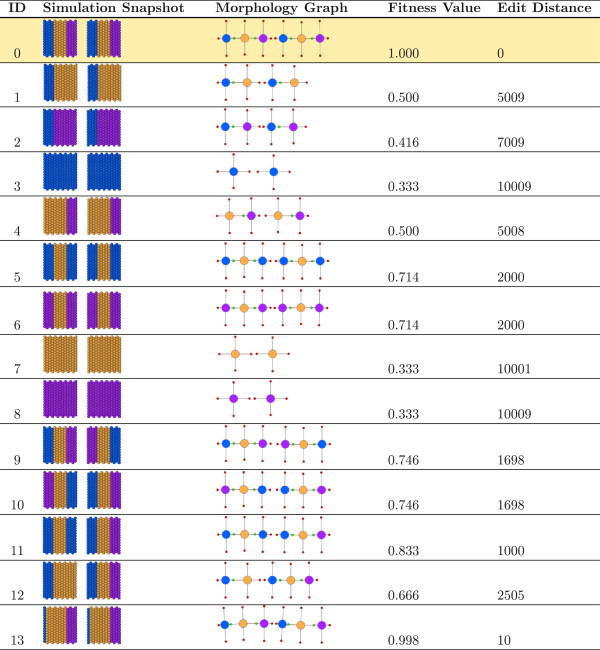
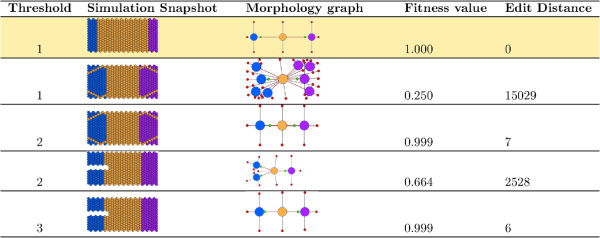
We are developing a model discovery framework that uses a cell-based modeling platform combined with evolutionary search to automatically search for and identify plausible mechanisms for the biological behavior described in PlanformDB. To automate the evolutionary search we developed a way to compare the output of the modeling platform to the morphological descriptions stored in PlanformDB. We used a flexible connected component algorithm to create a graph representation of the virtual worm from the robust, cell-based simulation data. These graphs can then be validated and compared with target data from PlanformDB using the well-known graph-edit distance calculation, which provides a quantitative metric of similarity between graphs. The graph edit distance calculation was integrated into a fitness function that was able to guide automated searches for unbiased models of planarian regeneration. We present a cell-based model of planarian that can regenerate anatomical regions following bisection of the organism, and show that the automated model discovery framework is capable of searching for and finding models of planarian regeneration that match experimental data stored in PlanformDB.
The work presented here, including our algorithm for converting cell-based models into graphs for comparison with data stored in an external data repository, has made feasible the automated development, training, and validation of computational models using morphology-based data. This work is part of an ongoing project to automate the search process, which will greatly expand our ability to identify, consider, and test biological mechanisms in the field of regenerative biology.
科学产生实验数据的能力已经超过了将数据有效可视化并整合到能够促进更高层次理解的概念框架中的能力。在这方面,再生生物学的多维和基于形状的观测数据提出了特别艰巨的挑战。再生生物学中有大量数据,但在理解诸如涡虫等生物体如何稳健地实现并维持身体形态方面进展甚微。这类数据的一个例子可以在一个新的数据库(PlanformDB)中找到,该数据库使用图形形式编码涡虫实验和形态学结果的描述。
我们正在开发一个模型发现框架,该框架使用基于细胞的建模平台结合进化搜索,自动搜索并识别PlanformDB中描述的生物行为的合理机制。为了使进化搜索自动化,我们开发了一种方法,将建模平台的输出与PlanformDB中存储的形态学描述进行比较。我们使用一种灵活的连通分量算法,从稳健的、基于细胞的模拟数据创建虚拟蠕虫的图形表示。然后,可以使用著名的图形编辑距离计算对这些图形进行验证,并与PlanformDB中的目标数据进行比较,该计算提供了图形之间相似性的定量度量。图形编辑距离计算被集成到一个适应度函数中,该函数能够指导对涡虫再生无偏模型的自动搜索。我们提出了一个基于细胞的涡虫模型,该模型在生物体被二等分后能够再生解剖区域,并表明自动模型发现框架能够搜索并找到与PlanformDB中存储的实验数据相匹配的涡虫再生模型。
这里介绍的工作,包括我们将基于细胞的模型转换为图形以与外部数据存储库中存储的数据进行比较的算法,使得使用基于形态学的数据对计算模型进行自动开发、训练和验证成为可能。这项工作是正在进行的使搜索过程自动化项目的一部分,这将极大地扩展我们在再生生物学领域识别、考虑和测试生物机制的能力。