Noorbakhsh Farshid, Baker Glen B, Power Christopher
Department of Immunology, Faculty of Medicine, Tehran University of Medical Sciences Tehran, Iran.
Department of Psychiatry, University of Alberta Edmonton, AB, Canada.
Front Cell Neurosci. 2014 Jun 3;8:134. doi: 10.3389/fncel.2014.00134. eCollection 2014.
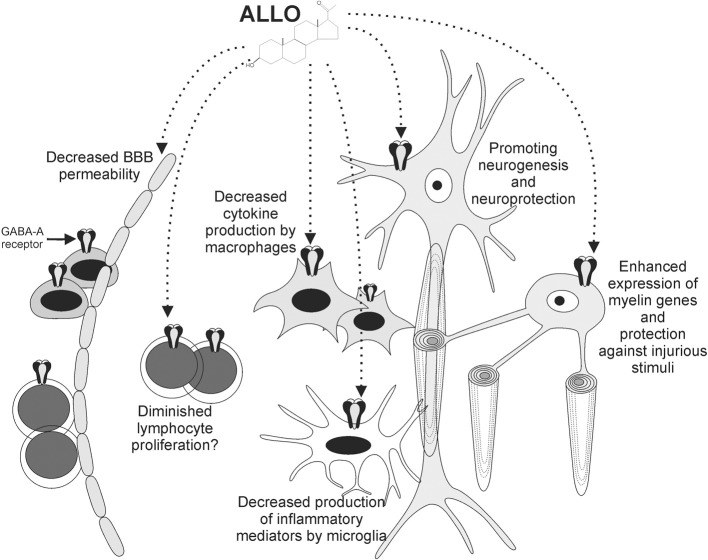
The progesterone derivative allopregnanolone (ALLO) is one of the most widely studied compounds among neurosteroids. Through interactions with GABA-A receptors expressed by neurons and glial cells, ALLO has been shown to affect diverse aspects of neural cell physiology, including cell proliferation and survival, migration, and gene expression. Recent data point to important roles for ALLO in different neurodegenerative disorders, including Alzheimer's disease, Parkinson's disease, and multiple sclerosis (MS). Dysregulation in ALLO biosynthesis pathways has been reported in brain tissue from MS patients as well as in the central nervous system (CNS) tissue derived from MS animal models. Administration of ALLO has been shown to ameliorate neurobehavioral deficits together with neuropathology and inflammation in the CNS of animals with autoimmune demyelination. These findings are in line with previous reports indicating growth- and differentiation-promoting actions of ALLO on neurons and glial cells as well as its neuroprotective effects in the context of other CNS diseases. Nonetheless, these findings have also raised the possibility that ALLO might influence leukocyte biology and associated neuroinflammatory mechanisms independent of its neuroregenerative properties. Herein, we review the current knowledge regarding the role of ALLO in the pathogenesis of MS, and discuss the potential cellular and molecular pathways that might be influenced by ALLO in the context of disease.
孕酮衍生物别孕烯醇酮(ALLO)是神经甾体中研究最为广泛的化合物之一。通过与神经元和神经胶质细胞表达的GABA - A受体相互作用,ALLO已被证明可影响神经细胞生理的多个方面,包括细胞增殖与存活、迁移以及基因表达。近期数据表明ALLO在不同的神经退行性疾病中发挥重要作用,这些疾病包括阿尔茨海默病、帕金森病和多发性硬化症(MS)。据报道,在MS患者的脑组织以及MS动物模型来源的中枢神经系统(CNS)组织中,ALLO生物合成途径存在失调。在患有自身免疫性脱髓鞘的动物的CNS中,给予ALLO已显示可改善神经行为缺陷以及神经病理学和炎症。这些发现与先前的报道一致,先前报道表明ALLO对神经元和神经胶质细胞具有促进生长和分化的作用,以及在其他CNS疾病背景下的神经保护作用。尽管如此,这些发现也提出了一种可能性,即ALLO可能独立于其神经再生特性而影响白细胞生物学和相关的神经炎症机制。在此,我们综述了关于ALLO在MS发病机制中作用的当前知识,并讨论了在疾病背景下可能受ALLO影响的潜在细胞和分子途径。