Scripps Institution of Oceanography, La Jolla, CA, USA.
PeerJ. 2014 May 27;2:e411. doi: 10.7717/peerj.411. eCollection 2014.
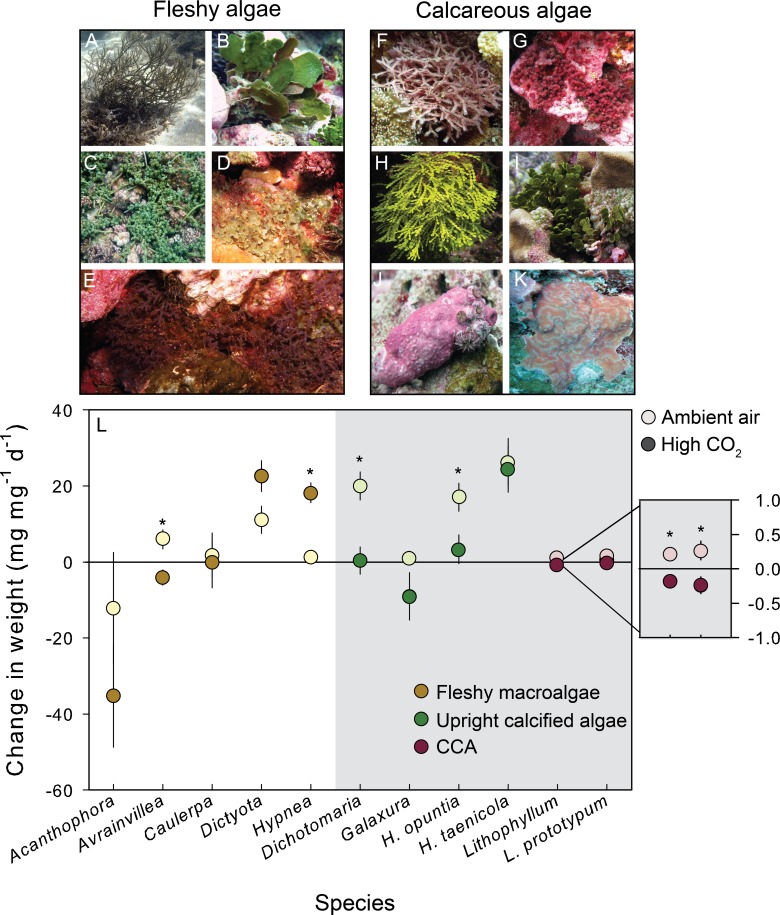
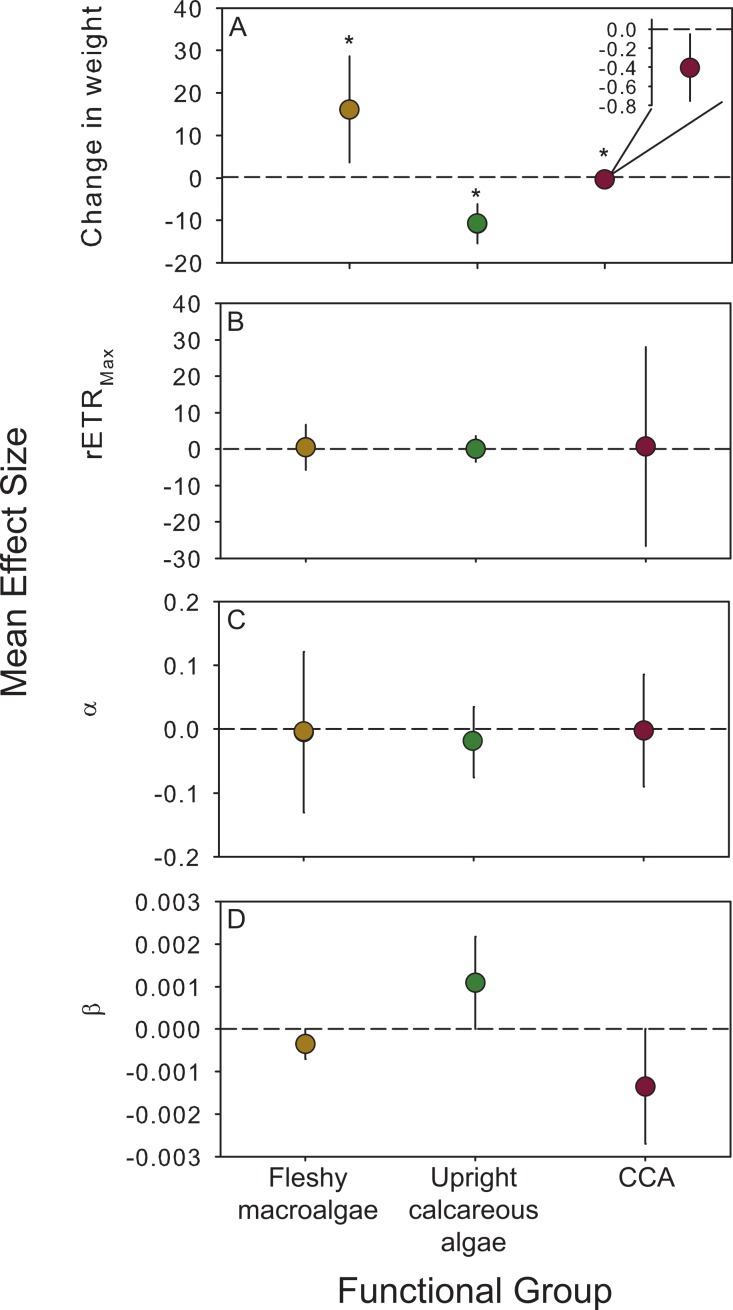
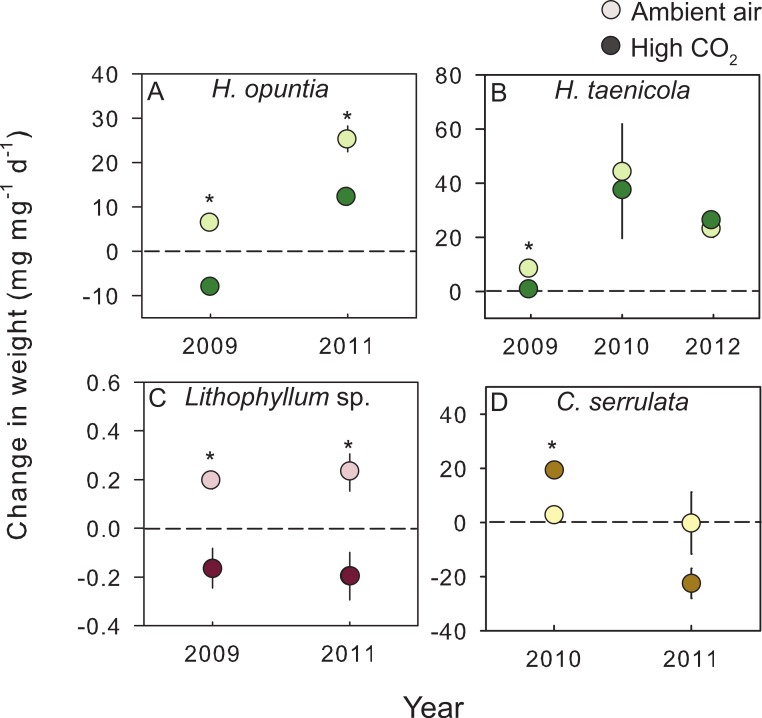
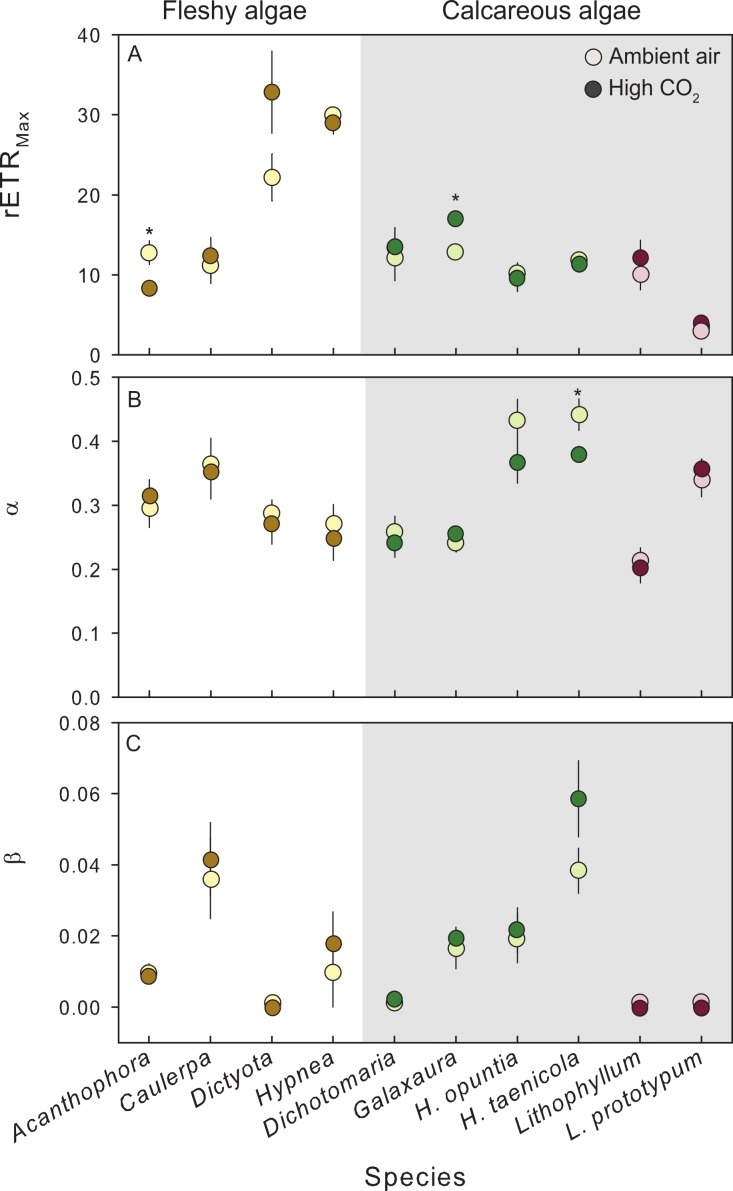
Despite the heightened awareness of ocean acidification (OA) effects on marine organisms, few studies empirically juxtapose biological responses to CO2 manipulations across functionally distinct primary producers, particularly benthic algae. Algal responses to OA may vary because increasing CO2 has the potential to fertilize photosynthesis but impair biomineralization. Using a series of repeated experiments on Palmyra Atoll, simulated OA effects were tested across a suite of ecologically important coral reef algae, including five fleshy and six calcareous species. Growth, calcification and photophysiology were measured for each species independently and metrics were combined from each experiment using a meta-analysis to examine overall trends across functional groups categorized as fleshy, upright calcareous, and crustose coralline algae (CCA). The magnitude of the effect of OA on algal growth response varied by species, but the direction was consistent within functional groups. Exposure to OA conditions generally enhanced growth in fleshy macroalgae, reduced net calcification in upright calcareous algae, and caused net dissolution in CCA. Additionally, three of the five fleshy seaweeds tested became reproductive upon exposure to OA conditions. There was no consistent effect of OA on algal photophysiology. Our study provides experimental evidence to support the hypothesis that OA will reduce the ability of calcareous algae to biomineralize. Further, we show that CO2 enrichment either will stimulate population or somatic growth in some species of fleshy macroalgae. Thus, our results suggest that projected OA conditions may favor non-calcifying algae and influence the relative dominance of fleshy macroalgae on reefs, perpetuating or exacerbating existing shifts in reef community structure.
尽管人们对海洋酸化 (OA) 对海洋生物的影响有了更高的认识,但很少有研究从实证角度对比不同功能的初级生产者(尤其是底栖藻类)对 CO2 处理的生物学反应。藻类对 OA 的反应可能会有所不同,因为增加 CO2 有可能促进光合作用,但会损害生物矿化作用。本研究利用帕迈拉环礁(Palmyra Atoll)的一系列重复实验,测试了一系列具有重要生态意义的珊瑚礁藻类,包括 5 种肉质藻类和 6 种钙质藻类,以模拟 OA 效应。对每种藻类分别测量其生长、钙化和光生理特性,并通过元分析将每个实验的指标综合起来,以检查根据功能分组(肉质、直立钙质和珊瑚藻)的总体趋势。OA 对藻类生长反应的影响程度因物种而异,但在功能组内的方向是一致的。暴露于 OA 条件通常会增强肉质大型藻类的生长,减少直立钙质藻类的净钙化作用,并导致珊瑚藻的净溶解。此外,在测试的 5 种肉质海藻中有 3 种在暴露于 OA 条件下会产生繁殖。OA 对藻类光生理特性没有一致的影响。本研究提供了实验证据,支持了 OA 将降低钙质藻类生物矿化能力的假设。此外,我们还表明,CO2 富集要么会刺激某些肉质大型藻类的种群或体细胞生长。因此,我们的结果表明,预计的 OA 条件可能有利于非钙化藻类,并影响肉质大型藻类在珊瑚礁上的相对优势,从而延续或加剧珊瑚礁群落结构的现有变化。