Bidmon Sonja, Terlutter Ralf, Röttl Johanna
Department of Marketing and International Management, Alpen-Adria Universitaet Klagenfurt, Klagenfurt am Woerthersee, Austria.
J Med Internet Res. 2014 Jun 11;16(6):e148. doi: 10.2196/jmir.3122.
Consumers are increasingly accessing health-related information via mobile devices. Recently, several apps to rate and locate physicians have been released in the United States and Germany. However, knowledge about what kinds of variables explain usage of mobile physician-rating apps is still lacking.
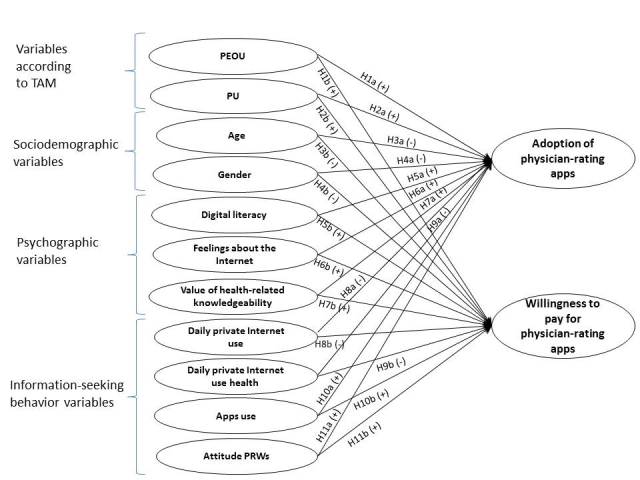
This study analyzes factors influencing the adoption of and willingness to pay for mobile physician-rating apps. A structural equation model was developed based on the Technology Acceptance Model and the literature on health-related information searches and usage of mobile apps. Relationships in the model were analyzed for moderating effects of physician-rating website (PRW) usage.
A total of 1006 randomly selected German patients who had visited a general practitioner at least once in the 3 months before the beginning of the survey were randomly selected and surveyed. A total of 958 usable questionnaires were analyzed by partial least squares path modeling and moderator analyses.
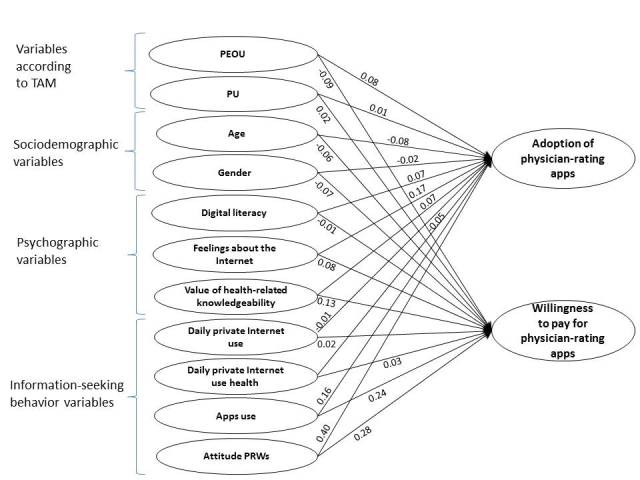
The suggested model yielded a high model fit. We found that perceived ease of use (PEOU) of the Internet to gain health-related information, the sociodemographic variables age and gender, and the psychographic variables digital literacy, feelings about the Internet and other Web-based applications in general, patients' value of health-related knowledgeability, as well as the information-seeking behavior variables regarding the amount of daily private Internet use for health-related information, frequency of using apps for health-related information in the past, and attitude toward PRWs significantly affected the adoption of mobile physician-rating apps. The sociodemographic variable age, but not gender, and the psychographic variables feelings about the Internet and other Web-based applications in general and patients' value of health-related knowledgeability, but not digital literacy, were significant predictors of willingness to pay. Frequency of using apps for health-related information in the past and attitude toward PRWs, but not the amount of daily Internet use for health-related information, were significant predictors of willingness to pay. The perceived usefulness of the Internet to gain health-related information and the amount of daily Internet use in general did not have any significant effect on both of the endogenous variables. The moderation analysis with the group comparisons for users and nonusers of PRWs revealed that the attitude toward PRWs had significantly more impact on the adoption and willingness to pay for mobile physician-rating apps in the nonuser group.
Important variables that contribute to the adoption of a mobile physician-rating app and the willingness to pay for it were identified. The results of this study are important for researchers because they can provide important insights about the variables that influence the acceptance of apps that allow for ratings of physicians. They are also useful for creators of mobile physician-rating apps because they can help tailor mobile physician-rating apps to the consumers' characteristics and needs.
消费者越来越多地通过移动设备获取与健康相关的信息。最近,美国和德国发布了几款用于对医生进行评分和定位的应用程序。然而,对于哪些变量能够解释移动医生评分应用程序的使用情况,目前仍缺乏相关了解。
本研究分析影响移动医生评分应用程序采用率和支付意愿的因素。基于技术接受模型以及与健康相关信息搜索和移动应用程序使用的文献,开发了一个结构方程模型。分析了模型中的关系,以探讨医生评分网站(PRW)使用情况的调节作用。
在调查开始前3个月内至少拜访过一次全科医生的1006名随机抽取的德国患者被随机选取并进行调查。通过偏最小二乘路径建模和调节分析,对958份可用问卷进行了分析。
所建议的模型具有较高的模型拟合度。我们发现,通过互联网获取与健康相关信息的感知易用性、社会人口统计学变量年龄和性别、心理统计学变量数字素养、对互联网及其他基于网络的应用程序的总体感受、患者对与健康相关知识的重视程度,以及与健康相关信息的日常私人互联网使用量、过去使用健康相关信息应用程序的频率和对医生评分网站的态度等信息寻求行为变量,均对移动医生评分应用程序的采用率有显著影响。社会人口统计学变量年龄而非性别,以及心理统计学变量对互联网及其他基于网络的应用程序的总体感受和患者对与健康相关知识的重视程度而非数字素养,是支付意愿的显著预测因素。过去使用健康相关信息应用程序的频率和对医生评分网站的态度而非与健康相关信息的日常互联网使用量,是支付意愿的显著预测因素。通过互联网获取与健康相关信息的感知有用性以及总体日常互联网使用量对两个内生变量均无显著影响。对医生评分网站用户和非用户进行分组比较的调节分析表明,在非用户组中,对医生评分网站的态度对移动医生评分应用程序的采用率和支付意愿的影响显著更大。
确定了有助于采用移动医生评分应用程序及其支付意愿的重要变量。本研究结果对研究人员具有重要意义,因为它们可以提供有关影响医生评分应用程序接受度的变量的重要见解。它们对移动医生评分应用程序的创建者也很有用,因为它们可以帮助根据消费者的特征和需求定制移动医生评分应用程序。