Lin Steven H, Zhang Jing, Giri Uma, Stephan Clifford, Sobieski Mary, Zhong Ling, Mason Kathy A, Molkentine Jessica, Thames Howard D, Yoo Stephen S, Heymach John V
Department of Radiation Oncology, Houston, TX.
Department of Radiation Oncology, Houston, TX.
J Thorac Oncol. 2014 Jul;9(7):965-973. doi: 10.1097/JTO.0000000000000199.
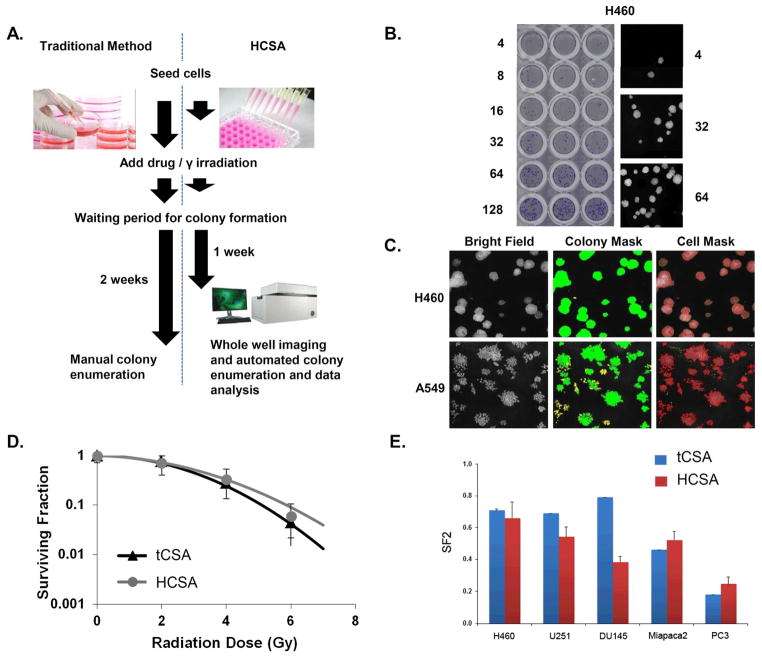
Traditional clonogenic survival and high throughput colorimetric assays are inadequate as drug screens to identify novel radiation sensitizers. We developed a method that we call the high content clonogenic survival assay (HCSA) that will allow screening of drug libraries to identify candidate radiation sensitizers.
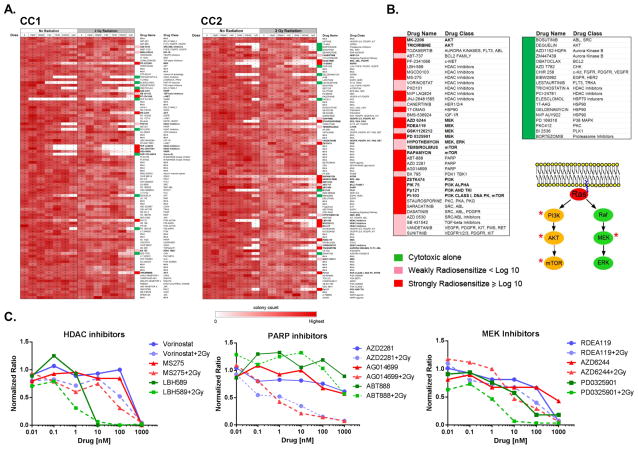
Drug screen using HCSA was done in 96 well plates. After drug treatment, irradiation, and incubation, colonies were stained with crystal violet and imaged on the INCell 6000 (GE Health). Colonies achieving 50 or more cells were enumerated using the INCell Developer image analysis software. A proof-of-principle screen was done on the KRAS mutant lung cancer cell line H460 and a Custom Clinical Collection (146 compounds).
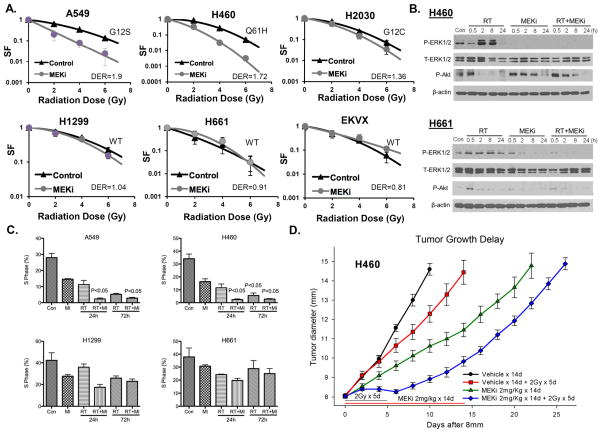
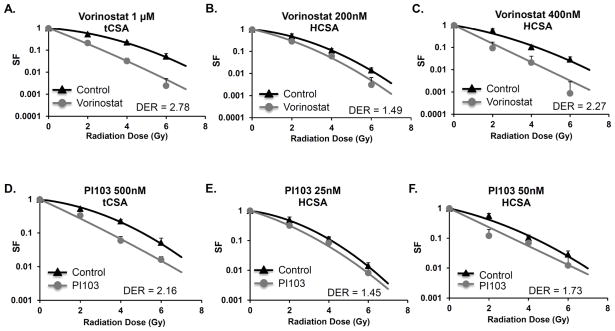
Multiple drugs of the same class were found to be radiation sensitizers and levels of potency seemed to reflect the clinical relevance of these drugs. For instance, several PARP inhibitors were identified as good radiation sensitizers in the HCSA screen. However, there were also a few PARP inhibitors not found to be sensitizing that have either not made it into clinical development, or in the case of BSI-201, was proven to not even be a PARP inhibitor. We discovered that inhibitors of pathways downstream of activated mutant KRAS (PI3K, AKT, mTOR, and MEK1/2) sensitized H460 cells to radiation. Furthermore, the potent MEK1/2 inhibitor tramenitib selectively enhanced radiation effects in KRAS mutant but not wild-type lung cancer cells.
Drug screening for novel radiation sensitizers is feasible using the HCSA approach. This is an enabling technology that will help accelerate the discovery of novel radiosensitizers for clinical testing.
传统的克隆形成存活和高通量比色测定法作为筛选新型辐射增敏剂的药物筛选方法并不充分。我们开发了一种我们称之为高内涵克隆形成存活测定法(HCSA)的方法,该方法将允许对药物文库进行筛选以鉴定候选辐射增敏剂。
使用HCSA进行的药物筛选在96孔板中进行。药物处理、照射和孵育后,用结晶紫对菌落进行染色,并在INCell 6000(通用电气医疗集团)上成像。使用INCell Developer图像分析软件对达到50个或更多细胞的菌落进行计数。在KRAS突变肺癌细胞系H460和一个定制临床化合物库(146种化合物)上进行了原理验证筛选。
发现同一类别的多种药物是辐射增敏剂,其效力水平似乎反映了这些药物的临床相关性。例如,在HCSA筛选中,几种PARP抑制剂被鉴定为良好的辐射增敏剂。然而,也有一些PARP抑制剂未被发现具有增敏作用,它们要么尚未进入临床开发阶段,要么就BSI-201而言,已被证明甚至不是PARP抑制剂。我们发现,活化突变型KRAS下游通路(PI3K、AKT、mTOR和MEK1/2)的抑制剂可使H460细胞对辐射敏感。此外,强效MEK1/2抑制剂曲美替尼选择性增强KRAS突变型而非野生型肺癌细胞的辐射效应。
使用HCSA方法筛选新型辐射增敏剂是可行的。这是一项赋能技术,将有助于加速新型放射增敏剂的发现以进行临床试验。