Liu Yu, Zeng Peibin, Wang Jingxing, Liu Gui, Xu Min, Ke Ling, He Miao, Liu Zhong
Experimental center of transfusion medicine, Institute of Blood Transfusion, Chinese Academy of Medical Sciences, Hua Cai Road 26 Hao, Dong San Huan Road Er Duan, Chengdu, Sichuan, China.
J Transl Med. 2014 Jun 12;12:164. doi: 10.1186/1479-5876-12-164.
Co-infections of HBV and HIV are frequent due to similar routes of transmission. In that transmission through blood is an important route for both HBV and HIV, evaluation of the prevalence of HBV in HIV infected blood donors may be important for transfusion safety. In addition, because the epidemiological characteristics of HBV in HIV infected patients and blood donors may differ from each other, understanding of it could be significant for therapy and prevention of HBV in HIV infected adults. However, data reported on these in Chinese people remains limited.
614 HIV confirmed positive samples were collected from blood donors and patients and were screened for HBsAg and HBV DNA. The samples screened reactive for HBsAg or positive for HBV DNA were tested for the other serological markers of HBV including anti-HBs, HBeAg, anti-HBe and anti-HBc. For the samples tested positive for HBV DNA, the S region of HBV was amplified by nested PCR and the HBV genotypes were determined.
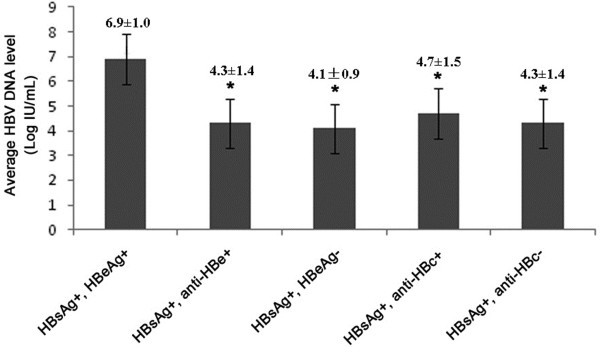
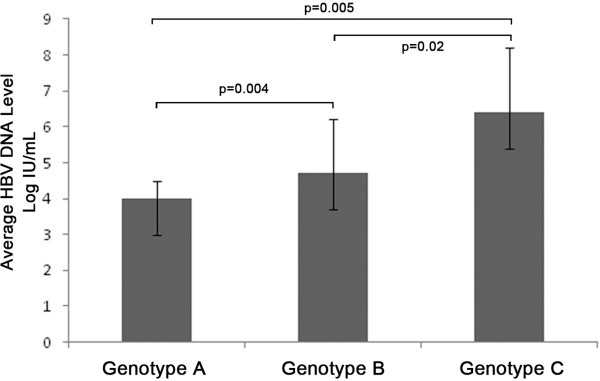
HBV coinfections were found in 12.9% (79/614) HIV infected individuals including 42/417(10.1%) blood donors and 37/197 (18.8%) AIDS patients. In the HBsAg positive individuals, 80.0% were HBeAg negative in which 10.0% were HBV DNA negative and 38.3% with HBV DNA lower than 2000 IU/ml. The average HBV DNA levels were lower in donors than in patients. In the HBV DNA positive populations, HBV genotypes B, A and C accounted for 48.1%, 22.8% and 8.86% respectively. Mutations related to the failure of HBsAg detection were found in 2 of the 4 HBsAg-/HBV DNA + subjects.
High prevalence of HBV in HIV infected individuals was found in this study. Hence, we recommend routine testing of HBV for patients newly diagnosed with HIV/AIDS in China. Some HIV-HBV co-infected patients remain undiagnosed if only conventional serological markers for HBV are used and it's important to detect HBV DNA for HIV infected patients. HBV DNA levels were relatively low in HBeAg negative patients, thus this serologic marker may be useful in prioritizing patients on their need for HBV treatment in settings in which HBV DNA is not available.
由于传播途径相似,HBV与HIV合并感染很常见。血液传播是HBV和HIV的重要传播途径,评估HIV感染献血者中HBV的流行情况对于输血安全可能很重要。此外,由于HIV感染患者和献血者中HBV的流行病学特征可能不同,了解这些特征对于HIV感染成人中HBV的治疗和预防可能具有重要意义。然而,关于中国人中这些情况的报道数据仍然有限。
从献血者和患者中收集614份HIV确诊阳性样本,进行HBsAg和HBV DNA筛查。对HBsAg筛查呈反应性或HBV DNA呈阳性的样本检测HBV的其他血清学标志物,包括抗-HBs、HBeAg、抗-HBe和抗-HBc。对于HBV DNA检测呈阳性的样本,通过巢式PCR扩增HBV的S区并确定HBV基因型。
在614例HIV感染个体中发现12.9%(79/614)合并HBV感染,其中417例献血者中有42例(10.1%),197例艾滋病患者中有37例(18.8%)。在HBsAg阳性个体中,80.0%为HBeAg阴性,其中10.0%的HBV DNA阴性,38.3%的HBV DNA低于2000 IU/ml。献血者的平均HBV DNA水平低于患者。在HBV DNA阳性人群中,HBV基因型B、A和C分别占48.1%、22.8%和8.86%。在4例HBsAg阴性/HBV DNA阳性受试者中的2例中发现了与HBsAg检测失败相关的突变。
本研究发现HIV感染个体中HBV感染率较高。因此,我们建议在中国对新诊断的HIV/AIDS患者进行HBV常规检测。如果仅使用传统的HBV血清学标志物,一些HIV-HBV合并感染患者仍未被诊断出来,对HIV感染患者检测HBV DNA很重要。HBeAg阴性患者的HBV DNA水平相对较低,因此在无法获得HBV DNA的情况下,该血清学标志物可能有助于确定患者对HBV治疗的需求优先级。