Gkikas Ilias, Petratou Dionysia, Tavernarakis Nektarios
Institute of Molecular Biology and Biotechnology, Foundation for Research and Technology-Hellas, Heraklion Crete, Greece.
Institute of Molecular Biology and Biotechnology, Foundation for Research and Technology-Hellas, Heraklion Crete, Greece ; Department of Basic Sciences, Faculty of Medicine, University of Crete, Heraklion Crete, Greece.
Front Genet. 2014 Jun 4;5:155. doi: 10.3389/fgene.2014.00155. eCollection 2014.
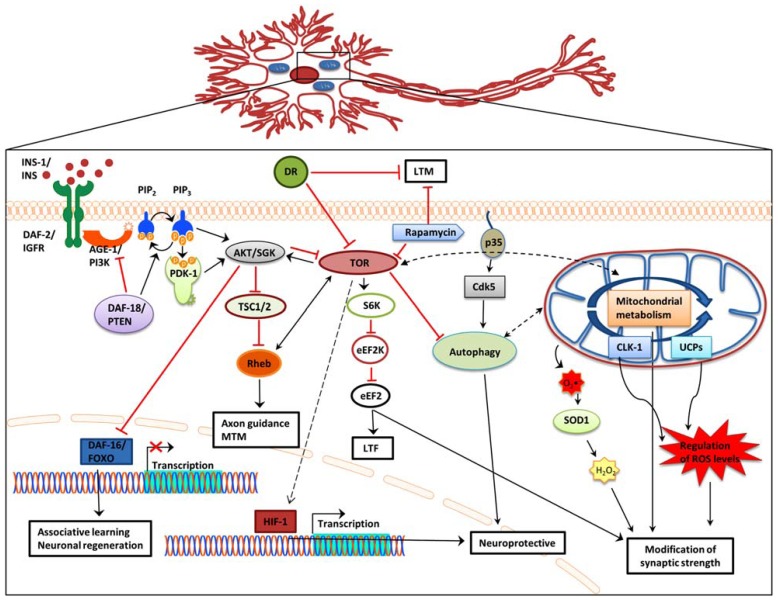
The aging process has been associated with numerous pathologies at the cellular, tissue, and organ level. Decline or loss of brain functions, including learning and memory, is one of the most devastating and feared aspects of aging. Learning and memory are fundamental processes by which animals adjust to environmental changes, evaluate various sensory signals based on context and experience, and make decisions to generate adaptive behaviors. Age-related memory impairment is an important phenotype of brain aging. Understanding the molecular mechanisms underlying age-related memory impairment is crucial for the development of therapeutic strategies that may eventually lead to the development of drugs to combat memory loss. Studies in invertebrate animal models have taught us much about the physiology of aging and its effects on learning and memory. In this review we survey recent progress relevant to conserved molecular pathways implicated in both aging and memory formation and consolidation.
衰老过程与细胞、组织和器官水平上的多种病理状况相关。大脑功能的衰退或丧失,包括学习和记忆能力,是衰老最具破坏性且令人担忧的方面之一。学习和记忆是动物适应环境变化、根据情境和经验评估各种感官信号并做出决策以产生适应性行为的基本过程。与年龄相关的记忆障碍是大脑衰老的一个重要表型。了解与年龄相关的记忆障碍背后的分子机制对于开发治疗策略至关重要,这些策略最终可能会促成对抗记忆丧失药物的研发。对无脊椎动物模型的研究让我们对衰老生理学及其对学习和记忆的影响有了很多了解。在这篇综述中,我们概述了与衰老以及记忆形成和巩固所涉及的保守分子途径相关的最新进展。