Karn Robert C, Chung Amanda G, Laukaitis Christina M
College of Medicine, University of Arizona, Tucson, AZ, USA.
Proteomes. 2013 Dec 1;1(3):275-289. doi: 10.3390/proteomes1030275.
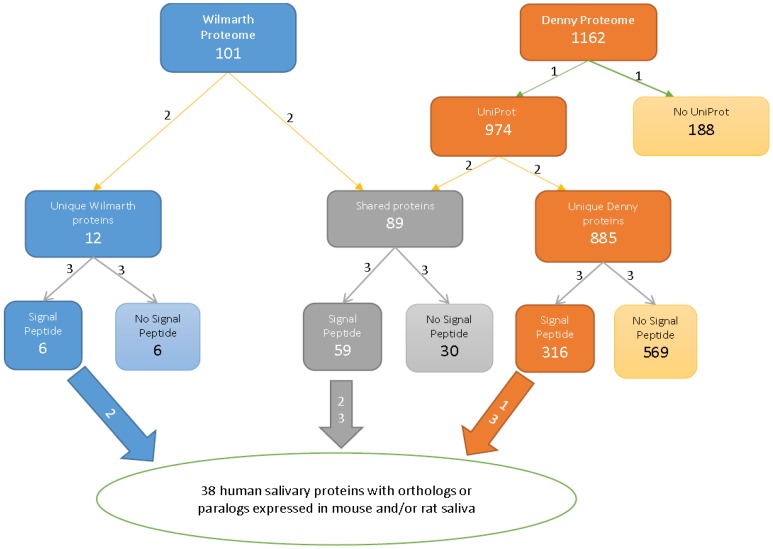
The overall goal of our study was to compare the proteins found in the saliva proteomes of three mammals: human, mouse and rat. Our first objective was to compare two human proteomes with very different analysis depths. The 89 shared proteins in this comparison apparently represent a core of highly-expressed human salivary proteins. Of the proteins unique to each proteome, one-half to 2/3 lack signal peptides and probably are contaminants instead of less highly-represented salivary proteins. We recently published the first rodent saliva proteomes with salivas collected from the genome mouse (C57BL/6) and the genome rat (BN/SsNHsd/Mcwi). Our second objective was to compare the proteins in the human proteome with those we identified in the genome mouse and rat to determine those common to all three mammals as well as the specialized rodent subset. We also identified proteins unique to each of the three mammals because differences in the secreted protein constitutions can provide clues to differences in the evolutionary adaptation of the secretions in the three different mammals.
我们研究的总体目标是比较三种哺乳动物(人类、小鼠和大鼠)唾液蛋白质组中发现的蛋白质。我们的首要目标是比较两种分析深度差异很大的人类蛋白质组。此次比较中89种共享蛋白质显然代表了高表达人类唾液蛋白质的核心。在每个蛋白质组特有的蛋白质中,二分之一到三分之二缺乏信号肽,可能是污染物而非代表性较低的唾液蛋白质。我们最近发表了从基因组小鼠(C57BL/6)和基因组大鼠(BN/SsNHsd/Mcwi)收集唾液的首批啮齿动物唾液蛋白质组。我们的第二个目标是将人类蛋白质组中的蛋白质与我们在基因组小鼠和大鼠中鉴定出的蛋白质进行比较,以确定这三种哺乳动物共有的蛋白质以及特有的啮齿动物亚组。我们还鉴定了这三种哺乳动物各自特有的蛋白质,因为分泌蛋白组成的差异可以为三种不同哺乳动物分泌物进化适应性的差异提供线索。