Hadley Dexter, Wu Zhi-Liang, Kao Charlly, Kini Akshata, Mohamed-Hadley Alisha, Thomas Kelly, Vazquez Lyam, Qiu Haijun, Mentch Frank, Pellegrino Renata, Kim Cecilia, Connolly John, Glessner Joseph, Hakonarson Hakon
The Center for Applied Genomics, The Children's Hospital of Philadelphia, Philadelphia, Pennsylvania 19104, USA.
1] The Center for Applied Genomics, The Children's Hospital of Philadelphia, Philadelphia, Pennsylvania 19104, USA [2] Department of Pediatrics, University of Pennsylvania School of Medicine, Philadelphia, Pennsylvania 19104, USA.
Nat Commun. 2014 Jun 13;5:4074. doi: 10.1038/ncomms5074.
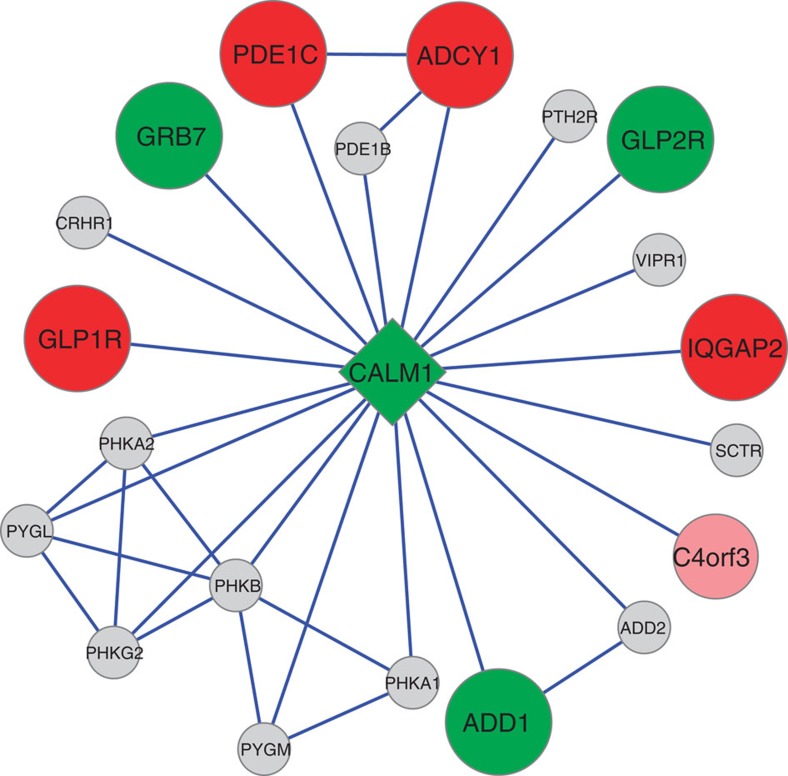
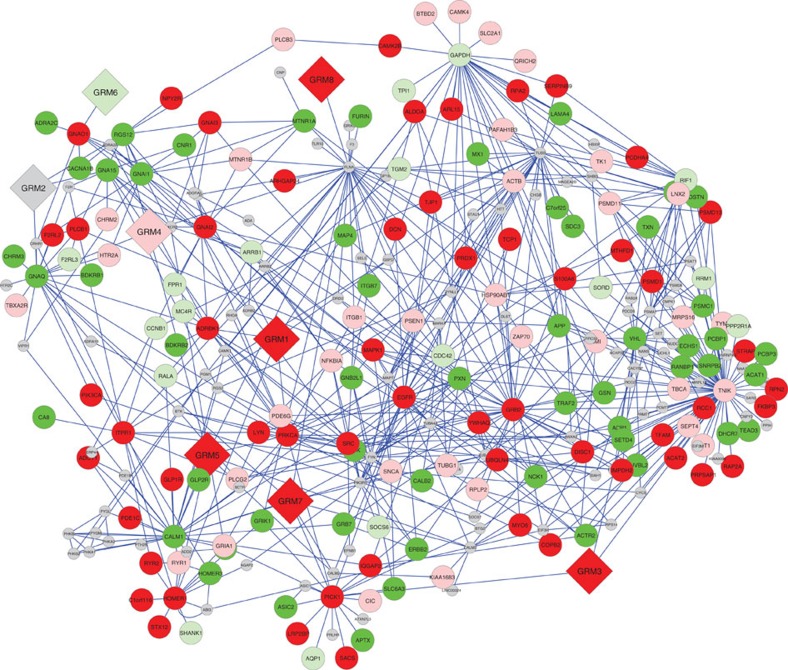
Although multiple reports show that defective genetic networks underlie the aetiology of autism, few have translated into pharmacotherapeutic opportunities. Since drugs compete with endogenous small molecules for protein binding, many successful drugs target large gene families with multiple drug binding sites. Here we search for defective gene family interaction networks (GFINs) in 6,742 patients with the ASDs relative to 12,544 neurologically normal controls, to find potentially druggable genetic targets. We find significant enrichment of structural defects (P ≤ 2.40E-09, 1.8-fold enrichment) in the metabotropic glutamate receptor (GRM) GFIN, previously observed to impact attention deficit hyperactivity disorder (ADHD) and schizophrenia. Also, the MXD-MYC-MAX network of genes, previously implicated in cancer, is significantly enriched (P ≤ 3.83E-23, 2.5-fold enrichment), as is the calmodulin 1 (CALM1) gene interaction network (P ≤ 4.16E-04, 14.4-fold enrichment), which regulates voltage-independent calcium-activated action potentials at the neuronal synapse. We find that multiple defective gene family interactions underlie autism, presenting new translational opportunities to explore for therapeutic interventions.
尽管多项报告显示,缺陷性基因网络是自闭症病因的基础,但很少能转化为药物治疗机会。由于药物与内源性小分子竞争蛋白质结合,许多成功的药物靶向具有多个药物结合位点的大基因家族。在此,我们在6742例自闭症谱系障碍(ASD)患者中,相对于12544例神经正常对照,搜索缺陷性基因家族相互作用网络(GFIN),以寻找潜在的可药物治疗的基因靶点。我们发现代谢型谷氨酸受体(GRM)GFIN中结构缺陷显著富集(P≤2.40E - 09,富集1.8倍),此前观察到该受体影响注意力缺陷多动障碍(ADHD)和精神分裂症。此外,先前与癌症相关的MXD - MYC - MAX基因网络也显著富集(P≤3.83E - 23,富集2.5倍),钙调蛋白1(CALM1)基因相互作用网络同样如此(P≤4.16E - 04,富集14.4倍),该网络在神经元突触处调节非电压依赖性钙激活动作电位。我们发现多个缺陷性基因家族相互作用是自闭症的基础,为探索治疗干预提供了新的转化机会。