Yokobe Junya, Kitahara Masaki, Matsushima Masato, Uezono Shoichi
Department of Anesthesiology, The Jikei University School of Medicine, Minato, Tokyo, Japan.
Division of Clinical Epidemiology, The Jikei University School of Medicine, Minato, Tokyo, Japan.
PLoS One. 2014 Jun 13;9(6):e99891. doi: 10.1371/journal.pone.0099891. eCollection 2014.
Although many previous studies have examined the preference of patients for different pain measurement scales, preference for anchor descriptors has not been thoroughly discussed.
To examine (1) the preferred end-phrases used in the VAS as anchor labels for Japanese patients with chronic pain, and (2) whether the preference differs according to factors such as age, sex, educational level, duration of pain, and pain intensity.
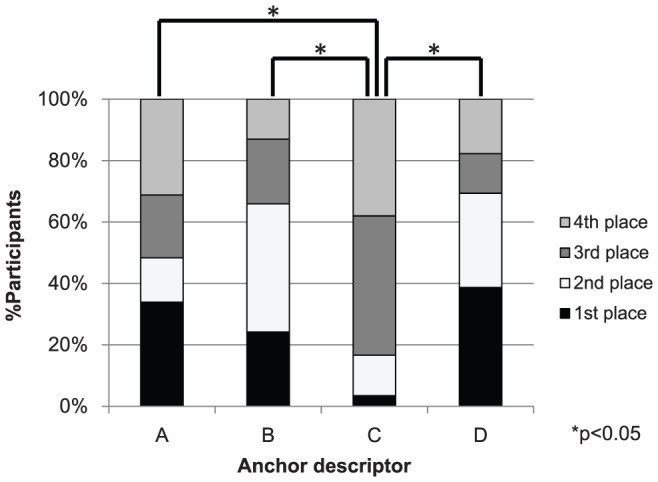
We performed an observational study in patients suffering from non-cancer chronic pain for more than 3 months at a pain center in Japan. The patients were asked to rate their pain intensity using four types of VAS that used the following different anchor descriptors: "worst pain" ("Worst"), "worst pain bearable" ("Bearable"), "worst pain imaginable" ("Imaginable"), and "worst pain you have ever experienced" ("Experienced"). They were also asked to rank the four scales according to ease of responding, and asked which descriptor best reflected their perceived pain.
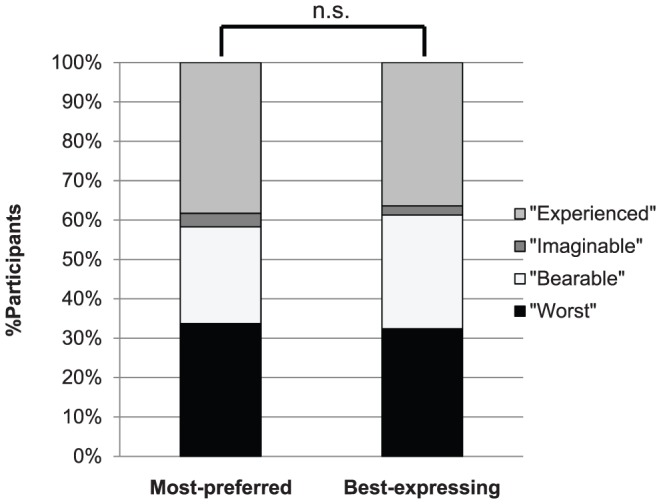
In total, 183 patients participated in the study. They consisted of 119 (65.0%) women and 64 (35.0%) men aged 18-84 years with the mean age of 56.9 years. "Experienced" was most preferred (69.8%), followed by "Bearable" (66.3%), "Worst" (48.8%), and "Imaginable" (16.9%). Factors such as age, sex, educational background, duration of pain, and pain intensity did not significantly affect the results. In 83.1% of patients, the preferred descriptor corresponded to the descriptor that best reflected patients' perceived pain.
The frequently used expression "worst pain imaginable" is considered to be difficult to understand for most patients. Widely preferred descriptors, such as "worst pain you have ever experienced" and "worst pain bearable", should be used when evaluating perceived pain. The preference of anchor descriptors was not significantly affected by the factors such as age, sex, educational level, duration of pain, and pain intensity.
尽管此前已有许多研究探讨了患者对不同疼痛测量量表的偏好,但对于锚定描述词的偏好尚未进行充分讨论。
研究(1)日本慢性疼痛患者在视觉模拟评分法(VAS)中用作锚定标签的首选结尾短语,以及(2)偏好是否因年龄、性别、教育程度、疼痛持续时间和疼痛强度等因素而有所不同。
我们在日本一家疼痛中心对患有非癌性慢性疼痛超过3个月的患者进行了一项观察性研究。要求患者使用四种不同的视觉模拟评分法对疼痛强度进行评分,这四种评分法使用了以下不同的锚定描述词:“最严重的疼痛”(“Worst”)、“可忍受的最严重疼痛”(“Bearable”)、“可想象的最严重疼痛”(“Imaginable”)和“你所经历过的最严重疼痛”(“Experienced”)。还要求他们根据回答的难易程度对这四种量表进行排序,并询问哪种描述词最能反映他们感觉到的疼痛。
共有183名患者参与了该研究。他们包括119名(65.0%)女性和64名(35.0%)男性,年龄在18至84岁之间,平均年龄为56.9岁。“Experienced”最受青睐(69.8%),其次是“Bearable”(66.3%)、“Worst”(48.8%)和“Imaginable”(16.9%)。年龄、性别、教育背景、疼痛持续时间和疼痛强度等因素对结果没有显著影响。在83.1%的患者中,首选描述词与最能反映患者感觉到的疼痛的描述词一致。
大多数患者认为常用表述“可想象的最严重疼痛”难以理解。在评估感觉到的疼痛时,应使用广受青睐的描述词,如“你所经历过的最严重疼痛”和“可忍受的最严重疼痛”。锚定描述词的偏好不受年龄、性别、教育程度、疼痛持续时间和疼痛强度等因素的显著影响。