Varley Katherine E, Gertz Jason, Roberts Brian S, Davis Nicholas S, Bowling Kevin M, Kirby Marie K, Nesmith Amy S, Oliver Patsy G, Grizzle William E, Forero Andres, Buchsbaum Donald J, LoBuglio Albert F, Myers Richard M
HudsonAlpha Institute for Biotechnology, 601 Genome Way, Huntsville, AL, 35806, USA.
Breast Cancer Res Treat. 2014 Jul;146(2):287-97. doi: 10.1007/s10549-014-3019-2. Epub 2014 Jun 15.
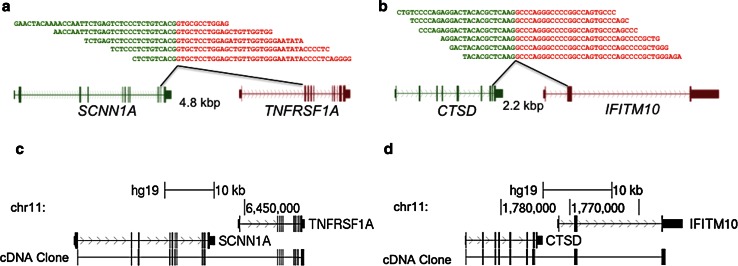
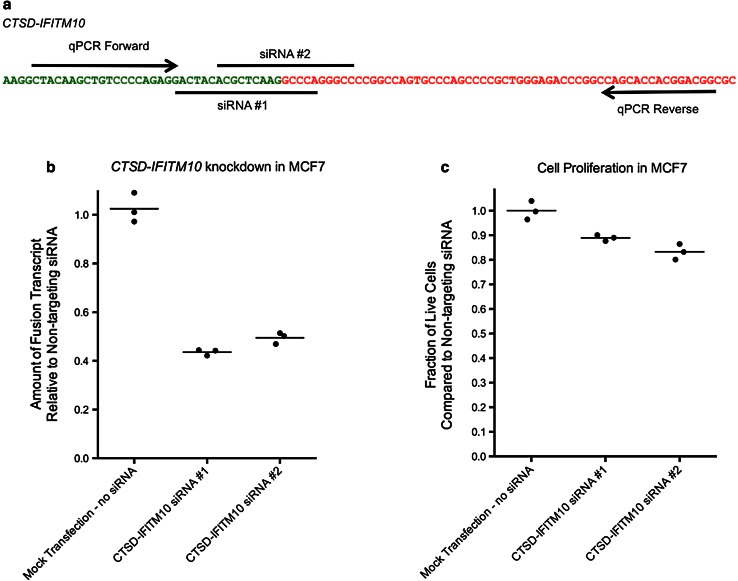
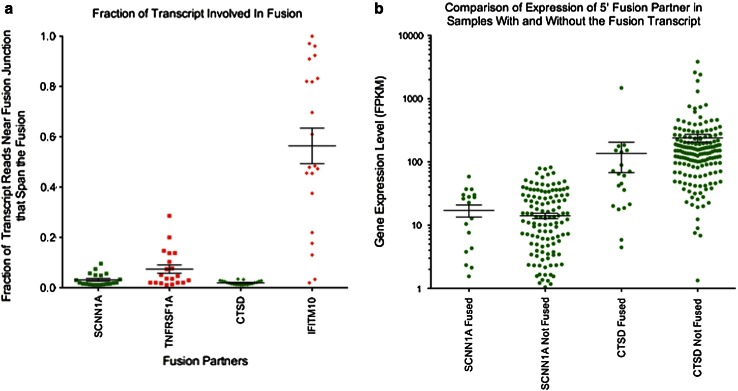
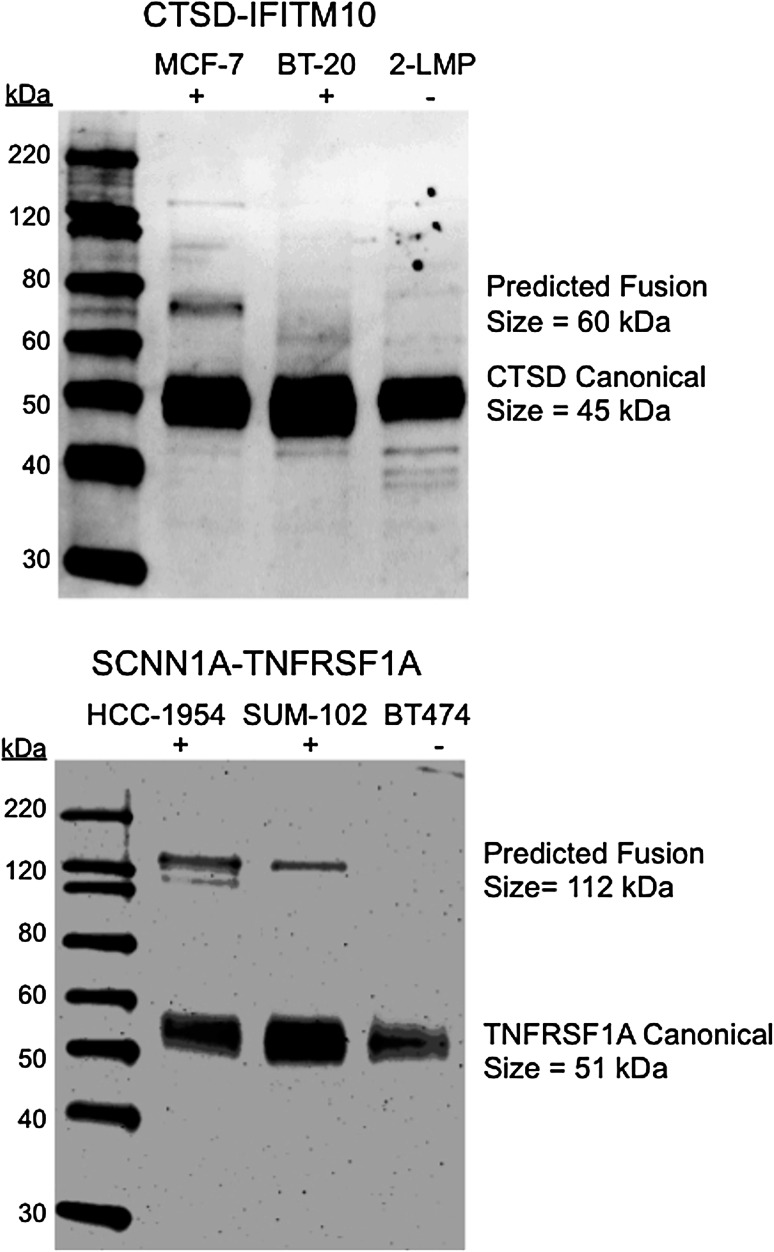
Read-through fusion transcripts that result from the splicing of two adjacent genes in the same coding orientation are a recently discovered type of chimeric RNA. We sought to determine if read-through fusion transcripts exist in breast cancer. We performed paired-end RNA-seq of 168 breast samples, including 28 breast cancer cell lines, 42 triple negative breast cancer primary tumors, 42 estrogen receptor positive (ER+) breast cancer primary tumors, and 56 non-malignant breast tissue samples. We analyzed the sequencing data to identify breast cancer associated read-through fusion transcripts. We discovered two recurrent read-through fusion transcripts that were identified in breast cancer cell lines, confirmed across breast cancer primary tumors, and were not detected in normal tissues (SCNN1A-TNFRSF1A and CTSD-IFITM10). Both fusion transcripts use canonical splice sites to join the last splice donor of the 5' gene to the first splice acceptor of the 3' gene, creating an in-frame fusion transcript. Western blots indicated that the fusion transcripts are translated into fusion proteins in breast cancer cells. Custom small interfering RNAs targeting the CTSD-IFITM10 fusion junction reduced expression of the fusion transcript and reduced breast cancer cell proliferation. Read-through fusion transcripts between adjacent genes with different biochemical functions represent a new type of recurrent molecular defect in breast cancer that warrant further investigation as potential biomarkers and therapeutic targets. Both breast cancer associated fusion transcripts identified in this study involve membrane proteins (SCNN1A-TNFRSF1A and CTSD-IFITM10), which raises the possibility that they could be breast cancer-specific cell surface markers.
通读融合转录本是由两个处于相同编码方向的相邻基因拼接而成的,是一种最近发现的嵌合RNA类型。我们试图确定乳腺癌中是否存在通读融合转录本。我们对168份乳腺样本进行了双端RNA测序,包括28个乳腺癌细胞系、42个三阴性乳腺癌原发肿瘤、42个雌激素受体阳性(ER+)乳腺癌原发肿瘤以及56个非恶性乳腺组织样本。我们分析了测序数据以识别与乳腺癌相关的通读融合转录本。我们发现了两种在乳腺癌细胞系中被识别出、在乳腺癌原发肿瘤中得到证实且在正常组织中未检测到的反复出现的通读融合转录本(SCNN1A-TNFRSF1A和CTSD-IFITM10)。两种融合转录本均使用典型剪接位点将5'基因的最后一个剪接供体与3'基因的第一个剪接受体连接起来,形成一个读码框内的融合转录本。蛋白质免疫印迹表明,融合转录本在乳腺癌细胞中被翻译成融合蛋白。靶向CTSD-IFITM10融合连接点的定制小干扰RNA降低了融合转录本的表达,并减少了乳腺癌细胞的增殖。具有不同生化功能的相邻基因之间的通读融合转录本代表了乳腺癌中一种新型的反复出现的分子缺陷,作为潜在的生物标志物和治疗靶点值得进一步研究。本研究中鉴定出的两种与乳腺癌相关的融合转录本均涉及膜蛋白(SCNN1A-TNFRSF1A和CTSD-IFITM10),这增加了它们可能是乳腺癌特异性细胞表面标志物的可能性。