Jomo Kenyatta University of Agriculture and Technology, Institute of Biotechnology Research, P. O. Box 62000-00200, Nairobi, Kenya.
Department of Biochemistry and Biotechnology, Kenyatta University, P.O. Box 43844, 00100 Nairobi Kenya.
Plant Methods. 2014 Jun 3;10:16. doi: 10.1186/1746-4811-10-16. eCollection 2014.
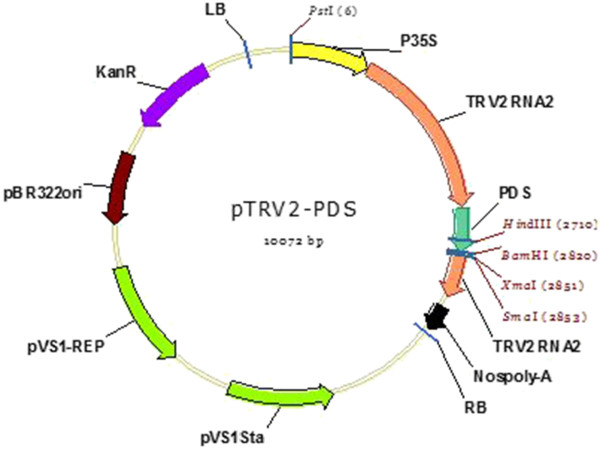
Striga hermonthica is a hemiparasitic weed that infects cereals in Sub Sahara Africa (SSA) resulting in up to 100% grain yield loss. This significant loss in grain yields is a major contributor to food insecurity and poverty in the region. Current strategies to control the parasite are costly, unavailable and remain unpracticed by small-scale farmers, underscoring the need for more economical and sustainable control strategies. Development of resistant germplasm is the most sustainable strategy in the control of S. hermonthica, but is constrained by paucity of resistance genes for introduction into crop germplasm. RNA interference (RNAi) has potential for developing host-derived resistance against S. hermonthica by transformation of host crops with RNAi sequences targeted at critical Striga genes. The application of RNAi in management of S. hermonthica is however constrained by lack of efficient high throughput screening protocols for the candidate genes for silencing, as well as sub optimal delivery of siRNAs into the parasite. In comparison to stable transformation, viral induced gene silencing (VIGS) is a rapid and powerful tool for plant functional genomics and provides an easy and effective strategy in screening for putative candidate genes to target through RNAi. In addition, VIGS allows for a secondary amplification of the RNAi signal increasing the siRNA threshold and facilitates siRNA transport through viral movement proteins. We tested the efficiency of the Tobacco rattle virus (TRV1 and TRV2) VIGS vectors in silencing S. hermonthica phytoene desaturase (PDS) gene through agrodrench and agro-infiltration.
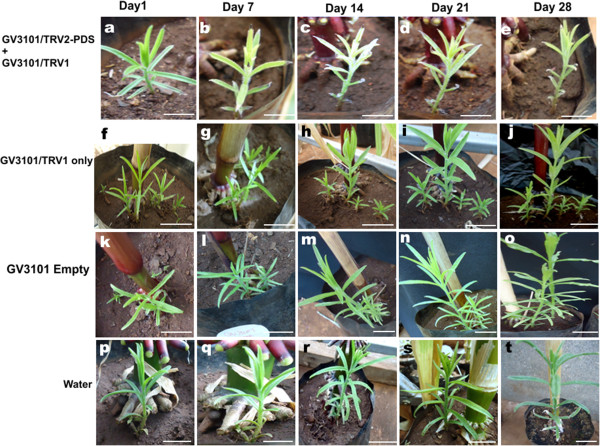
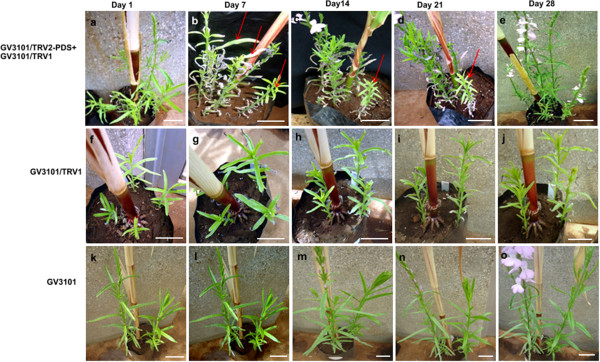
We report the validation of VIGS in S. hermonthica using a silencing cassette generated from TRV with a PDS gene insert. Agro-infiltrated and agro-drenched S. hermonthica leaves showed photo-bleaching phenotypes typical for PDS silencing within 7 and 14 days post infection respectively. In both cases S. hermonthica plants recovered from photo-bleaching effects within 28 days post inoculation. The transformation efficiency of the VIGS protocol in S. hermonthica was (60 ± 2.9)%.
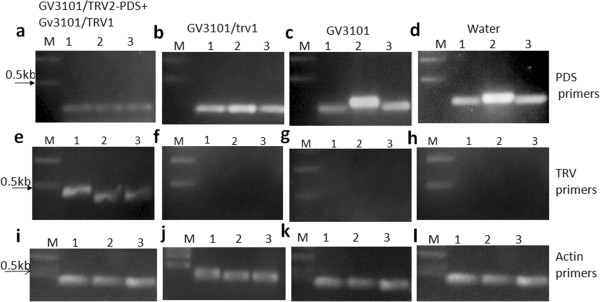
These results demonstrate that the TRV-VIGS system work in S. hermonthica and can be used for candidate gene validation for their role in the parasite development and parasitism, with the ultimate goal of developing resistant transgenic maize.
Striga hermonthica 是一种半寄生杂草,感染撒哈拉以南非洲(SSA)的谷物,导致谷物产量损失高达 100%。该地区粮食产量的巨大损失是粮食不安全和贫困的主要原因。目前控制寄生虫的策略成本高、无法获得且小规模农民无法实施,这突显了需要更经济和可持续的控制策略。开发抗性种质是控制 S. hermonthica 的最可持续策略,但受到引入作物种质的抗性基因匮乏的限制。RNA 干扰 (RNAi) 具有通过转化宿主作物带有针对关键 Striga 基因的 RNAi 序列来开发宿主衍生抗性的潜力。然而,由于缺乏有效的高通量筛选候选基因沉默的方案,以及 siRNA 递送至寄生虫的效果不理想,RNAi 在 S. hermonthica 管理中的应用受到限制。与稳定转化相比,病毒诱导基因沉默 (VIGS) 是植物功能基因组学的快速而强大的工具,为通过 RNAi 筛选潜在候选基因提供了一种简单有效的策略。此外,VIGS 允许 RNAi 信号的二次放大,增加 siRNA 阈值,并通过病毒运动蛋白促进 siRNA 运输。我们通过 agro 浸溃和 agro 滴注测试了烟草脆裂病毒 (TRV1 和 TRV2) VIGS 载体在沉默 S. hermonthica 类叶质素脱饱和酶 (PDS) 基因方面的效率。
我们报告了使用来自 TRV 的沉默盒验证 S. hermonthica 中的 VIGS,该沉默盒带有 PDS 基因插入物。 agro 浸溃和 agro 滴注的 S. hermonthica 叶片在感染后 7 和 14 天分别出现类 PDS 沉默的光漂白表型。在这两种情况下,S. hermonthica 植物在接种后 28 天内从光漂白效应中恢复。VIGS 方案在 S. hermonthica 中的转化效率为 (60±2.9)%。
这些结果表明,TRV-VIGS 系统在 S. hermonthica 中起作用,可以用于候选基因验证,以了解它们在寄生虫发育和寄生中的作用,最终目标是开发抗转基因玉米。