Turer Aslan T, Lewis Gregory D, O'Sullivan John F, Elmariah Sammy, Mega Jessica L, Addo Tayo A, Sabatine Marc S, de Lemos James A, Gerszten Robert E
Department of Medicine, Division of Cardiology, University of Texas Southwestern Medical Center, Dallas, Texas, United States of America.
Department of Internal Medicine, Division of Cardiology, Massachusetts General Hospital, Boston, Massachusetts, United States of America.
PLoS One. 2014 Jun 16;9(6):e99058. doi: 10.1371/journal.pone.0099058. eCollection 2014.
To determine whether increases in cardiac work lead to alterations in the plasma metabolome and whether such changes arise from the heart or peripheral organs.
There is growing evidence that the heart influences systemic metabolism through endocrine effects and affecting pathways involved in energy homeostasis.
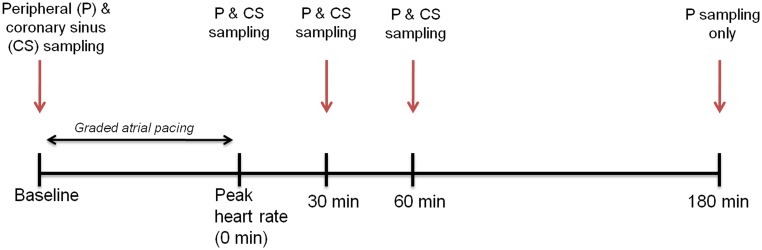
Nineteen patients referred for cardiac catheterization were enrolled. Peripheral and selective coronary sinus (CS) blood sampling was performed at serial timepoints following the initiation of pacing, and metabolite profiling was performed by liquid chromatography-mass spectrometry (LC-MS).
Pacing-stress resulted in a 225% increase in the median rate·pressure product from baseline. Increased myocardial work induced significant changes in the peripheral concentration of 43 of 125 metabolites assayed, including large changes in purine [adenosine (+99%, p = 0.006), ADP (+42%, p = 0.01), AMP (+79%, p = 0.004), GDP (+69%, p = 0.003), GMP (+58%, p = 0.01), IMP (+50%, p = 0.03), xanthine (+61%, p = 0.0006)], and several bile acid metabolites. The CS changes in metabolites qualitatively mirrored those in the peripheral blood in both timing and magnitude, suggesting the heart was not the major source of the metabolite release.
Isolated increases in myocardial work can induce changes in the plasma metabolome, but these changes do not appear to be directly cardiac in origin. A number of these dynamic metabolites have known signaling functions. Our study provides additional evidence to a growing body of literature on metabolic 'cross-talk' between the heart and other organs.
确定心脏做功增加是否会导致血浆代谢组的改变,以及这些变化是源于心脏还是外周器官。
越来越多的证据表明,心脏通过内分泌作用和影响能量稳态相关途径来影响全身代谢。
纳入19例因心脏导管插入术而转诊的患者。在起搏开始后的连续时间点进行外周血和选择性冠状窦(CS)血样采集,并通过液相色谱-质谱联用(LC-MS)进行代谢物谱分析。
起搏应激导致中位心率·血压乘积较基线增加225%。心肌做功增加导致所检测的125种代谢物中的43种在外周血浓度发生显著变化,包括嘌呤[腺苷(+99%,p = 0.006)、二磷酸腺苷(ADP,+42%,p = 0.01)、单磷酸腺苷(AMP,+79%,p = 0.004)、二磷酸鸟苷(GDP,+69%,p = 0.003)、单磷酸鸟苷(GMP,+58%,p = 0.01)、次黄嘌呤核苷酸(IMP,+50%,p = 0.03)、黄嘌呤(+61%,p = 0.0006)]以及几种胆汁酸代谢物的大幅变化。代谢物在冠状窦的变化在时间和幅度上在外周血中得到定性反映,提示心脏并非代谢物释放的主要来源。
单纯的心肌做功增加可诱导血浆代谢组发生变化,但这些变化似乎并非直接源于心脏。其中许多动态代谢物具有已知的信号传导功能。我们的研究为心脏与其他器官之间代谢“串扰”的不断增加的文献提供了额外证据。