Heart and Vascular Institute, Henry Ford Hospital, Detroit, Michigan; Center for Health Policy and Health Services Research, Henry Ford Hospital, Detroit, Michigan.
Heart and Vascular Institute, Henry Ford Hospital, Detroit, Michigan.
JACC Heart Fail. 2017 Nov;5(11):823-832. doi: 10.1016/j.jchf.2017.07.009.
This study sought to derive and validate plasma metabolite associations with survival in heart failure (HF) patients.
Profiling of plasma metabolites to predict the course of HF appears promising, but validation and incremental value of these profiles are less established.
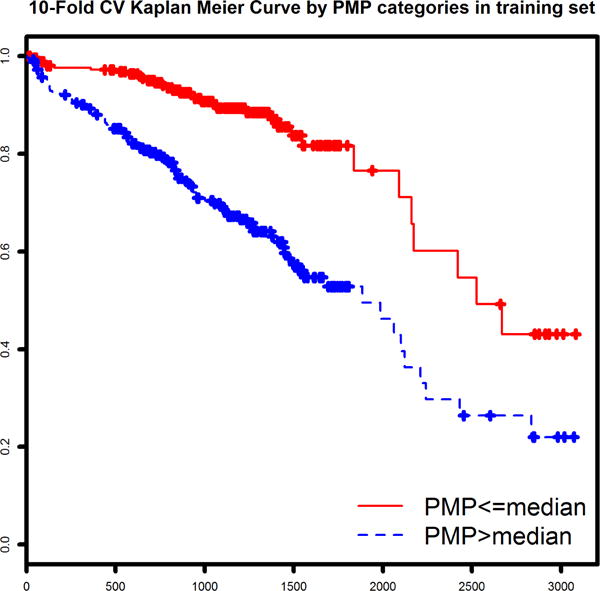
Patients (n = 1,032) who met Framingham HF criteria with a history of reduced ejection fraction were randomly divided into derivation and validation cohorts (n = 516 each). Amino acids, organic acids, and acylcarnitines were quantified using mass spectrometry in fasting plasma samples. We derived a prognostic metabolite profile (PMP) in the derivation cohort using Lasso-penalized Cox regression. Validity was assessed by 10-fold cross validation in the derivation cohort and by standard testing in the validation cohort. The PMP was analyzed as both a continuous variable (PMPscore) and dichotomized at the median (PMPcat), in univariate and multivariate models adjusted for clinical risk score and N-terminal pro-B-type natriuretic peptide.
Overall, 48% of patients were African American, 35% were women, and the average age was 69 years. After a median follow-up of 34 months, there were 256 deaths (127 and 129 in derivation and validation cohorts, respectively). Optimized modeling defined the 13 metabolite PMPs, which was cross validated as both the PMPscore (hazard ratio [HR]: 3.27; p < 2 × 10) and PMPcat (HR: 3.04; p = 2.93 × 10). The validation cohort showed similar results (PMPscore HR: 3.9; p < 2 × 10 and PMPcat HR: 3.99; p = 3.47 × 10). In adjusted models, PMP remained associated with mortality in the cross-validated derivation cohort (PMPscore HR: 1.63; p = 0.0029; PMPcat HR: 1.47; p = 0.081) and the validation cohort (PMPscore HR: 1.54; p = 0.037; PMPcat HR: 1.69; p = 0.043).
Plasma metabolite profiles varied across HF subgroups and were associated with survival incremental to conventional predictors. Additional investigation is warranted to define mechanisms and clinical applications.
本研究旨在建立并验证与心力衰竭(HF)患者生存相关的血浆代谢物谱。
对血浆代谢物进行分析以预测 HF 病程具有广阔的应用前景,但这些代谢物谱的验证和附加价值尚未得到充分确立。
本研究纳入了符合弗雷明汉 HF 标准且射血分数降低的患者(n=1032),并将其随机分为推导队列(n=516)和验证队列(n=516)。使用质谱法检测空腹血浆样本中的氨基酸、有机酸和酰基肉碱。我们使用 Lasso 惩罚 Cox 回归在推导队列中建立预后代谢物谱(PMP)。推导队列的 10 折交叉验证和验证队列的标准检验评估了其有效性。PMP 作为连续变量(PMPscore)和中位数(PMPcat)进行分析,并在调整了临床风险评分和 N 末端 pro-B 型利钠肽的多变量模型中进行分析。
患者的平均年龄为 69 岁,其中 48%为非裔美国人,35%为女性。中位随访 34 个月后,共有 256 例患者死亡(推导队列 127 例,验证队列 129 例)。经优化模型确定的 13 种代谢物 PMP ,经交叉验证后作为 PMPscore(风险比 [HR]:3.27;p<2×10)和 PMPcat(HR:3.04;p=2.93×10)均具有统计学意义。验证队列也得到了类似的结果(PMPscore HR:3.9;p<2×10;PMPcat HR:3.99;p=3.47×10)。在调整后的模型中,PMP 在交叉验证的推导队列(PMPscore HR:1.63;p=0.0029;PMPcat HR:1.47;p=0.081)和验证队列(PMPscore HR:1.54;p=0.037;PMPcat HR:1.69;p=0.043)中与死亡率仍具有相关性。
HF 亚组之间的血浆代谢物谱存在差异,且与生存相关,其预测价值高于传统预测因素。需要进一步研究以明确其作用机制和临床应用。