Willis Sarah R, Ahmed Hashim U, Moore Caroline M, Donaldson Ian, Emberton Mark, Miners Alec H, van der Meulen Jan
Department of Health Services Research and Policy, London School of Hygiene & Tropical Medicine, London, UK.
Division of Surgery and Interventional Science, University College London, London, UK Department of Urology, University College London Hospitals NHS Foundation Trust, London, UK.
BMJ Open. 2014 Jun 15;4(6):e004895. doi: 10.1136/bmjopen-2014-004895.
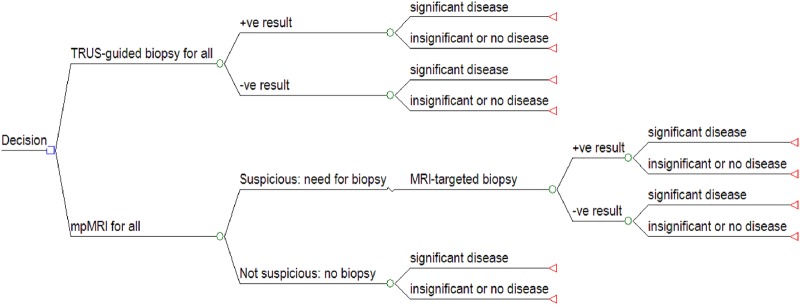
To compare the diagnostic outcomes of the current approach of transrectal ultrasound (TRUS)-guided biopsy in men with suspected prostate cancer to an alternative approach using multiparametric MRI (mpMRI), followed by MRI-targeted biopsy if positive.
Clinical decision analysis was used to synthesise data from recently emerging evidence in a format that is relevant for clinical decision making.
A hypothetical cohort of 1000 men with suspected prostate cancer.
mpMRI and, if positive, MRI-targeted biopsy compared with TRUS-guided biopsy in all men.
We report the number of men expected to undergo a biopsy as well as the numbers of correctly identified patients with or without prostate cancer. A probabilistic sensitivity analysis was carried out using Monte Carlo simulation to explore the impact of statistical uncertainty in the diagnostic parameters.
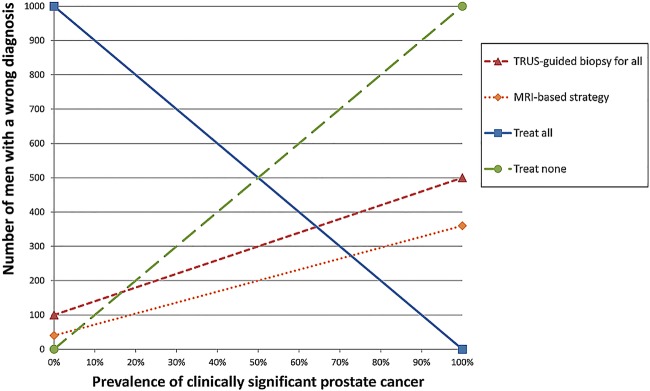
In 1000 men, mpMRI followed by MRI-targeted biopsy 'clinically dominates' TRUS-guided biopsy as it results in fewer expected biopsies (600 vs 1000), more men being correctly identified as having clinically significant cancer (320 vs 250), and fewer men being falsely identified (20 vs 50). The mpMRI-based strategy dominated TRUS-guided biopsy in 86% of the simulations in the probabilistic sensitivity analysis.
Our analysis suggests that mpMRI followed by MRI-targeted biopsy is likely to result in fewer and better biopsies than TRUS-guided biopsy. Future research in prostate cancer should focus on providing precise estimates of key diagnostic parameters.
比较经直肠超声(TRUS)引导下活检的当前方法与使用多参数磁共振成像(mpMRI)的替代方法在疑似前列腺癌男性中的诊断结果,若mpMRI结果为阳性则进行MRI靶向活检。
采用临床决策分析,以与临床决策相关的格式综合最新出现的证据数据。
一个由1000名疑似前列腺癌男性组成的假设队列。
对所有男性进行mpMRI检查,若结果为阳性则进行MRI靶向活检,并与TRUS引导下活检进行比较。
我们报告预计接受活检的男性人数以及正确识别出的患有或未患有前列腺癌的患者人数。使用蒙特卡洛模拟进行概率敏感性分析,以探讨诊断参数中统计不确定性的影响。
在1000名男性中,先进行mpMRI检查然后进行MRI靶向活检“在临床上优于”TRUS引导下活检,因为它导致预期活检次数更少(600次对1000次),更多男性被正确识别为患有临床意义的癌症(320人对250人),且被错误识别的男性更少(20人对50人)。在概率敏感性分析中,基于mpMRI的策略在86%的模拟中优于TRUS引导下活检。
我们的分析表明,与TRUS引导下活检相比,先进行mpMRI检查然后进行MRI靶向活检可能会减少活检次数并提高活检质量。未来前列腺癌的研究应侧重于提供关键诊断参数的精确估计。