Hopkins John B, Whittington Jesse, Clevenger Anthony P, Sawaya Michael A, St Clair Colleen Cassady
a Department of Biological Sciences , University of Alberta , Edmonton , Canada.
Isotopes Environ Health Stud. 2014;50(3):322-31. doi: 10.1080/10256016.2014.922555. Epub 2014 Jun 17.
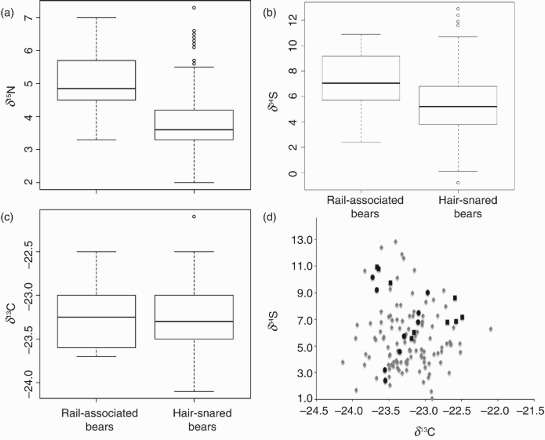
Human-wildlife conflict is a leading cause of adult mortality for large carnivores worldwide. Train collision is the primary cause of mortality for threatened grizzly bears (Ursus arctos) in Banff National Park. We investigated the use of stable isotope analysis as a tool for identifying bears that use the railway in Banff. Rail-associated bears had higher δ(15)N and δ(34)S values than bears sampled away from the rail, but similar δ(13)C values. Because elevated δ(15)N values are indicative of higher animal protein consumption, rail-associated bears likely preyed on ungulates that foraged along the rail or scavenged on train-killed animals. The higher δ(34)S values in bear hair could have resulted from bears consuming sulfur pellets spilled on the rail or through the uptake of sulfur in the plants bears or animals consumed. Similar δ(13)C values suggest that the two types of bears had generally similar plant-based diets. Results from this study suggest that stable isotopes analysis could be used as a non-invasive, affordable, and efficient technique to identify and monitor bears that forage on the railway in Banff and potentially other transportation corridors worldwide.
人类与野生动物的冲突是全球大型食肉动物成年个体死亡的主要原因。列车碰撞是班夫国家公园内受威胁的灰熊(棕熊)死亡的主要原因。我们研究了使用稳定同位素分析作为识别班夫地区利用铁路区域的熊的一种工具。与铁路相关区域的熊比在远离铁路区域采样的熊具有更高的δ(15)N和δ(34)S值,但δ(13)C值相似。由于δ(15)N值升高表明动物蛋白质摄入量更高,与铁路相关区域的熊可能捕食了在铁路沿线觅食的有蹄类动物或 scavenged 在被火车撞死的动物身上。熊毛发中较高的δ(34)S值可能是由于熊食用了洒落在铁路上的硫磺颗粒,或者是通过熊或其食用的动物所食用的植物中吸收了硫。相似的δ(13)C值表明这两种熊的植物性饮食总体上相似。这项研究的结果表明,稳定同位素分析可作为一种非侵入性、经济且高效的技术,用于识别和监测班夫地区以及全球其他潜在交通走廊上在铁路沿线觅食的熊。 (注:scavenged这个词原文有误,推测可能是scavenged,意为“ scavenged ”;推测中文意思是“ scavenged在被火车撞死的动物身上觅食” )