Becoña Elisardo, López-Durán Ana, Fernández del Río Elena, Martínez Úrsula
Smoking Cessation Unit, Department of Clinical Psychology and Psychobiology, Faculty of Psychology, University of Santiago de Compostela, Santiago de Compostela, Spain.
BMC Public Health. 2014 Jun 17;14:613. doi: 10.1186/1471-2458-14-613.
In recent years, the prevalence of daily smokers has decreased in all developed countries due to a great variety of factors. Despite this decrease, the effectiveness of clinical treatments has decreased and several studies report a change in smokers' characteristics. The purpose of the present study is to analyze the changes in the characteristics of Spanish smokers who seek smoking cessation treatment between 2001 and 2010 and the changes in the effectiveness of such treatment.
The sample was made up of 870 smokers who sought psychological treatment for giving up smoking at the Smoking Cessation Unit in the Faculty of Psychology of the University of Santiago de Compostela (Spain) during the period 2001 to 2010.
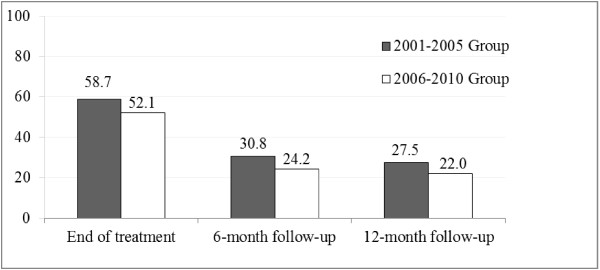
Smokers in the 2006-2010 group, compared to those in the 2001-2005 group, were older, smoked fewer cigarettes per day and of a brand with fewer mg/nicotine, had been smoking longer, were less motivated to give up smoking, and had more antecedents of depression. Quit rates were validated by testing smokers' carbon monoxide (CO) levels.Percentages of abstinence were higher in the 2001-2005 group than in the 2006-2010 group (58.7% vs. 52.15 at the end of treatment, p = 0.05); 30.8% vs. 24.2% at 6 months follow-up, p = 0.031; 27.5% vs. 22% at 12 months follow-up, p = 0.059). Although abstinence decreased more than 5% in the 2006-2010 group there were no differences between the two groups in nicotine dependence. Those participants who did not assist to the follow-up were considered smokers at pretreatment level.
In Spain there has been a qualitative change in the profile of the smokers seeking smoking cessation treatment. Treatment effectiveness has decreased, and the variables predicting intervention outcome have changed.
近年来,由于多种因素,所有发达国家每日吸烟者的患病率均有所下降。尽管有这种下降,但临床治疗的有效性却降低了,并且多项研究报告了吸烟者特征的变化。本研究的目的是分析2001年至2010年间寻求戒烟治疗的西班牙吸烟者的特征变化以及此类治疗有效性的变化。
样本由2001年至2010年期间在西班牙圣地亚哥德孔波斯特拉大学心理学系戒烟单元寻求心理治疗以戒烟的870名吸烟者组成。
与2001 - 2005年组相比,2006 - 2010年组的吸烟者年龄更大,每天吸烟支数更少,所吸香烟品牌的毫克/尼古丁含量更低,吸烟时间更长,戒烟动力更小,且有更多抑郁症病史。通过检测吸烟者的一氧化碳(CO)水平来验证戒烟率。2001 - 2005年组的戒烟百分比高于2006 - 2010年组(治疗结束时为58.7%对52.15%,p = 0.05);6个月随访时为30.8%对24.2%,p = 0.031;12个月随访时为27.5%对22%,p = 0.059)。尽管2006 - 2010年组的戒烟率下降超过5%,但两组在尼古丁依赖方面没有差异。那些未参加随访的参与者被视为处于治疗前水平的吸烟者。
在西班牙,寻求戒烟治疗的吸烟者的特征发生了质的变化。治疗效果降低了,预测干预结果的变量也发生了变化。