Wongsuntornpoj Sarach, Moreno Switt Andrea I, Bergholz Peter, Wiedmann Martin, Chaturongakul Soraya
Department of Microbiology, Faculty of Science, Mahidol University, Bangkok, Thailand.
Department of Food Science, Cornell University, Ithaca, NY, USA; Facultad de Ecología y Recursos Naturales, Universidad Andres Bello, Santiago, Chile.
Vet Microbiol. 2014 Aug 6;172(1-2):345-52. doi: 10.1016/j.vetmic.2014.05.023. Epub 2014 May 29.
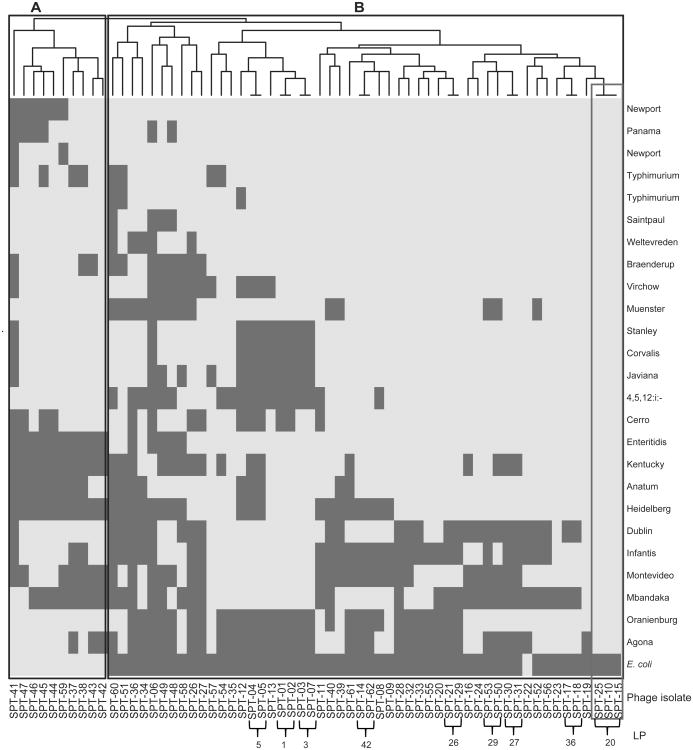
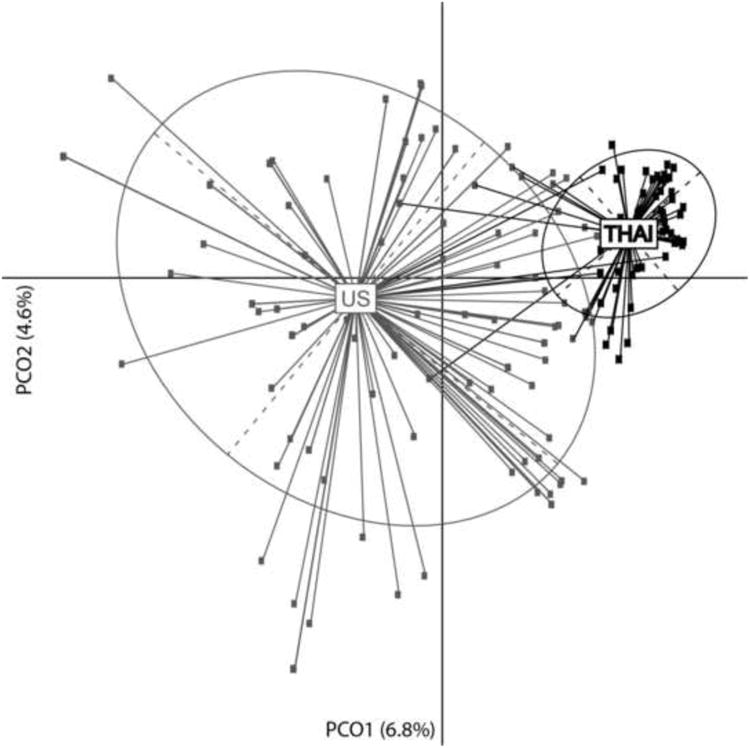
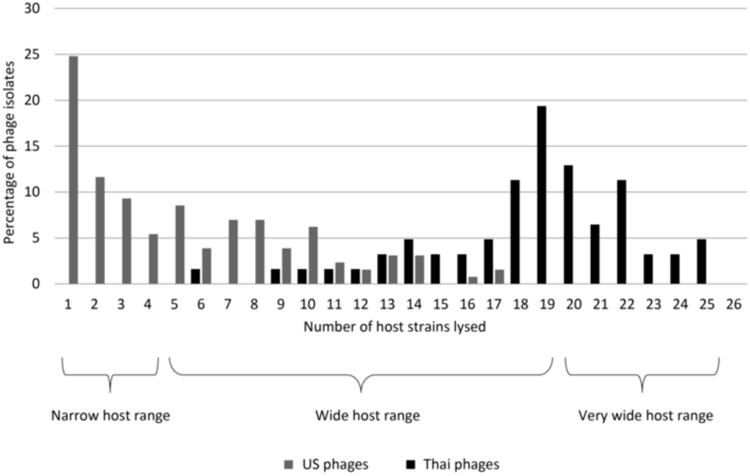
Salmonella is a zoonotic pathogen with globally distributed serovars as well as serovars predominantly found in certain regions; for example, serovar Weltevreden is rarely isolated in the U.S., but is common in Thailand. Relative to our understanding of Salmonella diversity, our understanding of the global diversity of Salmonella phages is limited. We hypothesized that the serovar diversity in a given environment and farming system will affect the Salmonella phage diversity associated with animal hosts. We thus isolated and characterized Salmonella phages from 15 small-scale dairy farms in Thailand and compared the host ranges of the 62 Salmonella phage isolates obtained with host range diversity for 129 phage isolates obtained from dairy farms in the U.S. The 62 phage isolates from Thailand represented genome sizes ranging from 40 to 200 kb and showed lysis of 6-25 of the 26 host strains tested (mean number of strain lysed=19). By comparison, phage isolates previously obtained in a survey of 15 U.S. dairy farms showed a narrow host range (lysis of 1-17; mean number of strains lysed=4); principal coordinate analysis also confirmed U.S. and Thai phages had distinct host lysis profiles. Our data indicate that dairy farms that differ in management practices and are located on different continents can yield phage isolates that differ in their host ranges, providing an avenue for isolation of phages with desirable host range characteristics for commercial applications. Farming systems characterized by coexistence of different animals may facilitate presence of Salmonella phages with wide host ranges.
沙门氏菌是一种人畜共患病原体,其血清型在全球分布,也有一些血清型主要在某些地区被发现;例如,韦尔泰弗里登血清型在美国很少分离到,但在泰国很常见。相对于我们对沙门氏菌多样性的了解,我们对沙门氏菌噬菌体全球多样性的了解有限。我们假设,特定环境和养殖系统中的血清型多样性会影响与动物宿主相关的沙门氏菌噬菌体多样性。因此,我们从泰国的15个小型奶牛场分离并鉴定了沙门氏菌噬菌体,并将获得的62株沙门氏菌噬菌体分离株的宿主范围与从美国奶牛场获得的129株噬菌体分离株的宿主范围多样性进行了比较。来自泰国的62株噬菌体分离株的基因组大小在40至200 kb之间,在所测试的26株宿主菌株中能裂解6 - 25株(平均裂解菌株数 = 19)。相比之下,之前在美国15个奶牛场调查中获得的噬菌体分离株显示出较窄的宿主范围(裂解1 - 17株;平均裂解菌株数 = 4);主坐标分析也证实美国和泰国的噬菌体具有不同的宿主裂解谱。我们的数据表明,管理方式不同且位于不同大陆的奶牛场可能产生宿主范围不同的噬菌体分离株,这为分离具有理想宿主范围特征的噬菌体用于商业应用提供了一条途径。以不同动物共存为特征的养殖系统可能有利于存在宿主范围广泛的沙门氏菌噬菌体。