Nishida Norihiro, Kanchiku Tsukasa, Kato Yoshihiko, Imajo Yasuaki, Yoshida Yuichiro, Kawano Syunichi, Taguchi Toshihiko
Department of Orthopedic Surgery, Yamaguchi University Graduate School of Medicine, Ube, Yamaguchi 755-8505, Japan.
Exp Ther Med. 2014 May;7(5):1095-1099. doi: 10.3892/etm.2014.1557. Epub 2014 Feb 18.
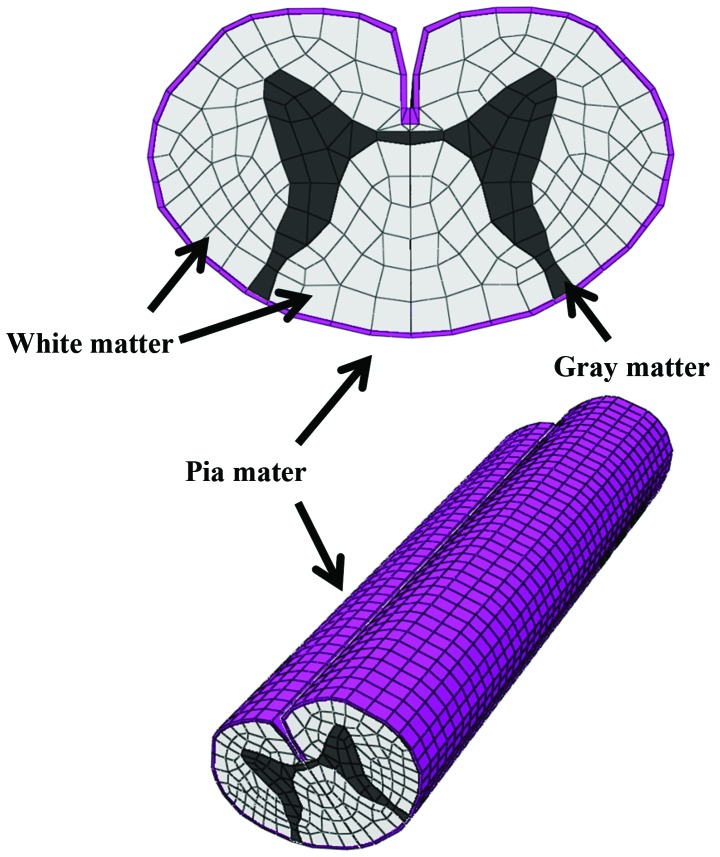
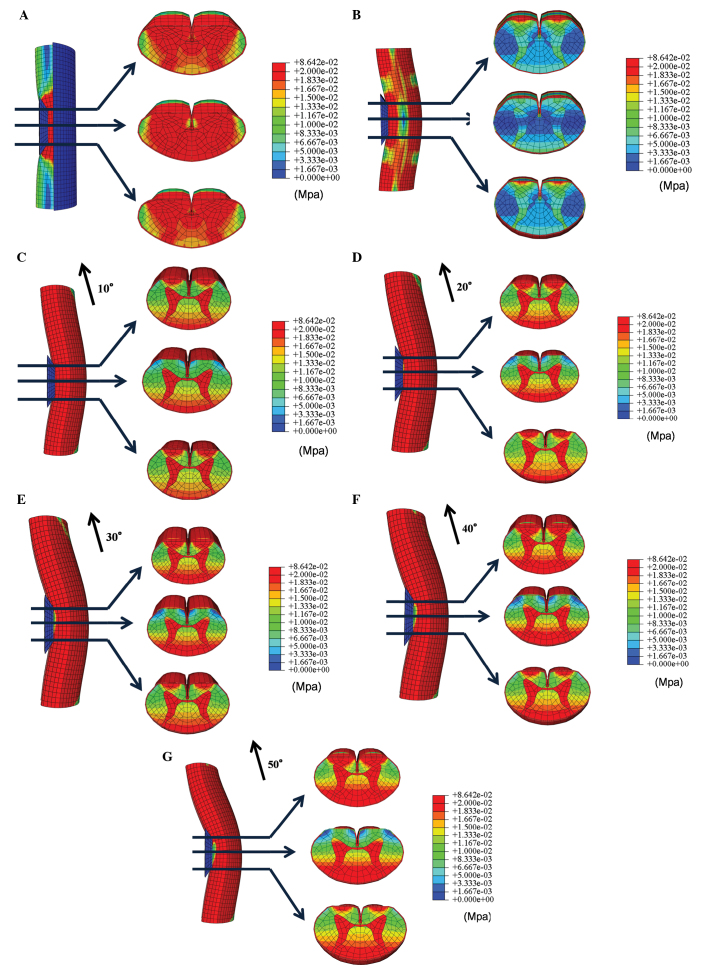
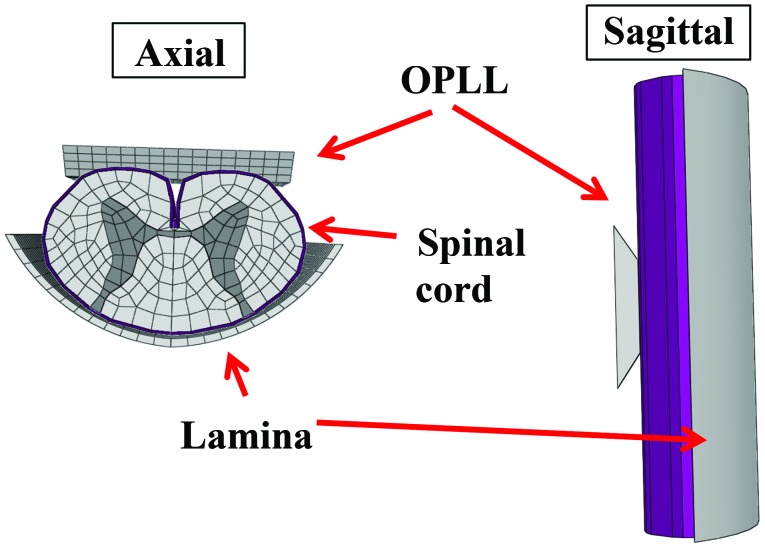
Cervical ossification of the posterior longitudinal ligament (OPLL) results in myelopathy. Conservative treatment is usually ineffective, thus, surgical treatment is required. One of the reasons for the poor surgical outcome following laminoplasty for cervical OPLL is kyphosis. In the present study, a 3-dimensional finite element method (3D-FEM) was used to analyze the stress distribution in preoperative, posterior decompression and kyphosis models of OPLL. The 3D-FEM spinal cord model established in this study consisted of gray and white matter, as well as pia mater. For the preoperative model, 30% anterior static compression was applied to OPLL. For the posterior decompression model, the lamina was shifted backwards and for the kyphosis model, the spinal cord was studied at 10, 20, 30, 40 and 50° kyphosis. In the preoperative model, high stress distributions were observed in the spinal cord. In the posterior decompression model, stresses were lower than those observed in the preoperative model. In the kyphosis model, an increase in the angle of kyphosis resulted in augmented stress on the spinal cord. Therefore, the results of the present study indicated that posterior decompression was effective, but stress distribution increased with the progression of kyphosis. In cases where kyphosis progresses following surgery, detailed follow-ups are required in case the symptoms worsen.
颈椎后纵韧带骨化(OPLL)可导致脊髓病。保守治疗通常无效,因此需要手术治疗。颈椎OPLL行椎板成形术后手术效果不佳的原因之一是后凸畸形。在本研究中,采用三维有限元方法(3D-FEM)分析OPLL术前、后路减压及后凸畸形模型中的应力分布。本研究建立的3D-FEM脊髓模型由灰质、白质以及软脑膜组成。对于术前模型,对OPLL施加30%的前向静态压迫。对于后路减压模型,椎板向后移位;对于后凸畸形模型,在10°、20°、30°、40°和50°后凸畸形状态下研究脊髓。在术前模型中,脊髓观察到高应力分布。在后路减压模型中,应力低于术前模型。在后凸畸形模型中,后凸畸形角度增加导致脊髓上的应力增大。因此,本研究结果表明后路减压是有效的,但应力分布随着后凸畸形的进展而增加。在术后出现后凸畸形进展的病例中,若症状恶化则需要进行详细的随访。