Zhang Lian-Fang, Qi Jin, Zuo GuiLai, Jia Peng, Shen Xing, Shao Jin, Kang Hui, Yang HuiLin, Deng LianFu
Shanghai Key Laboratory for Bone and Joint Disease, Shanghai Institute of Traumatology and Orthopaedics, Ruijin Hospital, Shanghai Jiao Tong University School of Medicine, Shanghai, China; Department of Orthopaedic, The First Affiliated Hospital of Soochow University, Suzhou, China.
Shanghai Key Laboratory for Bone and Joint Disease, Shanghai Institute of Traumatology and Orthopaedics, Ruijin Hospital, Shanghai Jiao Tong University School of Medicine, Shanghai, China.
PLoS One. 2014 Jun 18;9(6):e99946. doi: 10.1371/journal.pone.0099946. eCollection 2014.
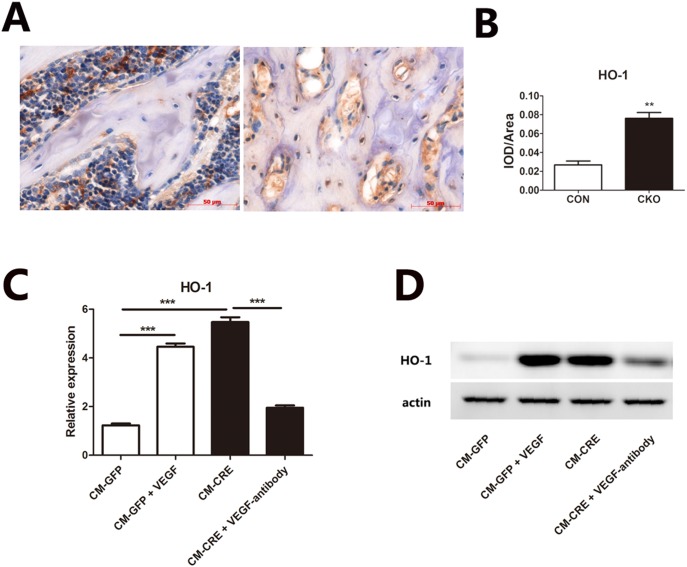
The hypoxia-inducible factors (HIFα) are the critical factors that couple angiogenesis and osteogenesis by activating transcription of VEGF in osteoblasts. Mice lacking von Hippel-Lindau gene (Vhl), thus overexpressing HIFα in osteoblasts develop extremely dense and highly vascularized long bones. Here we provide evidence that osteoblasts lacking Vhl overexpress and secrete high levels of VEGF, which subsequently promotes the proliferation and osteogenic differentiation of bone marrow stromal cells (BMSC) by promoting expression of Heme oxygenase-1 (HO-1) in BMSC. Conditioned medium from osteoblasts Vhl (CM-CRE) promoted the proliferation and osteogenic differentiation of BMSC, in comparison with conditioned medium derived from normal osteoblasts (CM-GFP). Recombinant VEGF stimulated the proliferation and osteogenic differentiation of BMSC culturing in CM-GFP. By contrast, VEGF-neutralizing antibody inhibited the proliferation and osteogenic differentiation of BMSC culturing in CM-CRE. Treatment with a HO-1 inhibitor, SnPP, significantly inhibited VEGF-induced BMSC proliferation and osteogenic differentiation. On the contrary, activation of HO-1 with CoPP reversed the suppressing of VEGF-antibody on the proliferation and osteogesis of BMSC culturing in CM-CRE. These studies suggest that osteoblasts promote the proliferation and osteogenic differentiation of BMCS by VEGF/HO-1 pathway.
缺氧诱导因子(HIFα)是通过激活成骨细胞中血管内皮生长因子(VEGF)的转录来连接血管生成和成骨作用的关键因子。缺乏冯·希佩尔-林道基因(Vhl)从而在成骨细胞中过表达HIFα的小鼠,其长骨发育得极其致密且血管高度丰富。在此我们提供证据表明,缺乏Vhl的成骨细胞过表达并分泌高水平的VEGF,随后通过促进骨髓基质细胞(BMSC)中血红素加氧酶-1(HO-1)的表达来促进BMSC的增殖和成骨分化。与源自正常成骨细胞的条件培养基(CM-GFP)相比,成骨细胞Vhl的条件培养基(CM-CRE)促进了BMSC的增殖和成骨分化。重组VEGF刺激了在CM-GFP中培养的BMSC的增殖和成骨分化。相反,VEGF中和抗体抑制了在CM-CRE中培养的BMSC的增殖和成骨分化。用HO-1抑制剂SnPP处理显著抑制了VEGF诱导的BMSC增殖和成骨分化。相反,用CoPP激活HO-1可逆转VEGF抗体对在CM-CRE中培养的BMSC增殖和成骨作用的抑制。这些研究表明,成骨细胞通过VEGF/HO-1途径促进BMSC的增殖和成骨分化。