Liu Miao, Wu Qingsi, Chen Peng, Büchele Berthold, Bian Maohong, Dong Shengjian, Huang Dake, Ren Cuiping, Zhang Yuxia, Hou Xin, Simmet Thomas, Shen Jijia
Department of Microbiology and Parasitology, Anhui Medical University, Hefei, Anhui, People's Republic of China; Anhui Provincial Laboratory of Microbiology and Parasitology, Anhui Medical University, Hefei, Anhui, People's Republic of China.
College of Clinical Medical Sciences, Anhui Medical University, Hefei, Anhui, People's Republic of China.
PLoS One. 2014 Jun 18;9(6):e100129. doi: 10.1371/journal.pone.0100129. eCollection 2014.
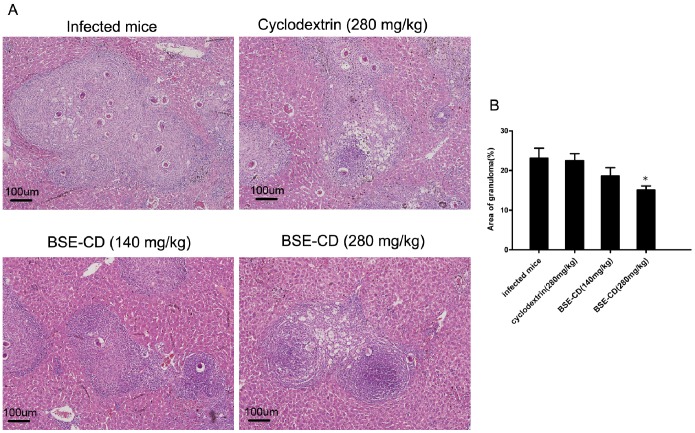
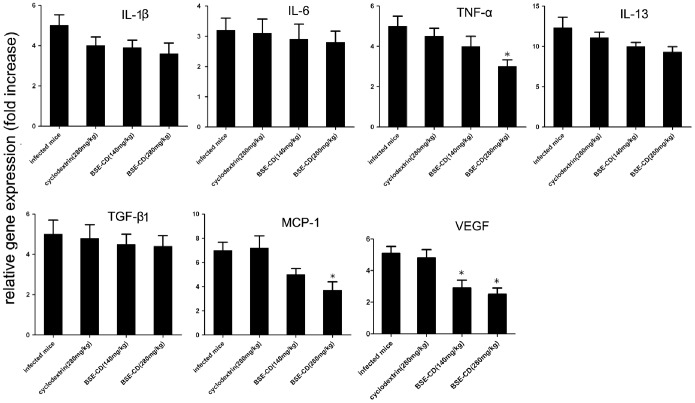
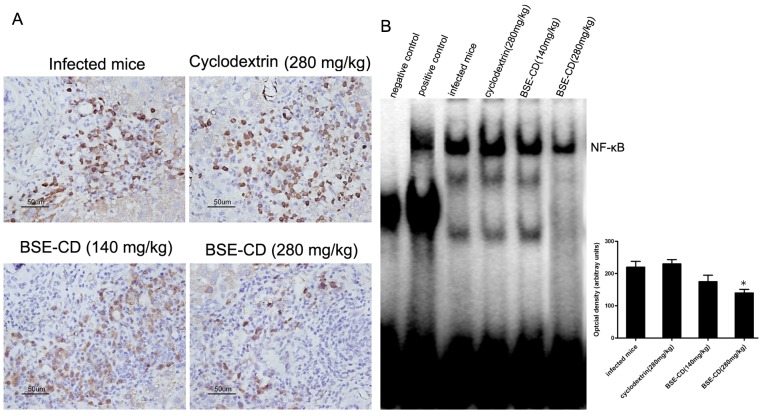
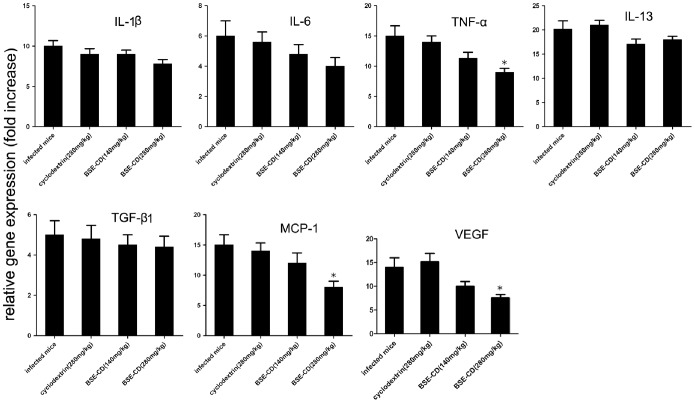
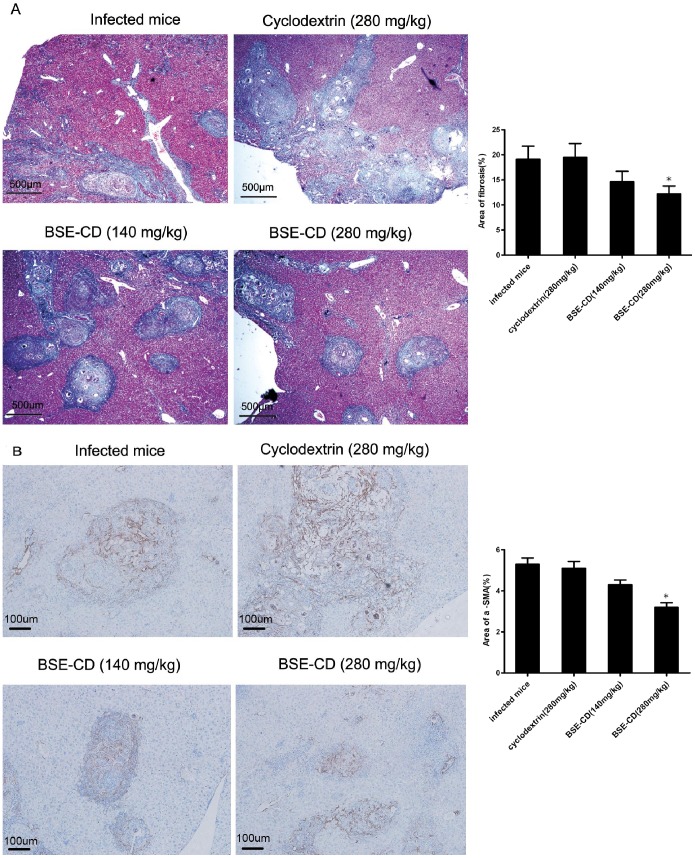
Boswellic acid (BA)-containing extracts such as BSE have anti-inflammatory and immunomodulatory activity. In chronic schistosomiasis, the hepatic granuloma and fibrosis induced by egg deposition in the liver is the most serious pathological manifestations. However, little is known regarding the role of BAs in Schistosoma japonicum (S. japonicum) egg-induced liver granuloma and fibrosis. In order to investigate the effect of a water-soluble complex preparation of BSE, BSE-CD, on S. japonicum egg-induced liver pathology, liver granuloma and fibrosis were induced by infecting C57BL/6 mice with 18-22 cercariae of S. japonicum. S. japonicum cercariae infected mice were injected with BSE-CD at the onset of egg granuloma formation (early phase BSE-CD treatment after 4 weeks infection) or after the formation of liver fibrosis (late phase BSE-CD treatment after 7 weeks infection). Our data show that treatment of infected mice with BSE-CD significantly reduced both the extent of hepatic granuloma and fibrosis. Consistent with an inhibition of NF-κB signaling as evidenced by reduced IκB kinase (IKK) activation, the mRNA expression of VEGF (vascular endothelial growth factor, VEGF), TNF-α (tumor necrosis factor-alpha TNF-α) and MCP-1 (monocyte chemotactic protein 1, MCP-1) was decreased. Moreover, immunohistochemical analysis (IHC) revealed that the content of α-SMA in liver tissue of BSE-CD treated mice was dramatically decreased. Our findings suggest that BSE-CD treatment attenuates S. japonicum egg-induced hepatic granulomas and fibrosis, at least partly due to reduced NF-κB signaling and the subsequently decreased expression of VEGF, TNF-α, and MCP-1. Suppression of the activation of hepatic stellate cells (HSC) may also be involved in the therapeutic efficacy of BSE-CD.
含有波希鼠李糖酸(BA)的提取物,如BSE,具有抗炎和免疫调节活性。在慢性血吸虫病中,肝脏中虫卵沉积诱导的肝肉芽肿和纤维化是最严重的病理表现。然而,关于波希鼠李糖酸在日本血吸虫(日本血吸虫)虫卵诱导的肝肉芽肿和纤维化中的作用知之甚少。为了研究BSE的水溶性复合制剂BSE-CD对日本血吸虫虫卵诱导的肝脏病理的影响,通过用18-22条日本血吸虫尾蚴感染C57BL/6小鼠来诱导肝肉芽肿和纤维化。日本血吸虫尾蚴感染的小鼠在虫卵肉芽肿形成开始时(感染4周后的早期BSE-CD治疗)或肝纤维化形成后(感染7周后的晚期BSE-CD治疗)注射BSE-CD。我们的数据表明,用BSE-CD治疗感染小鼠可显著降低肝肉芽肿和纤维化的程度。与NF-κB信号传导的抑制一致,如IκB激酶(IKK)活化降低所证明的,血管内皮生长因子(VEGF)、肿瘤坏死因子-α(TNF-α)和单核细胞趋化蛋白1(MCP-1)的mRNA表达降低。此外,免疫组织化学分析(IHC)显示,BSE-CD治疗小鼠肝组织中α-SMA的含量显著降低。我们的研究结果表明,BSE-CD治疗可减轻日本血吸虫虫卵诱导的肝肉芽肿和纤维化,至少部分原因是NF-κB信号传导减少以及随后VEGF、TNF-α和MCP-1的表达降低。肝星状细胞(HSC)活化的抑制也可能参与BSE-CD的治疗效果。