Boodai Shurooq A, McColl John H, Reilly John J
University of Glasgow School of Medicine, Level 3 New Lister Building, GRI, 10 Alexander Parade, Glasgow, Scotland.
Trials. 2014 Jun 19;15:234. doi: 10.1186/1745-6215-15-234.
Few randomised controlled trials (RCTs) of interventions for the treatment of adolescent obesity have taken place outside the western world. This RCT tested whether a simple 'good practice' intervention for the treatment of adolescent obesity would have a greater impact on weight status and other outcomes than a referral to primary care (control) in adolescents in Kuwait City.
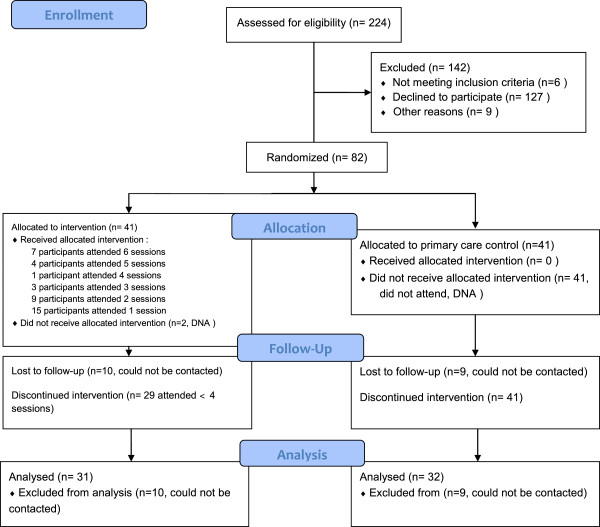
We report on an assessor-blinded RCT of a treatment intervention in 82 obese 10- to 14-year-olds (mean age 12.4, SD 1.2 years), randomised to a good practice treatment or primary care control group over 6 months. The good practice intervention was intended as relatively low intensity (6 hours contact over 24 weeks, group-based), aiming to change sedentary behaviour, physical activity, and diet. The primary outcome was a change in body mass index (BMI) Z score; other outcomes were changes in waist circumference and blood pressure.
The retention of subjects to follow up was acceptable (n = 31 from the intervention group, and n = 32 from the control group), but engagement with both the intervention and control treatment was poor. Treatment had no significant effect on BMI Z score relative to control, and no other significant benefits to intervention were observed.
The trial was feasible, but highlights the need to engage obese adolescents and their families in the interventions being trialled. The trial should inform the development of future adolescent obesity treatment trials in the Gulf States with the incorporation of qualitative assessment in future intervention trials.
RCT Registered as National Adolescent Treatment Trial for Obesity in Kuwait (NATTO): http://www.controlled-trials.com/ISRCTN37457227, 1 December 2009.
在西方世界以外,针对青少年肥胖症治疗干预措施的随机对照试验(RCT)较少。这项RCT测试了一种简单的“良好实践”干预措施,用于治疗科威特城青少年肥胖症,与转介至初级保健(对照组)相比,是否会对体重状况和其他结果产生更大影响。
我们报告了一项评估者盲法RCT,对82名10至14岁肥胖青少年(平均年龄12.4岁,标准差1.2岁)进行治疗干预,在6个月内随机分为良好实践治疗组或初级保健对照组。良好实践干预旨在为相对低强度(24周内6小时接触,基于小组),旨在改变久坐行为、身体活动和饮食。主要结局是体重指数(BMI)Z评分的变化;其他结局是腰围和血压的变化。
受试者随访的保留率可以接受(干预组n = 31,对照组n = 32),但对干预和对照治疗的参与度都很差。与对照组相比,治疗对BMI Z评分没有显著影响,也未观察到干预有其他显著益处。
该试验是可行的,但突出了让肥胖青少年及其家庭参与试验干预措施的必要性。该试验应为海湾国家未来青少年肥胖症治疗试验的开展提供参考,在未来的干预试验中纳入定性评估。
RCT注册为科威特全国青少年肥胖治疗试验(NATTO):http://www.controlled-trials.com/ISRCTN37457227,2009年12月1日。