Chen Zhu, Xiao Hua-En, Ramchandra Paudel, Huang Hai-Jiang
Department of Radiology, The Second Xiangya Hospital of Central South University, Changsha, Hunan 410011, P.R. China.
Department of Pathology, The Second Xiangya Hospital of Central South University, Changsha, Hunan 410011, P.R. China.
Oncol Lett. 2014 Apr;7(4):956-962. doi: 10.3892/ol.2014.1844. Epub 2014 Jan 31.
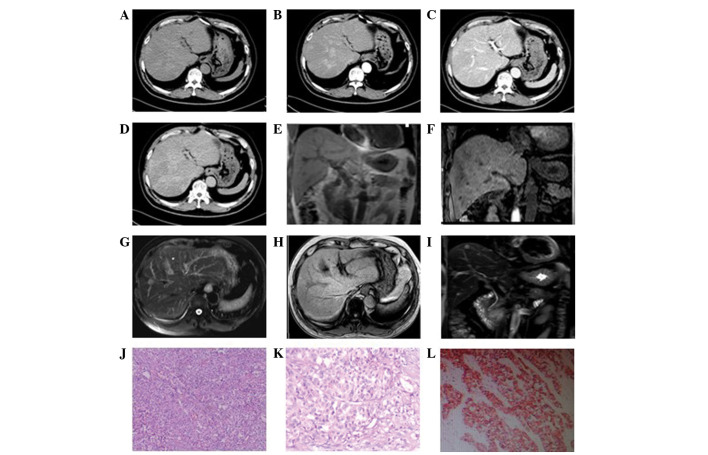
The present study aimed to analyze the imaging features and pathological basis of primary hepatic neuroendocrine carcinoma (PHNEC). A retrospective analysis of the imaging and pathological features of nine PHNEC cases was carried out at The Second Xiangya Hospital of Central South University (Changsha, China). The nine patients were subjected to dynamic contrast-enhanced computed tomography (CT) scanning of the liver and pathological diagnosis of the tissue samples. In addition, two patients were subjected to magnetic resonance imaging (MRI). CT scanning revealed the presence of single or multiple masses in the liver with a maximum diameter of 1-10 cm. These hepatic masses were of low density as showed by plain CT. These masses showed uneven or annular enhancement at their margins in the arterial phase. The venous portal phase showed consistent or declined enhancement and the delayed phase showed light enhancement in these masses. In addition, multiple intrahepatic nodules with long T1 and T2 signal intensities and obvious enhancement were observed by MRI in one patient, while intrahepatic lesions with moderate length T2 signal intensities and light enhancement not visible on the T1 image were observed in another patient. Pathological analysis revealed that the tumor cells exhibited morphological diversity. Immunohistochemical staining revealed that the tumor cells were chromogranin A- and synaptophysin-positive, and carcinoembryonic antigen-, hepatocytic antigen- and α-fetoprotein-negative. Imaging methods, including CT and MRI, are useful for the diagnosis of PHNEC; however, pathological examination is required for a final, definite diagnosis.
本研究旨在分析原发性肝神经内分泌癌(PHNEC)的影像学特征及病理基础。对中南大学湘雅二医院(中国长沙)9例PHNEC患者的影像学和病理特征进行回顾性分析。这9例患者均接受了肝脏动态对比增强计算机断层扫描(CT)及组织样本的病理诊断。此外,2例患者还接受了磁共振成像(MRI)检查。CT扫描显示肝脏存在单个或多个肿块,最大直径为1 - 10厘米。平扫CT显示这些肝脏肿块呈低密度。这些肿块在动脉期边缘呈不均匀或环形强化。门静脉期强化一致或减弱,延迟期肿块呈轻度强化。另外,1例患者的MRI检查发现多个肝内结节,T1和T2信号长,强化明显;另1例患者肝内病变T2信号强度中等,T1图像上未见明显强化。病理分析显示肿瘤细胞形态多样。免疫组化染色显示肿瘤细胞嗜铬粒蛋白A和突触素阳性,癌胚抗原、肝细胞抗原和甲胎蛋白阴性。包括CT和MRI在内的影像学方法对PHNEC的诊断有帮助;然而,最终明确诊断仍需病理检查。