Takagi Hidefumi, Azuma Kazuo, Tsuka Takeshi, Imagawa Tomohiro, Osaki Tomohiro, Okamoto Yoshiharu
The United Graduate School of Veterinary Science, Yamaguchi University, Yamaguchi 753-8515, Japan ; Takagi Animal Clinic, Saijo, Ehime 793-0035, Japan.
Faculty of Agriculture, Tottori University, Tottori 680-8533, Japan.
Oncol Lett. 2014 Apr;7(4):1007-1010. doi: 10.3892/ol.2014.1852. Epub 2014 Feb 4.
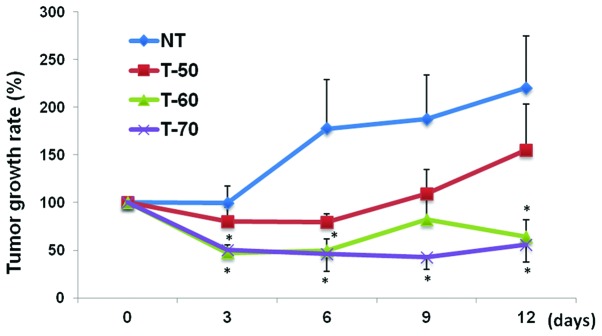
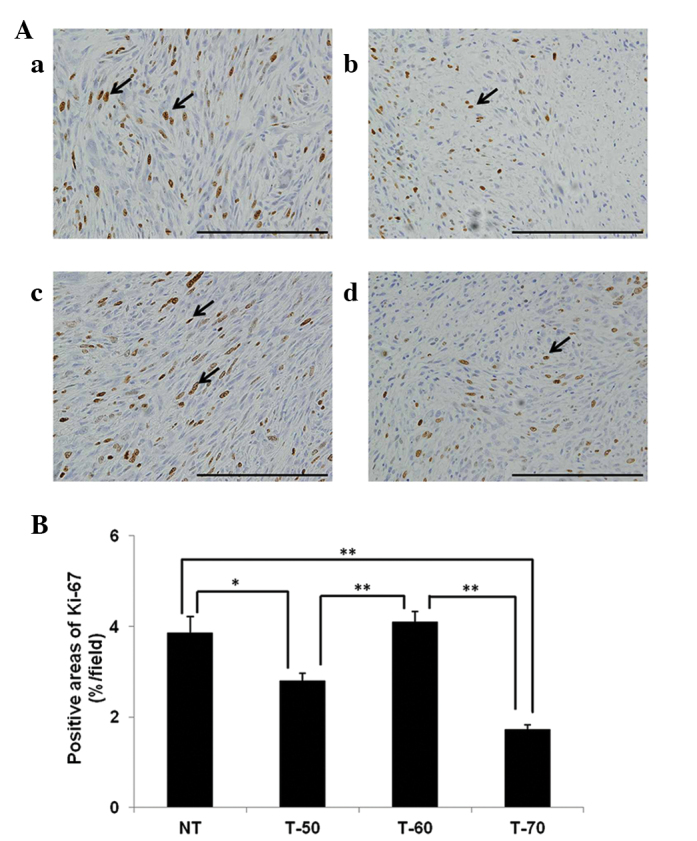
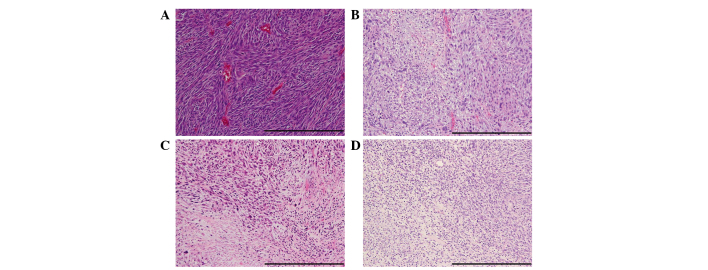
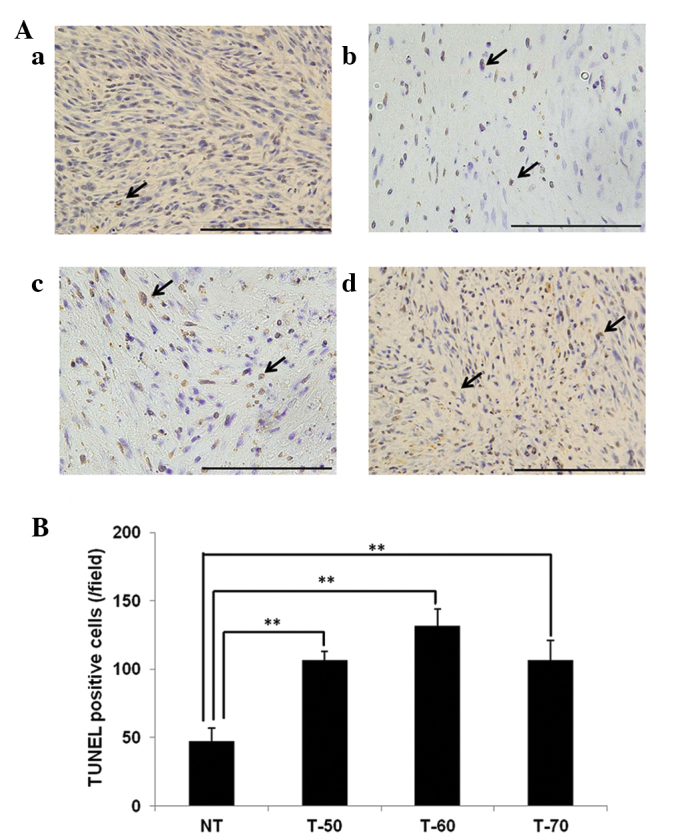
High-temperature hyperthermia (HTH) is an established treatment option for cancer. The aim of the present study was to reveal the exact correlation between HTH at temperatures of 50-70°C and the resulting antitumor effects, using a glioma rat model. In the 60°C (T-60) and 70°C (T-70) HTH groups, tumor growth rates were significantly suppressed compared with those in the nontreatment (NT) group. In the 50°C (T-50) HTH group, tumor growth rates were not suppressed compared with those in the NT group. The numbers of terminal dUTP nick-end labeling-positive cells in tumor tissue were significantly higher in the T-50, T-60 and T-70 groups than those in the NT group. The Ki-67-positive areas were significantly decreased in the T-70 group compared with those in the NT and T-60 groups. Our data indicate that HTH at 60 and 70°C suppresses tumor growth in a glioma rat model. In particular, cell proliferation was significantly suppressed by HTH at 70°C. However, differences in the mechanism of action of HTH at 60 and 70°C were observed.
高温热疗(HTH)是一种既定的癌症治疗选择。本研究的目的是使用胶质瘤大鼠模型揭示50 - 70°C温度下的HTH与由此产生的抗肿瘤效果之间的确切相关性。在60°C(T - 60)和70°C(T - 70)HTH组中,与未治疗(NT)组相比,肿瘤生长速率显著受到抑制。在50°C(T - 50)HTH组中,与NT组相比肿瘤生长速率未受到抑制。T - 50、T - 60和T - 70组肿瘤组织中末端脱氧核苷酸转移酶介导的缺口末端标记阳性细胞数量显著高于NT组。与NT组和T - 60组相比,T - 70组中Ki - 67阳性区域显著减少。我们的数据表明,60°C和70°C的HTH可抑制胶质瘤大鼠模型中的肿瘤生长。特别是,70°C的HTH显著抑制细胞增殖。然而,观察到60°C和70°C的HTH作用机制存在差异。