
磁铁矿FeO表面的水排列
Water Ordering on the Magnetite FeO Surfaces.
作者信息
Zaki Eman, Jakub Zdenek, Mirabella Francesca, Parkinson Gareth S, Shaikhutdinov Shamil, Freund Hans-Joachim
机构信息
Abteilung Chemische Physik , Fritz-Haber-Institut der Max-Planck-Gesellschaft , Faradayweg 4-6 , 14195 Berlin , Germany.
Institut für Angewandte Physik , TU Wien , Wiedner Hauptstr. 8-10 , 1040 Vienna , Austria.
出版信息
J Phys Chem Lett. 2019 May 16;10(10):2487-2492. doi: 10.1021/acs.jpclett.9b00773. Epub 2019 May 2.
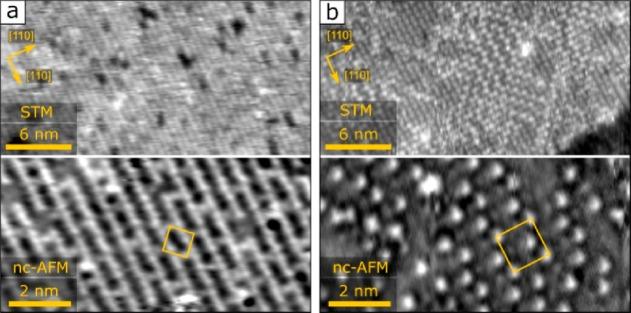
The interaction of water with the most prominent surfaces of FeO, (001) and (111), is directly compared using a combination of temperature-programmed desorption, temperature-programmed low energy electron diffraction (TP LEED), and scanning probe microscopies. Adsorption on the (√2 × √2)R45°-reconstructed surface of FeO(001) is strongly influenced by the surface reconstruction, which remains intact at all coverages. Close to the completion of the first monolayer, however, the ad-layer adopts a longer-range (2 × 2) superstructure. This finding is discussed in the context of a similar (2 × 2) superstructure recently observed on the (111) facet, which exists over a significantly larger range of temperatures and coverages. In both cases, the long-range order is evidence that water-water interactions exert a significant influence on the structure already prior to the nucleation of the second layer. We conclude that the stability differences stem from the smaller unit cell on the (111) surface, and the ability of water to more easily form stable hexagonal ice-like structures on the hexagonal substrate.
通过程序升温脱附、程序升温低能电子衍射(TP LEED)和扫描探针显微镜相结合的方法,直接比较了水与FeO最显著表面(001)和(111)的相互作用。水在FeO(001)的(√2×√2)R45°重构表面上的吸附受到表面重构的强烈影响,该重构在所有覆盖度下均保持完整。然而,在接近第一个单分子层形成完成时,吸附层采用了更大尺度的(2×2)超结构。这一发现是在最近在(111)晶面上观察到的类似(2×2)超结构的背景下进行讨论的,该超结构在显著更大的温度和覆盖度范围内存在。在这两种情况下,长程有序表明,在第二层成核之前,水-水相互作用就已经对结构产生了重大影响。我们得出结论,稳定性差异源于(111)表面较小的晶胞,以及水在六方衬底上更容易形成稳定的六方冰状结构的能力。


 Zotero 插件