Rivas Gustavo B S, de Souza Nataly Araujo, Peixoto Alexandre A, Bruno Rafaela V
Laboratório de Biologia Molecular, Instituto Oswaldo Cruz, Fundação Oswaldo Cruz (FIOCRUZ), Rio de Janeiro, Brazil.
Parasit Vectors. 2014 Jun 19;7:278. doi: 10.1186/1756-3305-7-278.
Insect vectors have been established as models in Chronobiology for many decades, and recent studies have demonstrated a close relationship between the circadian clock machinery, daily rhythms of activity and vectorial capacity. Lutzomyia longipalpis, the primary vector of Leishmania (Leishmania) infantum in the New World, is reported to have crepuscular/nocturnal activity in the wild. However, most of these studies applied hourly CDC trap captures, which is a good indicative of L. longipalpis behaviour, but has limited accuracy due to the inability to record the daily activity of a single insect during consecutive days. In addition, very little is known about the activity pattern of L. longipalpis under seasonal variations of average temperature and day length in controlled laboratory conditions.
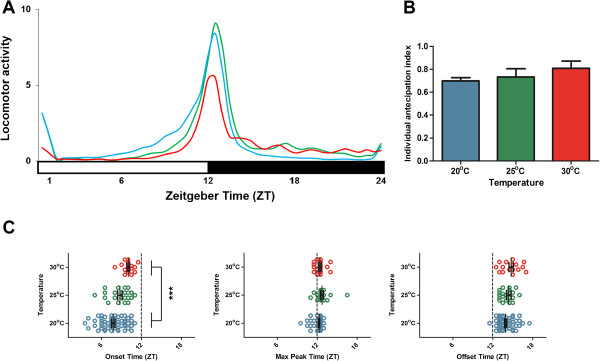
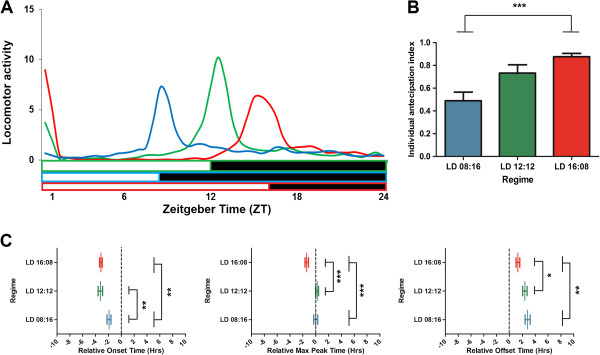
We recorded the locomotor activity of L. longipalpis males under different artificial regimes of temperature and photoperiod. First, in order to test the effects of temperature on the activity, sandflies were submitted to regimes of light/dark cycles similar to the equinox photoperiod (LD 12:12) combined with different constant temperatures (20°C, 25°C and 30°C). In addition, we recorded sandfly locomotor activity under a mild constant temperature (25°C with different day length regimes: 8 hours, 12 hours and 16 hours).
L. longipalpis exhibited more activity at night, initiating dusk-related activity (onset time) at higher rather than lower temperatures. In parallel, changes of photoperiod affected anticipation as well as all the patterns of activity (onset, peak and offset time). However, under LD 16:08, sandflies presented the earliest values of maximum peak and offset times, contrary to other regimes.
Herein, we showed that light and temperature modulate L. longipalpis behaviour under controlled laboratory conditions, suggesting that sandflies might use environmental information to sustain their crepuscular/nocturnal activity, as well as other important aspects as mating and host-seeking at appropriate times in different seasons. Our results depict previously unappreciated aspects of the L. longipalpis daily rhythms of activity that might have important epidemiological implications.
几十年来,昆虫媒介已成为时间生物学的模型,最近的研究表明昼夜节律机制、日常活动节律与传病能力之间存在密切关系。长须罗蛉是新世界婴儿利什曼原虫的主要传播媒介,据报道在野外具有黄昏/夜间活动习性。然而,这些研究大多采用每小时一次的疾病控制中心诱捕捕获法,这能很好地反映长须罗蛉的行为,但由于无法连续记录单个昆虫的日常活动,准确性有限。此外,关于在可控实验室条件下平均温度和日照长度的季节性变化时长须罗蛉的活动模式,人们了解甚少。
我们记录了不同人工温度和光周期条件下长须罗蛉雄虫的运动活动。首先,为了测试温度对活动的影响,将白蛉置于类似于昼夜平分点光周期(LD 12:12)并结合不同恒定温度(20°C、25°C和30°C)的明暗循环条件下。此外,我们记录了在温和恒定温度(25°C)下不同日照长度条件(8小时、12小时和16小时)的白蛉运动活动。
长须罗蛉在夜间表现出更多活动,在较高而非较低温度下开始与黄昏相关的活动(开始时间)。同时,光周期的变化影响预期以及所有活动模式(开始、峰值和结束时间)。然而,在LD 16:08条件下,与其他条件相反,白蛉的最大峰值和结束时间最早。
在此,我们表明在可控实验室条件下,光和温度调节长须罗蛉的行为,这表明白蛉可能利用环境信息来维持其黄昏/夜间活动,以及在不同季节的适当时间进行交配和寻找宿主等其他重要活动。我们的结果描绘了长须罗蛉日常活动节律中以前未被认识的方面,这可能具有重要的流行病学意义。