Rubio-Moraga Angela, Ahrazem Oussama, Pérez-Clemente Rosa M, Gómez-Cadenas Aurelio, Yoneyama Koichi, López-Ráez Juan Antonio, Molina Rosa Victoria, Gómez-Gómez Lourdes
Departamento de Ciencia y Tecnología Agroforestal y Genética, Facultad de Farmacia, Instituto Botánico, Universidad de Castilla-La Mancha, Campus Universitario s/n, 02071 Albacete, Spain.
BMC Plant Biol. 2014 Jun 19;14:171. doi: 10.1186/1471-2229-14-171.
In saffron (Crocus sativus), new corms develop at the base of every shoot developed from the maternal corm, a globular underground storage stem. Since the degree of bud sprouts influences the number and size of new corms, and strigolactones (SLs) suppress growth of pre-formed axillary bud, it was considered appropriate to investigate SL involvement in physiology and molecular biology in saffron. We focused on two of the genes within the SL pathway, CCD7 and CCD8, encoding carotenoid cleavage enzymes required for the production of SLs.
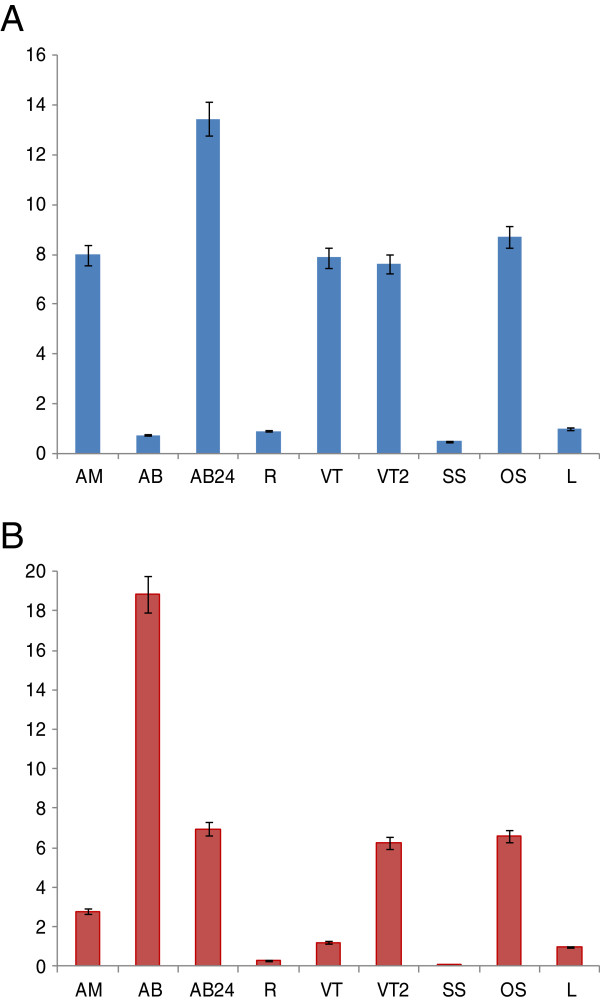
The CsCCD7 and CsCCD8 genes are the first ones isolated and characterized from a non-grass monocotyledonous plant. CsCCD7 and CsCCD8 expression showed some overlapping, although they were not identical. CsCCD8 was highly expressed in quiescent axillary buds and decapitation dramatically reduced its expression levels, suggesting its involvement in the suppression of axillary bud outgrowth. Furthermore, in vitro experiments showed also the involvement of auxin, cytokinin and jasmonic acid on the sprouting of axillary buds from corms in which the apical bud was removed. In addition, CsCCD8 expression, but not CsCCD7, was higher in the newly developed vascular tissue of axillary buds compared to the vascular tissue of the apical bud.
We showed that production and transport of auxin in saffron corms could act synergistically with SLs to arrest the outgrowth of the axillary buds, similar to the control of above-ground shoot branching. In addition, jasmonic acid seems to play a prominent role in bud dormancy in saffron. While cytokinins from roots promote bud outgrowth. In addition the expression results of CsCCD8 suggest that SLs could positively regulate procambial activity and the development of new vascular tissues connecting leaves with the mother corm.
在藏红花(番红花)中,新的球茎在由母球茎(一种球状地下贮藏茎)发育而来的每个芽的基部形成。由于芽的萌发程度会影响新球茎的数量和大小,而独脚金内酯(SLs)会抑制已形成的腋芽生长,因此研究SLs在藏红花生理和分子生物学中的作用被认为是合适的。我们聚焦于SL途径中的两个基因,即CCD7和CCD8,它们编码合成SLs所需的类胡萝卜素裂解酶。
CsCCD7和CsCCD8基因是首次从非禾本科单子叶植物中分离和鉴定出来的。CsCCD7和CsCCD8的表达虽不完全相同,但有部分重叠。CsCCD8在静止的腋芽中高度表达,去顶处理显著降低了其表达水平,表明它参与了腋芽生长的抑制。此外,体外实验还表明生长素、细胞分裂素和茉莉酸参与了去除顶芽的球茎腋芽的萌发。另外,与顶芽的维管组织相比,CsCCD8在腋芽新发育的维管组织中的表达更高,而CsCCD7则不然。
我们发现藏红花球茎中生长素的产生和运输可能与SLs协同作用,以抑制腋芽的生长,这与地上枝条分枝的控制类似。此外,茉莉酸似乎在藏红花的芽休眠中起重要作用。而来自根部的细胞分裂素促进芽的生长。此外,CsCCD8的表达结果表明SLs可能正向调节原形成层活性以及连接叶片与母球茎的新维管组织的发育。