Audrain-McGovern Janet, Wileyto E Paul, Ashare Rebecca, Cuevas Jocelyn, Strasser Andrew A
Department of Psychiatry, Perelman School of Medicine, University of Pennsylvania, Philadelphia, Pennsylvania.
Department of Biostatistics and Epidemiology, Perelman School of Medicine, University of Pennsylvania, Philadelphia, Pennsylvania.
Biol Psychiatry. 2014 Nov 1;76(9):689-97. doi: 10.1016/j.biopsych.2014.04.018. Epub 2014 May 15.
There is a disproportionately high smoking prevalence among individuals who are prone to depression. While depression has been conceptualized as a disorder of dysregulated positive affect and disrupted reward processing, little research has been conducted to determine the role of smoking in these processes among depression-prone smokers.
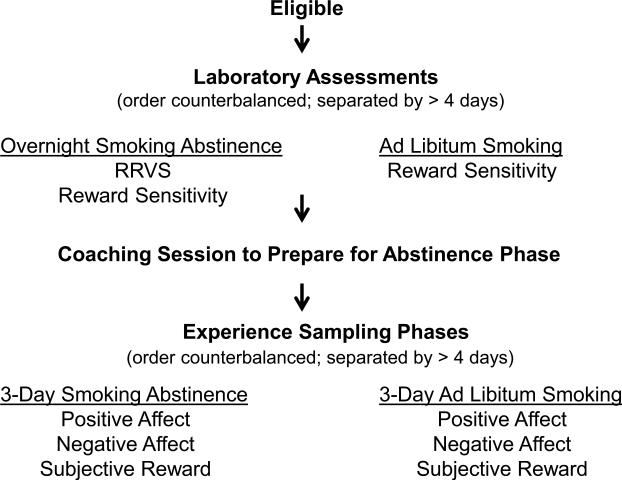
Depression-prone smokers (DP+; n = 34) and smokers not depression-prone (DP-; n = 49) underwent two laboratory sessions, one while smoking abstinent and one while smoking ad libitum, to assess the relative reinforcing value of smoking and reward sensitivity. Using experience sampling methods, participants completed self-report measures of subjective reward, positive affect, and negative affect across 3 days while smoking as usual and 3 days while smoking abstinent.
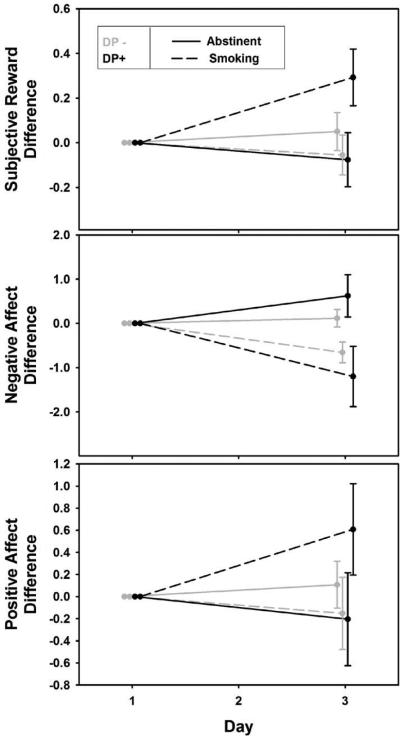
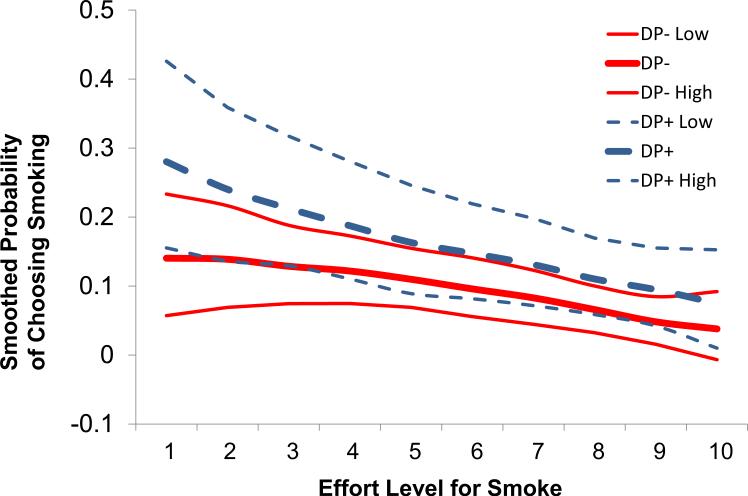
DP+ were two times more likely to work for cigarette puffs versus money in a progressive ratio, choice task (odds ratio 2.05; 95% confidence interval 1.04 to 4.06, p = .039) compared with DP-. Reward sensitivity as measured by the signal detection task did not yield any significant findings. Mixed models regressions revealed a three-way interaction (depression group, smoking phase, and time) for subjective reward, negative affect, and positive affect. For all three of these outcomes, the slopes for DP- and DP+ differed significantly from each other (ps < .05) and the effect of smoking (versus abstinence) over time was greater for DP+ than DP- smokers (ps < .05).
These findings indicate that the effects of smoking on reward and positive affect regulation are specific to DP+ smokers and highlight novel targets for smoking cessation treatment in this population.
在易患抑郁症的人群中,吸烟率高得不成比例。虽然抑郁症被概念化为一种积极情感失调和奖赏处理中断的疾病,但很少有研究来确定吸烟在这些过程中对易患抑郁症的吸烟者的作用。
易患抑郁症的吸烟者(DP+;n = 34)和不易患抑郁症的吸烟者(DP-;n = 49)接受了两次实验室测试,一次是在戒烟时,一次是在随意吸烟时,以评估吸烟的相对强化价值和奖赏敏感性。使用经验抽样方法,参与者在照常吸烟的3天和戒烟的3天内完成了主观奖赏、积极情感和消极情感的自我报告测量。
在一个累进比率选择任务中,与DP-相比,DP+为获得烟 puff 而非金钱而工作的可能性高出两倍(优势比2.05;95%置信区间1.04至4.06,p = .039)。通过信号检测任务测量的奖赏敏感性未得出任何显著结果。混合模型回归揭示了主观奖赏、消极情感和积极情感的三向交互作用(抑郁组、吸烟阶段和时间)。对于所有这三个结果,DP-和DP+的斜率彼此有显著差异(p值< .05),并且随着时间的推移,吸烟(与戒烟相比)对DP+吸烟者的影响大于DP-吸烟者(p值< .05)。
这些发现表明,吸烟对奖赏和积极情感调节的影响特定于DP+吸烟者,并突出了该人群戒烟治疗的新靶点。