Wooten Matthew, Weng Hao-Jui, Hartke Timothy V, Borzan Jasenka, Klein Amanda H, Turnquist Brian, Dong Xinzhong, Meyer Richard A, Ringkamp Matthias
Department of Neurosurgery, School of Medicine, Johns Hopkins University, Baltimore, Maryland 21287, USA.
Department of Neuroscience, School of Medicine, Johns Hopkins University, Baltimore, Maryland 21205, USA.
Nat Commun. 2014 Jun 20;5:4122. doi: 10.1038/ncomms5122.
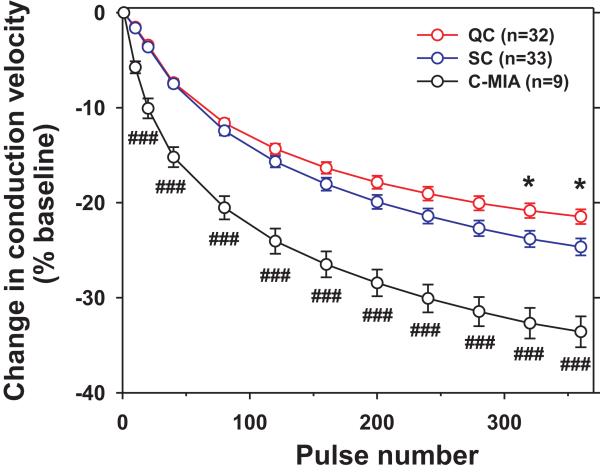
In primates, C-fibre polymodal nociceptors are broadly classified into two groups based on mechanosensitivity. Here we demonstrate that mechanically sensitive polymodal nociceptors that respond either quickly (QC) or slowly (SC) to a heat stimulus differ in responses to a mild burn, heat sensitization, conductive properties and chemosensitivity. Superficially applied capsaicin and intradermal injection of β-alanine, an MrgprD agonist, excite vigorously all QCs. Only 40% of SCs respond to β-alanine, and their response is only half that of QCs. Mechanically insensitive C-fibres (C-MIAs) are β-alanine insensitive but vigorously respond to capsaicin and histamine with distinct discharge patterns. Calcium imaging reveals that β-alanine and histamine activate distinct populations of capsaicin-responsive neurons in primate dorsal root ganglion. We suggest that histamine itch and capsaicin pain are peripherally encoded in C-MIAs, and that primate polymodal nociceptive afferents form three functionally distinct subpopulations with β-alanine responsive QC fibres likely corresponding to murine MrgprD-expressing, non-peptidergic nociceptive afferents.
在灵长类动物中,C类纤维多模式伤害感受器根据机械敏感性大致分为两组。在此我们证明,对热刺激快速(QC)或缓慢(SC)作出反应的机械敏感多模式伤害感受器在对轻度烧伤、热敏化、传导特性和化学敏感性的反应方面存在差异。表面应用辣椒素和皮内注射β-丙氨酸(一种MrgprD激动剂)能强烈兴奋所有的QC。只有40%的SC对β-丙氨酸有反应,且其反应强度仅为QC的一半。机械不敏感C类纤维(C-MIA)对β-丙氨酸不敏感,但对辣椒素和组胺有强烈反应,且放电模式不同。钙成像显示,β-丙氨酸和组胺激活灵长类动物背根神经节中不同群体的辣椒素反应性神经元。我们认为,组胺性瘙痒和辣椒素性疼痛在C-MIA中进行外周编码,并且灵长类动物多模式伤害性传入纤维形成三个功能不同的亚群,其中对β-丙氨酸有反应的QC纤维可能对应于表达小鼠MrgprD的非肽能伤害性传入纤维。