Department of Radiology, Faculty of Medicine, Chulalongkorn University, Bangkok, Thailand.
Department of Radiology, Faculty of Medicine, Siriraj Hospital, Mahidol University, Bangkok, Thailand.
J Neurogastroenterol Motil. 2014 Jul 31;20(3):371-8. doi: 10.5056/jnm13114.
BACKGROUND/AIMS: To report gastric emptying scintigraphy, normal values should be established for a specific protocol. The aim of this study was to provide normal gastric emptying values and determine factors affecting gastric emptying using Asian rice-based meal in healthy volunteers.
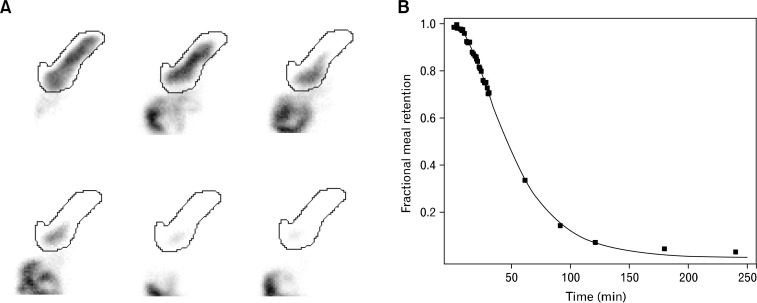
One hundred and ninety-two healthy volunteers were included at 7 tertiary care centers across Thailand. Gastric emptying scintigraphy was acquired in 45 degree left anterior oblique view immediately after ingestion of a 267 kcal steamed-rice with technetium-99m labeled-microwaved egg meal with 100 mL water for up to 4 hours.
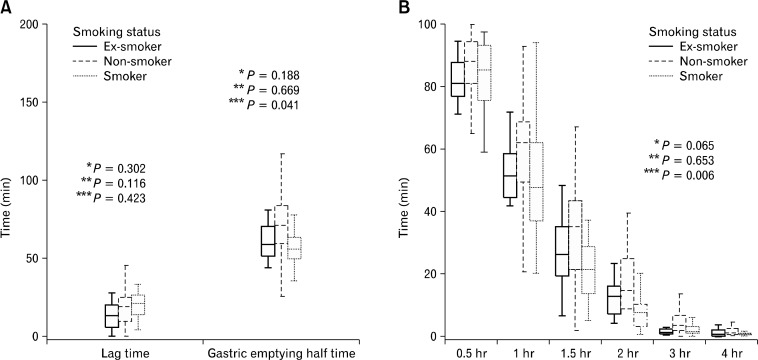
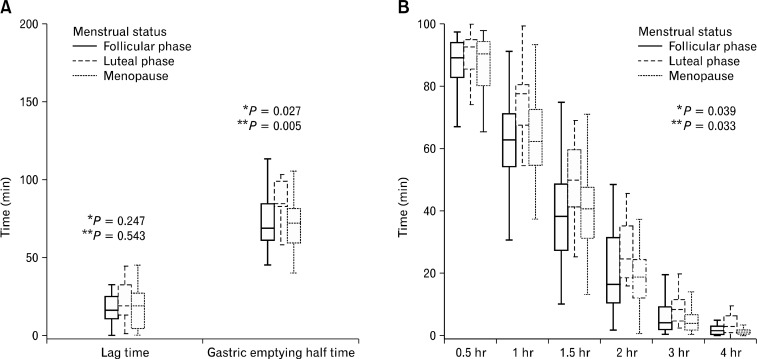
One hundred and eighty-nine volunteers (99 females, age 43 ± 14 years) completed the study. The medians (5-95th percentiles) of lag time, gastric emptying half time (GE T1/2) and percent gastric retentions at 2 and 4 hours for all volunteers were 18.6 (0.5-39.1) minutes, 68.7 (45.1-107.8) minutes, 16.3% (2.7-49.8%) and 1.1% (0.2-8.8%), respectively. Female volunteers had significantly slower gastric emptying compared to male (GE T1/2, 74 [48-115] minutes vs. 63 (41-96) minutes; P < 0.05). Female volunteers who were in luteal phase of menstrual cycle had significantly slower gastric emptying compared to those in follicular phase or menopausal status (GE T1/2, 85 [66-102] mintes vs. 69 [50-120] minutes or 72 [47-109] minutes, P < 0.05). All of smoking volunteers were male. Smoker male volunteers had significantly faster gastric emptying compared to non-smoker males (GE T1/2, 56 [44-80] minutes vs. 67 [44-100] minutes, P < 0.05). Age, body mass index and alcohol consumption habits did not affect gastric emptying values.
A steamed-rice with microwaved egg meal was well tolerated by healthy volunteers. Gender, menstrual status and smoking status were found to affect solid gastric emptying.
背景/目的:为了报告胃排空闪烁成像,应该为特定方案建立正常数值。本研究的目的是提供正常的胃排空值,并确定使用亚洲米饭餐在健康志愿者中影响胃排空的因素。
在泰国的 7 个三级护理中心共纳入 192 名健康志愿者。志愿者在摄入 267 卡路里的蒸米饭后立即以 45 度左前斜位进行胃排空闪烁成像,该米饭与用 100 毫升水微波处理的锝-99m 标记鸡蛋餐混合,持续 4 小时。
189 名志愿者(99 名女性,年龄 43 ± 14 岁)完成了研究。所有志愿者的中位(5-95 百分位数)潜伏期、胃排空半衰期(GE T1/2)和 2 小时和 4 小时时的胃潴留百分比分别为 18.6(0.5-39.1)分钟、68.7(45.1-107.8)分钟、16.3%(2.7-49.8%)和 1.1%(0.2-8.8%)。与男性相比,女性志愿者的胃排空明显较慢(GE T1/2,74 [48-115] 分钟 vs. 63 [41-96] 分钟;P < 0.05)。处于月经周期黄体期的女性志愿者与处于卵泡期或绝经状态的志愿者相比,胃排空明显较慢(GE T1/2,85 [66-102] 分钟 vs. 69 [50-120] 分钟或 72 [47-109] 分钟,P < 0.05)。所有吸烟者均为男性。与非吸烟者男性相比,吸烟者男性志愿者的胃排空明显较快(GE T1/2,56 [44-80] 分钟 vs. 67 [44-100] 分钟,P < 0.05)。年龄、体重指数和饮酒习惯均未影响胃排空值。
健康志愿者对蒸米饭和微波鸡蛋餐耐受良好。性别、月经状态和吸烟状态被发现会影响固体胃排空。