Leventhal Daniel K, Stoetzner Colin, Abraham Rohit, Pettibone Jeff, DeMarco Kayla, Berke Joshua D
Department of Neurology, University of Michigan, Ann Arbor, Michigan 48109 ; Movement Disorders Program, University of Michigan, Ann Arbor, Michigan 48109 ; Neuroscience Program, University of Michigan, Ann Arbor, Michigan 48109.
Department of Psychology, University of Michigan, Ann Arbor, Michigan 48109.
Basal Ganglia. 2014 Jun 1;4(2):43-54. doi: 10.1016/j.baga.2013.11.001.
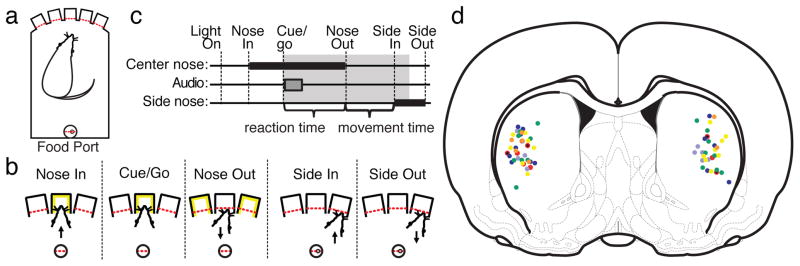
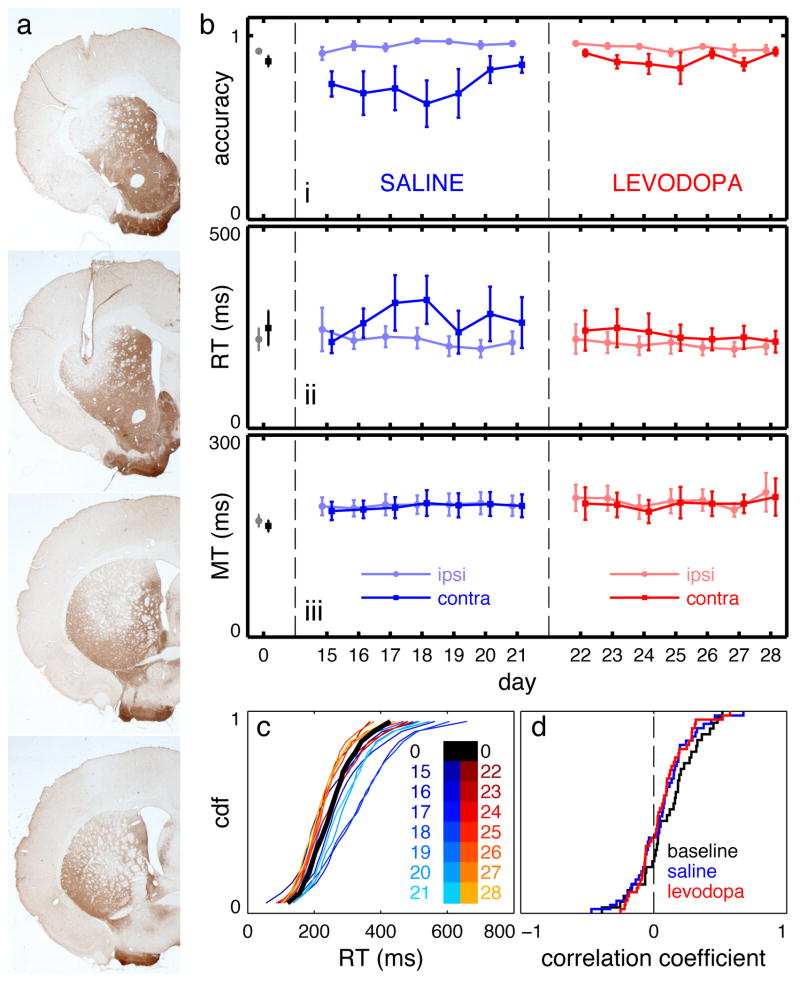
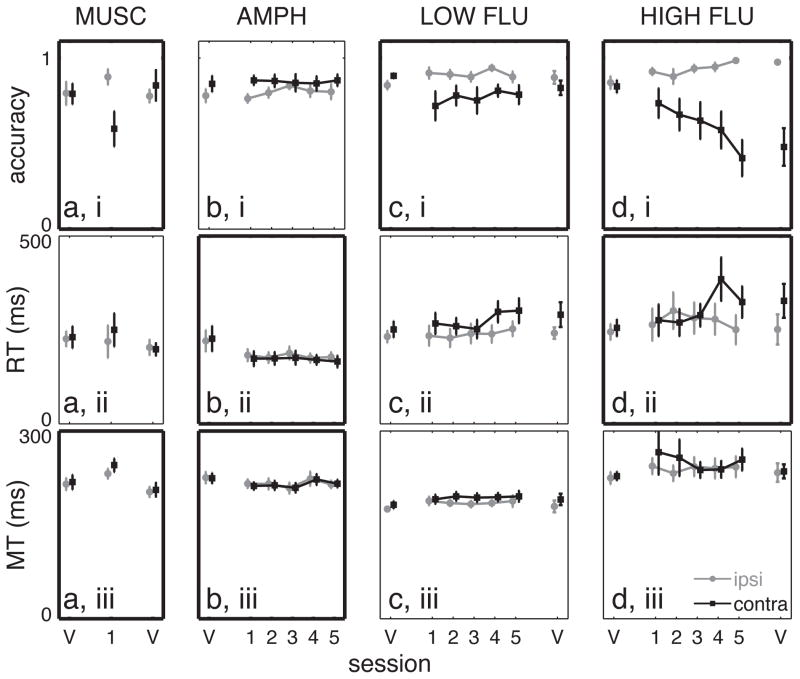
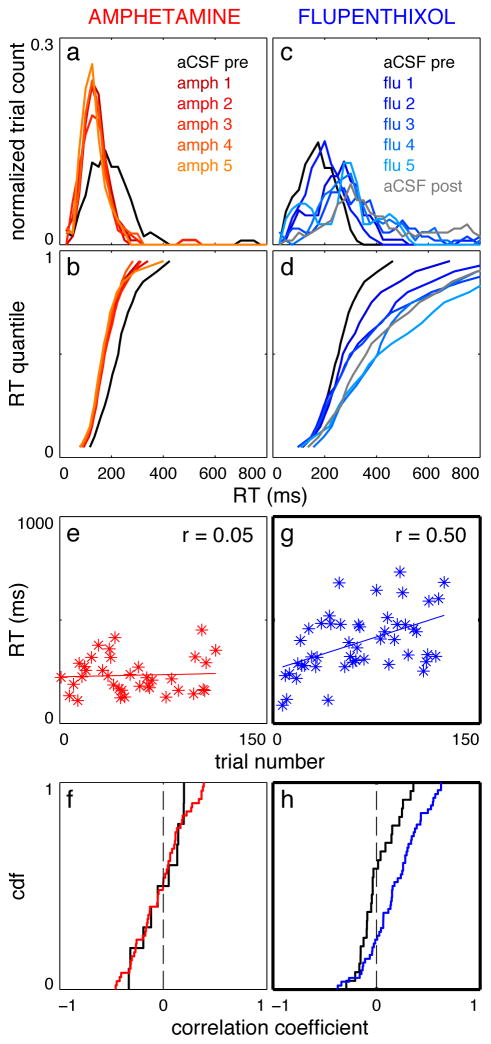
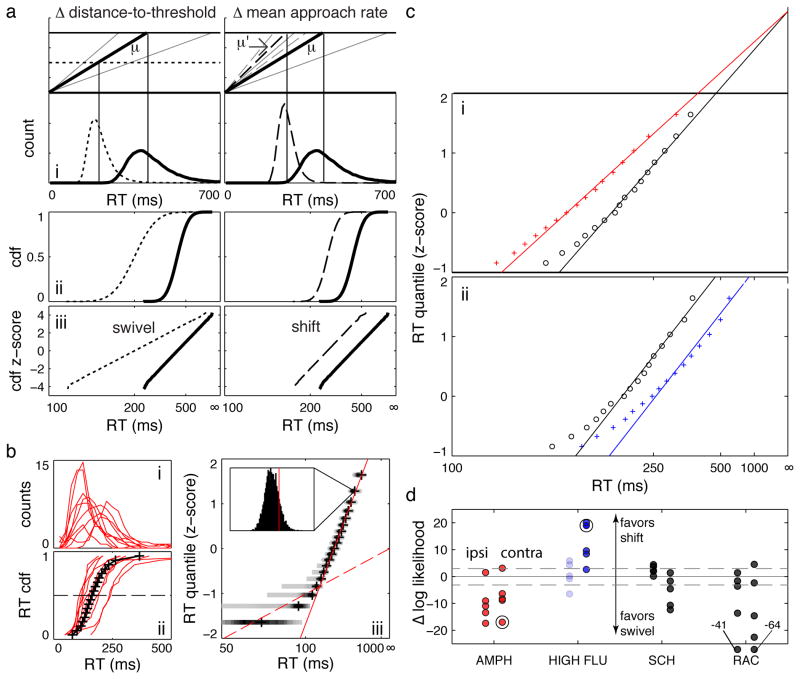
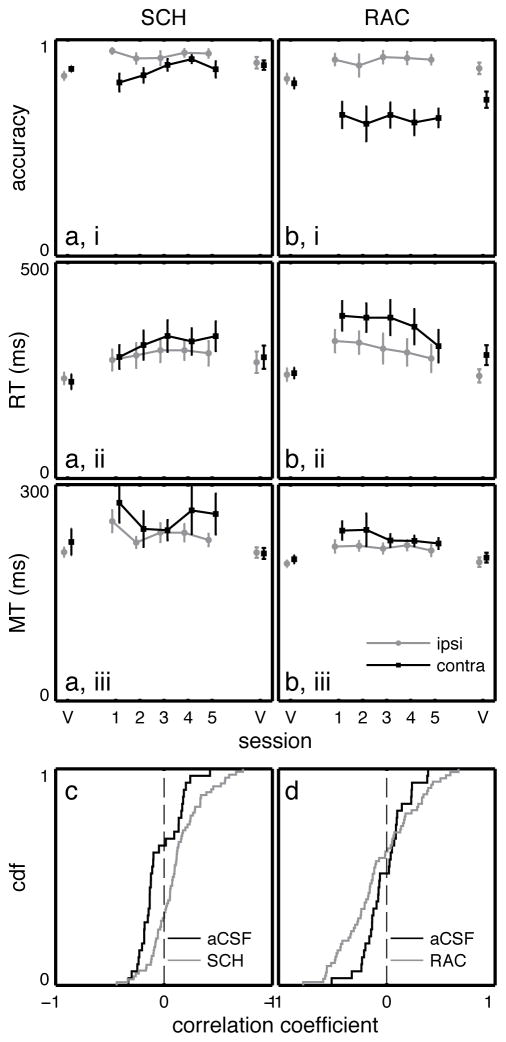
Striatal dopamine is an important modulator of current behavior, as seen in the rapid and dramatic effects of dopamine replacement therapy in Parkinson Disease (PD). Yet there is also extensive evidence that dopamine acts as a learning signal, modulating synaptic plasticity within striatum to affect future behavior. Disentangling these "performance" and "learning" functions is important for designing effective, long-term PD treatments. We conducted a series of unilateral drug manipulations and dopamine terminal lesions in the dorsolateral striatum of rats highly-trained to perform brief instructed head/neck movements (two-alternative forced choice task). Reaction times and accuracy were measured longitudinally to determine if task behavior changed immediately, progressed over time, and/or persisted after drug withdrawal. Enhanced dopamine signaling with amphetamine caused an immediate, nonprogressive, and bilateral decrease in reaction times (RT). The altered RT distributions were consistent with reduced distance to threshold in the linear approach to threshold with ergodic rate (LATER) model of decision-making. Conversely, the dopamine antagonist flupenthixol caused experience-dependent, persistent changes in RT and accuracy indicative of a "learning" effect. These RT distributions were consistent with a slowed rate of approach to decision threshold. Our results show that dopaminergic signaling makes dissociable contributions to current and future behavior even within a single striatal subregion, and provide important clues for both models of normal decision-making and the design of novel drug therapies in PD.
纹状体多巴胺是当前行为的重要调节因子,这在帕金森病(PD)中多巴胺替代疗法的快速显著效果中可见一斑。然而,也有大量证据表明多巴胺作为一种学习信号,调节纹状体内的突触可塑性以影响未来行为。区分这些“表现”和“学习”功能对于设计有效的长期PD治疗方法至关重要。我们在经过高度训练以执行简短指令性头部/颈部运动(双选强制选择任务)的大鼠背外侧纹状体中进行了一系列单侧药物操作和多巴胺终末损伤。纵向测量反应时间和准确性,以确定任务行为是否立即改变、随时间推移是否进展以及/或者在停药后是否持续。用苯丙胺增强多巴胺信号导致反应时间(RT)立即、非渐进性且双侧性减少。改变后的RT分布与决策的线性趋近阈值与遍历率(LATER)模型中到阈值距离的减少一致。相反,多巴胺拮抗剂氟哌噻吨导致RT和准确性出现依赖经验的持续性变化,表明存在“学习”效应。这些RT分布与决策阈值趋近速度减慢一致。我们的结果表明,即使在单个纹状体亚区域内,多巴胺能信号对当前和未来行为也有可分离的贡献,并为正常决策模型和PD新型药物疗法的设计提供了重要线索。