Jeong Tae-Dong, Lee Woochang, Choi Sung-Eun, Kim Jae Seung, Kim Hong-Kyu, Bae Sung Jin, Chun Sail, Min Won-Ki
Department of Laboratory Medicine, University of Ulsan College of Medicine and Asan Medical Center, 88 Olympic-ro 43-gil, Songpa-gu, Seoul 138-736, Republic of Korea.
Department of Nuclear Medicine, University of Ulsan College of Medicine and Asan Medical Center, 88 Olympic-ro 43-gil, Songpa-gu, Seoul 138-736, Republic of Korea.
Biomed Res Int. 2014;2014:398397. doi: 10.1155/2014/398397. Epub 2014 May 15.
The presence of common risk factors suggests that there is a relationship between osteoporosis and cardiovascular disease, possibly via dyslipidemia and inflammation. We investigated the relationships among the lipid profile, the inflammation marker high-sensitivity C-reactive protein (hsCRP), bone turnover markers, and bone mineral density (BMD) to assess the correlation between osteoporosis and cardiovascular disease and identify factors predicting osteoporosis.
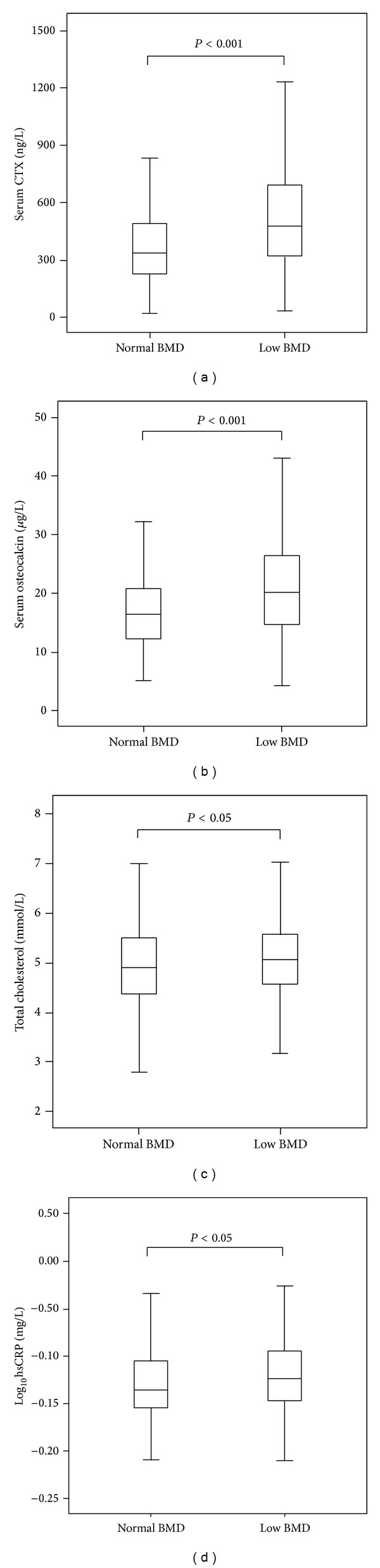
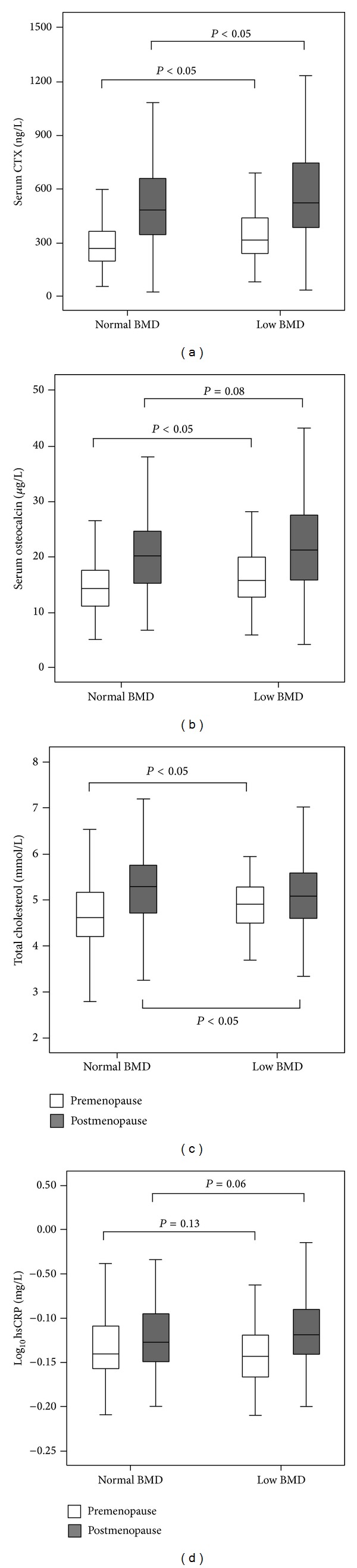
The study included 759 Korean women older than 20 years of age. The BMD, serum lipid profile, and levels of hsCRP, cross-linked C-terminal peptide (CTX), and osteocalcin were measured. We compared the serum biomarkers between groups with normal and low BMD and assessed the correlations between the levels of bone turnover markers and the lipid profile and hsCRP level.
The concentrations of CTX, osteocalcin, and total cholesterol were significantly higher in the low BMD group than in the normal BMD group in premenopausal women group. However, hsCRP was not correlated with these parameters. Multivariate logistic regression analysis revealed that TC (OR, 1.647; 95% CI, 1.190-2.279) and osteocalcin (OR, 1.044; 95% CI, 1.002-1.088) had an increased risk of low BMD in premenopausal women.
These results indicate that total cholesterol concentration is correlated with the levels of bone turnover markers, suggesting that it might predict osteoporosis in premenopausal women.
常见风险因素的存在表明骨质疏松症与心血管疾病之间可能存在关联,可能是通过血脂异常和炎症。我们研究了血脂谱、炎症标志物高敏C反应蛋白(hsCRP)、骨转换标志物和骨密度(BMD)之间的关系,以评估骨质疏松症与心血管疾病之间的相关性,并确定预测骨质疏松症的因素。
该研究纳入了759名年龄超过20岁的韩国女性。测量了骨密度、血清血脂谱以及hsCRP、交联C末端肽(CTX)和骨钙素的水平。我们比较了骨密度正常和较低的两组之间的血清生物标志物,并评估了骨转换标志物水平与血脂谱和hsCRP水平之间的相关性。
在绝经前女性组中,低骨密度组的CTX、骨钙素和总胆固醇浓度显著高于正常骨密度组。然而,hsCRP与这些参数无关。多因素逻辑回归分析显示,总胆固醇(OR,1.647;95%CI,1.190-2.279)和骨钙素(OR,1.044;95%CI,1.002-1.088)使绝经前女性发生低骨密度的风险增加。
这些结果表明总胆固醇浓度与骨转换标志物水平相关,提示其可能预测绝经前女性的骨质疏松症。