Crescenzo Raffaella, Bianco Francesca, Mazzoli Arianna, Giacco Antonia, Liverini Giovanna, Iossa Susanna
Department of Biology, Complesso Universitario di Monte Sant'Angelo, Edificio 7, Via Cinthia, I-80126 Napoli, Italy.
BMC Geriatr. 2014 Jun 21;14:79. doi: 10.1186/1471-2318-14-79.
We considered of interest to evaluate how aging affects mitochondrial function in skeletal muscle.
We measured mitochondrial oxidative capacity and proton leak, together with lipid oxidative damage, superoxide dismutase specific activity and uncoupling protein 3 content, in subsarcolemmal and intermyofibrillar mitochondria from adult (six months) and old (two years) rats. Body composition, resting metabolic rate and plasma non esterified fatty acid levels were also assessed.
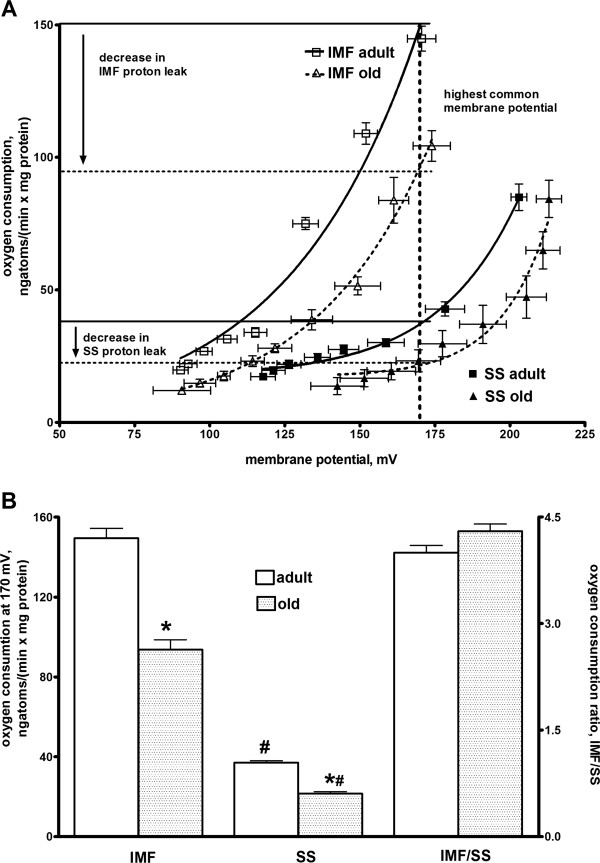
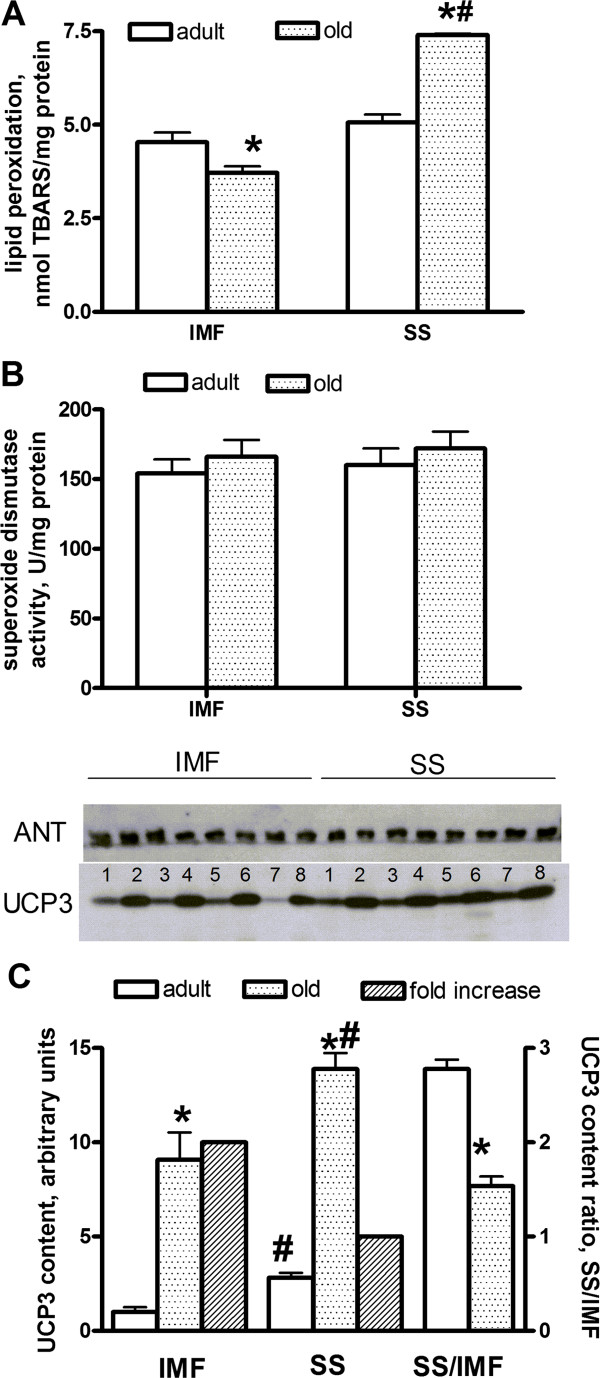
Old rats displayed significantly higher body energy and lipids, while body proteins were significantly lower, compared to adult rats. In addition, plasma non esterified fatty acid levels were significantly higher, while resting metabolic rates were found to be significantly lower, in old rats compared to adult ones. Significantly lower oxidative capacities in whole tissue homogenates and in intermyofibrillar and subsarcolemmal mitochondria were found in old rats compared to adult ones. Subsarcolemmal and intermyofibrillar mitochondria from old rats exhibited a significantly lower proton leak rate, while oxidative damage was found to be significantly higher only in subsarcolemmal mitochondria. Mitochondrial superoxide dismutase specific activity was not significantly affected in old rats, while significantly higher content of uncoupling protein 3 was found in both mitochondrial populations from old rats compared to adult ones, although the magnitude of the increase was lower in subsarcolemmal than in intermyofibrillar mitochondria.
The decrease in oxidative capacity and proton leak in intermyofibrillar and subsarcolemmal mitochondria could induce a decline in energy expenditure and thus contribute to the reduced resting metabolic rate found in old rats, while oxidative damage is present only in subsarcolemmal mitochondria.
我们认为评估衰老如何影响骨骼肌中的线粒体功能很有意义。
我们测量了成年(6个月)和老年(2年)大鼠肌膜下和肌原纤维间线粒体的线粒体氧化能力和质子泄漏,以及脂质氧化损伤、超氧化物歧化酶比活性和解偶联蛋白3含量。还评估了身体组成、静息代谢率和血浆非酯化脂肪酸水平。
与成年大鼠相比,老年大鼠的身体能量和脂质显著更高,而身体蛋白质显著更低。此外,与成年大鼠相比,老年大鼠的血浆非酯化脂肪酸水平显著更高,而静息代谢率显著更低。与成年大鼠相比,老年大鼠全组织匀浆以及肌原纤维间和肌膜下线粒体的氧化能力显著更低。老年大鼠的肌膜下和肌原纤维间线粒体表现出显著更低的质子泄漏率,而氧化损伤仅在肌膜下线粒体中显著更高。老年大鼠的线粒体超氧化物歧化酶比活性没有受到显著影响,而与成年大鼠相比,老年大鼠的两个线粒体群体中解偶联蛋白3的含量均显著更高,尽管肌膜下线粒体中增加的幅度低于肌原纤维间线粒体。
肌原纤维间和肌膜下线粒体氧化能力和质子泄漏的降低可能导致能量消耗下降,从而导致老年大鼠静息代谢率降低,而氧化损伤仅存在于肌膜下线粒体中。