Germeyer Ariane, Savaris Ricardo F, Jauckus Julia, Lessey Bruce
Department of Gynecological Endocrinology and Reproductive Medicine, University Hospital Heidelberg, Heidelberg, Germany.
Reprod Biol Endocrinol. 2014 Jun 20;12:53. doi: 10.1186/1477-7827-12-53.
The pathophysiology of recurrent pregnancy loss (RPL) is still unknown in 50% of the cases. Herein we measure the expression of beta3 integrin subunit, a well-known implantation marker, in women with or without RPL and correlate it with the histological dating of the endometrial tissue.
LH-timed endometrial biopsies were obtained from cases (RPL; n = 21, age 33.9+/-4.7) and healthy controls (n = 29; age 29.8+/-4.1) during the mid-secretory phase (post ovulatory day: 8 to 10). Endometrial samples were timed histologically according to Noyes' criteria and underwent immunohistochemical staining for beta3 integrin expression. For statistical analysis the semi-quantitative HSCORE was assessed. Type I (beta3 negative in an out-of-phase endometrium) and Type II defect (beta3 negative in an in-phase endometrium) were also analysed. Statistical analysis was done with Student t-test, Mann Whitney U test, ANCOVA and chi square for trend. Significance was set as P < 0.05.
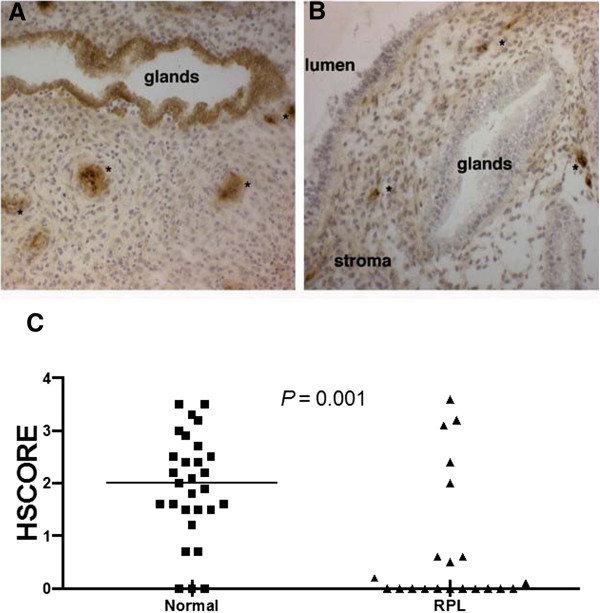
The mean (SD) age in controls was lower compared to cases [(29.8 (4.1) vs. 33.9 (4.7) - P = 0.001; Student t-test)]. The median (range) expression of beta3 integrin in controls and cases was 1.94 (0 to 3.5) vs. 0.82 (0 to 3.6), respectively (P = 0.001; Mann Whitney U test). Significance was still significant after adjusting for age (P = 0.03;ANCOVA). The normal positive staining > =0.7 of beta3 integrin subunit and in-phase endometrium was seen in 24 out of 29 (82.8%) controls, but in only 6 out of 21 (28.6%) of cases with RPL; Type I and II defects were seen in 10.3 and 6.9% of controls, while present in 52.4 and 19.1% of cases, respectively (P = 0.0005; chi-square).
Women with unexplained RPL had significantly reduced integrin expression compared to controls. Our findings underline the need for further molecular analysis of endometrial tissue in affected women.
复发性流产(RPL)的病理生理学在50%的病例中仍不清楚。在此,我们检测了β3整合素亚基(一种著名的着床标志物)在有或无复发性流产的女性中的表达,并将其与子宫内膜组织的组织学分期相关联。
在分泌中期(排卵后第8至10天)从病例组(复发性流产;n = 21,年龄33.9±4.7)和健康对照组(n = 29;年龄29.8±4.1)获取促黄体生成素(LH)定时的子宫内膜活检组织。根据诺伊斯标准对子宫内膜样本进行组织学定时,并进行β3整合素表达的免疫组织化学染色。为进行统计分析,评估半定量HSCORE。还分析了I型(分泌期不同步的子宫内膜中β3阴性)和II型缺陷(分泌期同步的子宫内膜中β3阴性)。采用学生t检验、曼-惠特尼U检验、协方差分析和趋势卡方检验进行统计分析。显著性设定为P < 0.05。
与病例组相比,对照组的平均(标准差)年龄较低[(29.8(4.1)对33.9(4.7)-P = 0.001;学生t检验)]。对照组和病例组中β3整合素的中位数(范围)表达分别为1.94(0至3.5)和0.82(0至3.6)(P = 0.001;曼-惠特尼U检验)。在调整年龄后,显著性仍然显著(P = 0.03;协方差分析)。29名对照组中有24名(82.8%)β3整合素亚基和分泌期同步的子宫内膜正常阳性染色≥0.7,但21名复发性流产病例中只有6名(28.6%);I型和II型缺陷在对照组中分别见于10.3%和6.9%,而在病例组中分别为52.4%和19.1%(P = 0.0005;卡方检验)。
与对照组相比,不明原因复发性流产的女性整合素表达显著降低。我们的研究结果强调了对受影响女性的子宫内膜组织进行进一步分子分析的必要性。