Kurihara Toshiyuki, Yamauchi Junichiro, Otsuka Mitsuo, Tottori Nobuaki, Hashimoto Takeshi, Isaka Tadao
Department of Sport and Health Science, Ritsumeikan University, 1-1-1 Noji Higashi, Kusatsu, Shiga 525-8577, Japan.
Future Institute for Sport Sciences, Tokyo, Japan.
J Foot Ankle Res. 2014 May 5;7:26. doi: 10.1186/1757-1146-7-26. eCollection 2014.
The aims of this study were to investigate the relationships between the maximum isometric toe flexor muscle strength (TFS) and cross-sectional area (CSA) of the plantar intrinsic and extrinsic muscles and to identify the major determinant of maximum TFS among CSA of the plantar intrinsic and extrinsic muscles.
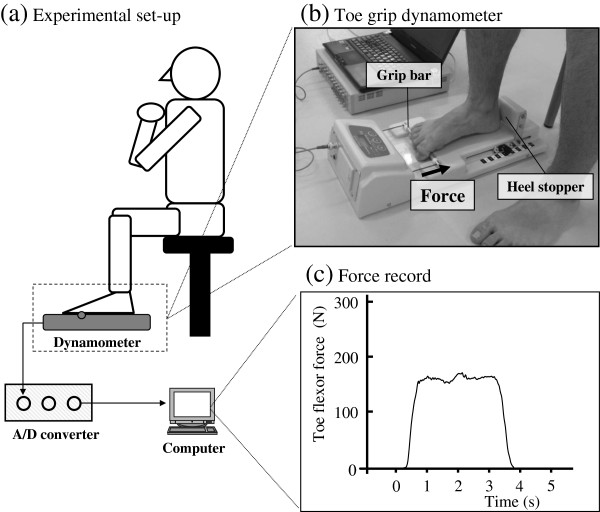
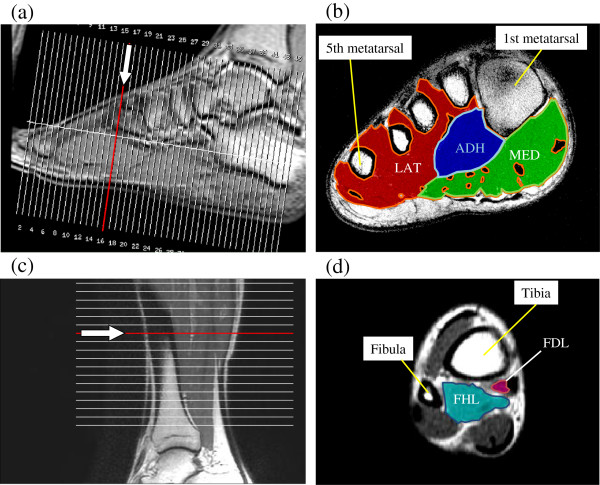
Twenty six young healthy participants (14 men, 12 women; age, 20.4 ± 1.6 years) volunteered for the study. TFS was measured by a specific designed dynamometer, and CSA of plantar intrinsic and extrinsic muscles were measured using magnetic resonance imaging (MRI). To measure TFS, seated participants optimally gripped the bar with their toes and exerted maximum force on the dynamometer. For each participant, the highest force produced among three trials was used for further analysis. To measure CSA, serial T1-weighted images were acquired.
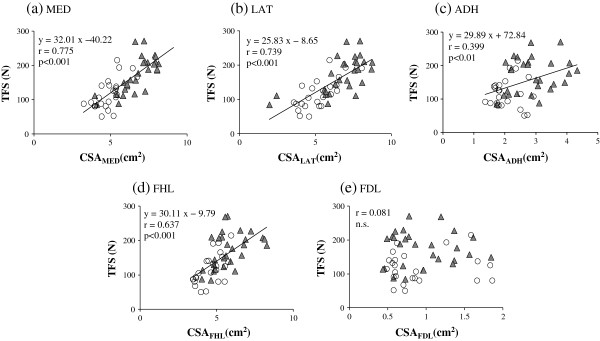
TFS was significantly correlated with CSA of the plantar intrinsic and extrinsic muscles. Stepwise multiple linear regression analyses identified that the major determinant of TFS was CSA of medial parts of plantar intrinsic muscles (flexor hallucis brevis, flexor digitorum brevis, quadratus plantae, lumbricals and abductor hallucis). There was no significant difference between men and women in TFS/CSA.
CSA of the plantar intrinsic and extrinsic muscles is one of important factors for determining the maximum TFS in humans.
本研究旨在探讨跖部固有肌和外在肌的最大等长趾屈肌力量(TFS)与横截面积(CSA)之间的关系,并确定在跖部固有肌和外在肌的CSA中,最大TFS的主要决定因素。
26名年轻健康参与者(14名男性,12名女性;年龄,20.4±1.6岁)自愿参与本研究。TFS通过专门设计的测力计进行测量,跖部固有肌和外在肌的CSA使用磁共振成像(MRI)进行测量。为测量TFS,参与者坐在椅子上,用脚趾最佳地握住横杆,并在测力计上施加最大力。对于每位参与者,三次试验中产生的最高力用于进一步分析。为测量CSA,采集连续的T1加权图像。
TFS与跖部固有肌和外在肌的CSA显著相关。逐步多元线性回归分析确定,TFS的主要决定因素是跖部固有肌内侧部分(拇短屈肌、趾短屈肌、跖方肌、蚓状肌和拇展肌)的CSA。TFS/CSA在男性和女性之间无显著差异。
跖部固有肌和外在肌的CSA是决定人类最大TFS的重要因素之一。