Lu Jing, Peng Jianlong, Wang Jinan, Shen Qiancheng, Bi Yi, Gong Likun, Zheng Mingyue, Luo Xiaomin, Zhu Weiliang, Jiang Hualiang, Chen Kaixian
Department of Medicinal Chemistry, School of Pharmacy, Yantai University, Yantai, Shandong 264005, China ; Drug Discovery and Design Center, State Key Laboratory of Drug Research, Shanghai Institute of Materia Medica, Chinese Academy of Sciences, 555 Zuchongzhi Road, Shanghai 201203, China.
Drug Discovery and Design Center, State Key Laboratory of Drug Research, Shanghai Institute of Materia Medica, Chinese Academy of Sciences, 555 Zuchongzhi Road, Shanghai 201203, China.
J Cheminform. 2014 May 16;6:26. doi: 10.1186/1758-2946-6-26. eCollection 2014.
Acute toxicity means the ability of a substance to cause adverse effects within a short period following dosing or exposure, which is usually the first step in the toxicological investigations of unknown substances. The median lethal dose, LD50, is frequently used as a general indicator of a substance's acute toxicity, and there is a high demand on developing non-animal-based prediction of LD50. Unfortunately, it is difficult to accurately predict compound LD50 using a single QSAR model, because the acute toxicity may involve complex mechanisms and multiple biochemical processes.
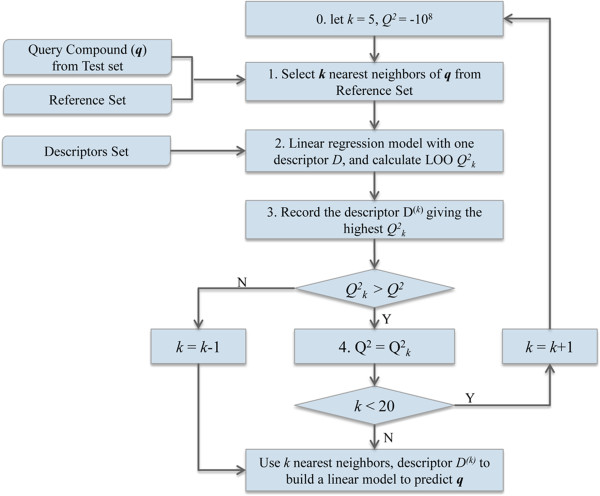
In this study, we reported the use of local lazy learning (LLL) methods, which could capture subtle local structure-toxicity relationships around each query compound, to develop LD50 prediction models: (a) local lazy regression (LLR): a linear regression model built using k neighbors; (b) SA: the arithmetical mean of the activities of k nearest neighbors; (c) SR: the weighted mean of the activities of k nearest neighbors; (d) GP: the projection point of the compound on the line defined by its two nearest neighbors. We defined the applicability domain (AD) to decide to what an extent and under what circumstances the prediction is reliable. In the end, we developed a consensus model based on the predicted values of individual LLL models, yielding correlation coefficients R(2) of 0.712 on a test set containing 2,896 compounds.
Encouraged by the promising results, we expect that our consensus LLL model of LD50 would become a useful tool for predicting acute toxicity. All models developed in this study are available via http://www.dddc.ac.cn/admetus.
急性毒性是指物质在给药或接触后的短时间内引起不良反应的能力,这通常是未知物质毒理学研究的第一步。半数致死剂量(LD50)常被用作物质急性毒性的一般指标,并且对开发基于非动物的LD50预测方法有很高的需求。不幸的是,使用单一的定量构效关系(QSAR)模型难以准确预测化合物的LD50,因为急性毒性可能涉及复杂的机制和多个生化过程。
在本研究中,我们报告了使用局部懒惰学习(LLL)方法来开发LD50预测模型,该方法可以捕捉每个查询化合物周围微妙的局部结构-毒性关系:(a)局部懒惰回归(LLR):使用k个邻居构建的线性回归模型;(b)SA:k个最近邻活性的算术平均值;(c)SR:k个最近邻活性的加权平均值;(d)GP:化合物在由其两个最近邻定义的直线上的投影点。我们定义了适用域(AD)来确定预测在何种程度和何种情况下是可靠的。最后,我们基于各个LLL模型的预测值开发了一个共识模型,在包含2896种化合物的测试集上得到的相关系数R(2)为0.712。
受这些有前景的结果鼓舞,我们期望我们的LD50共识LLL模型将成为预测急性毒性的有用工具。本研究中开发的所有模型均可通过http://www.dddc.ac.cn/admetus获得。