Bai Yeon, Wunderlich Shahla M, Kashdan Rickie
Department of Health and Nutrition Sciences, Montclair State University, 1 Normal Avenue, Montclair, NJ 07043, USA.
Jersey Shore University Medical Center, Family Health Center-Prenatal, 71 Davis Avenue, Neptune, NJ 07753, USA.
ISRN Nutr. 2013 Jun 27;2013:560810. doi: 10.5402/2013/560810. eCollection 2013.
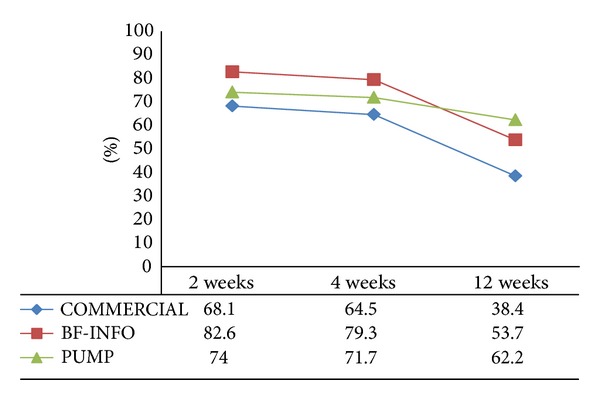
The type of gift bags given to new mothers at the time of discharge from the hospital can influence their confidence in breastfeeding. Most hospitals in the US continue to distribute commercial gift bags containing formula samples despite the reported negative influence of commercial bags on the duration of breastfeeding. This study compared breastfeeding outcomes in women receiving three different kinds of gift bags at discharge. A prospective intervention study was conducted during 2009-2010 in New Jersey. Three breastfeeding cohorts were recruited and assigned to three groups: COMMERCIAL received discharge bags containing formula samples, BF-INFO received breastfeeding information and supplies, and PUMP received breastfeeding information/supplies plus a manual breast pump. Follow-up contacts were at 2, 4, and 12 postpartum weeks to determine breastfeeding outcome. The mean durations of exclusive (EBF) and partial breastfeeding were compared between groups using ANOVA. A total of 386 participants completed the study. The mean EBF duration (weeks) in the PUMP (n = 138, 8.28 ± 4.86) and BF-INFO (n = 121, 7.87 ± 4.63) were significantly longer (P < 0.01) than COMMERCIAL (n = 127, 6.12 ± 4.49). The rate of EBF through 12 weeks in PUMP was most consistent. The mean duration of partial breastfeeding showed similar results: significantly longer in PUMP and BF-INFO than COMMERCIAL (P < 0.01).
产妇出院时所获礼品袋的类型会影响她们母乳喂养的信心。尽管有报道称商业礼品袋对母乳喂养时长有负面影响,但美国大多数医院仍继续发放装有配方奶粉样品的商业礼品袋。本研究比较了出院时接受三种不同类型礼品袋的女性的母乳喂养结果。2009年至2010年在新泽西州进行了一项前瞻性干预研究。招募了三个母乳喂养队列并将其分为三组:商业组收到装有配方奶粉样品的出院袋,母乳喂养信息组收到母乳喂养信息和用品,吸奶器组收到母乳喂养信息/用品外加一个手动吸奶器。产后第2、4和12周进行随访以确定母乳喂养结果。使用方差分析比较各组之间纯母乳喂养(EBF)和部分母乳喂养的平均时长。共有386名参与者完成了研究。吸奶器组(n = 138,8.28 ± 4.86)和母乳喂养信息组(n = 121,7.87 ± 4.63)的平均纯母乳喂养时长(周)显著长于商业组(n = 127,6.12 ± 4.49)(P < 0.01)。吸奶器组在12周时的纯母乳喂养率最为稳定。部分母乳喂养的平均时长也显示出类似结果:吸奶器组和母乳喂养信息组显著长于商业组(P < 0.01)。