Bulir David C, Waltho Daniel A, Stone Christopher B, Mwawasi Kenneth A, Nelson Jordan C, Mahony James B
M. G. DeGroote Institute for Infectious Disease Research, Faculty of Health Sciences and Department of Pathology and Molecular Medicine, McMaster University, and Father Sean O'Sullivan Research Centre, St. Joseph's Healthcare, Hamilton, Ontario, Canada.
PLoS One. 2014 Jun 24;9(6):e99315. doi: 10.1371/journal.pone.0099315. eCollection 2014.
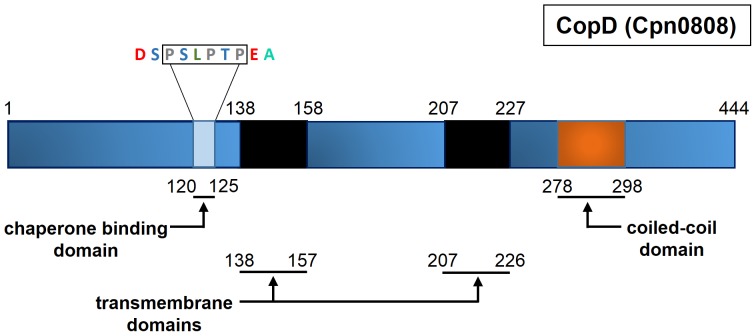
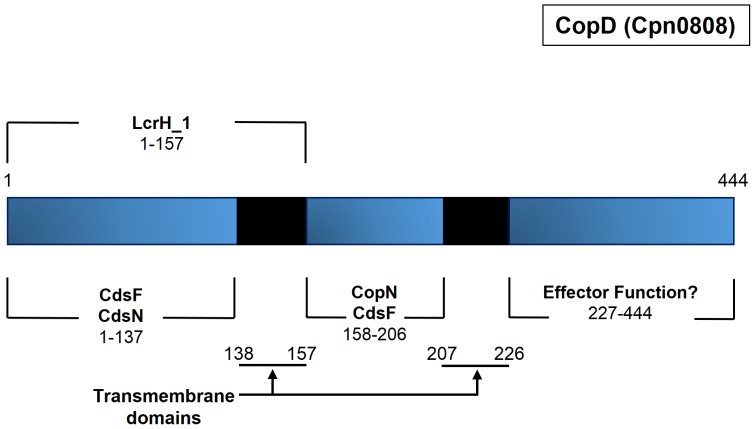
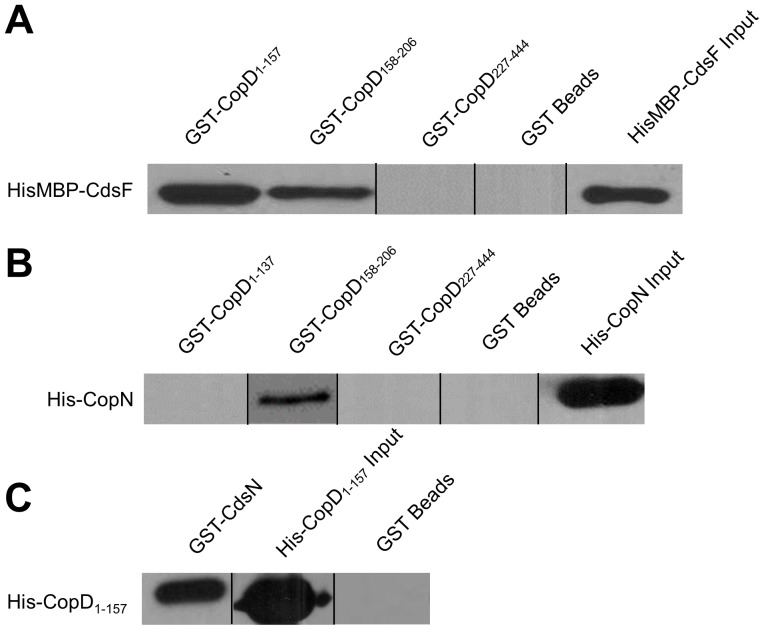
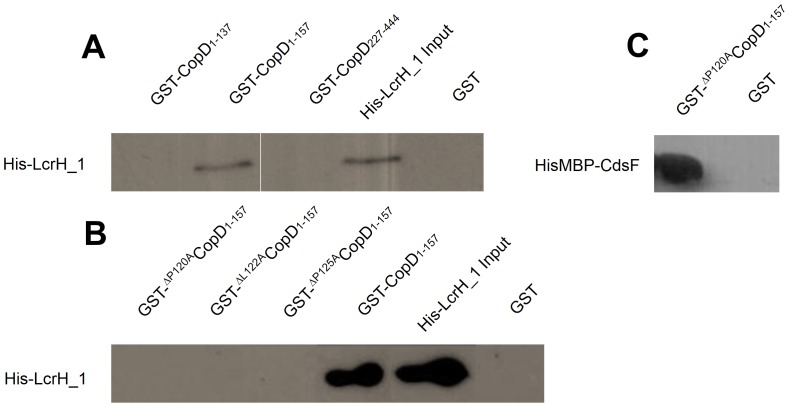
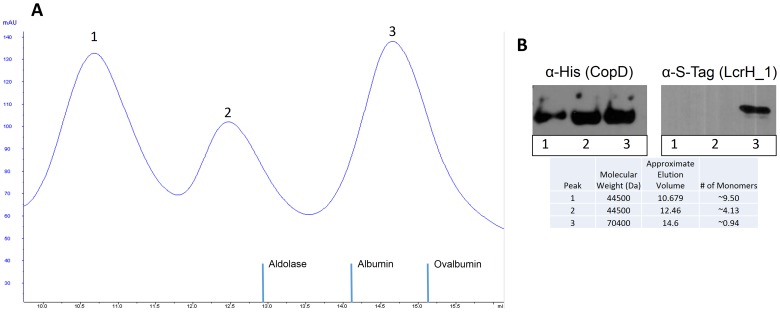
Pathogenic Gram-negative bacteria use type III secretion (T3S) to inject effector proteins into the host cell to create appropriate conditions for infection and intracellular replication. Chlamydia spp. are believed to use T3S to infect their host cell, and the translocator proteins are an essential component of this system. Chlamydia pneumoniae contains genes encoding two sets of translocator proteins; CopB and CopD, and CopB2 and CopD2. In this study, we identified novel interactions between CopD and three type III secretion proteins; namely, CopN, CdsN, and CdsF. We identified a CopD putative chaperone binding motif, PxLxxP, within the N-terminal region (CopD amino acids 120-125), which was necessary for interaction with its putative chaperone LcrH_1. Using size exclusion chromatography, we showed that CopD and LcrH_1 formed higher order structures in solution with CopD and LcrH_1 binding in a ratio of 1∶1, which is unique for T3SS translocator proteins. Lastly, we showed that antibodies to CopD reduced C. pneumoniae infectivity by >95%. Collectively, this data suggests that CopD plays a critical role in pathogenesis and likely functions as a hydrophobic translocator of the type III secretion system in Chlamydia pneumoniae.
致病性革兰氏阴性菌利用Ⅲ型分泌系统(T3S)将效应蛋白注入宿主细胞,为感染和细胞内复制创造适宜条件。沙眼衣原体被认为利用T3S感染其宿主细胞,而转运蛋白是该系统的重要组成部分。肺炎衣原体含有编码两组转运蛋白的基因;CopB和CopD,以及CopB2和CopD2。在本研究中,我们鉴定了CopD与三种Ⅲ型分泌蛋白之间的新相互作用;即CopN、CdsN和CdsF。我们在N端区域(CopD氨基酸120 - 125)鉴定出一个CopD假定的伴侣结合基序PxLxxP,这是其与假定伴侣LcrH_1相互作用所必需的。使用尺寸排阻色谱法,我们表明CopD和LcrH_1在溶液中形成了更高阶的结构,CopD和LcrH_1以1∶1的比例结合,这对于Ⅲ型分泌系统转运蛋白来说是独特的。最后,我们表明针对CopD的抗体可使肺炎衣原体的感染性降低>95%。总体而言,这些数据表明CopD在发病机制中起关键作用,并且可能作为肺炎衣原体Ⅲ型分泌系统的疏水转运蛋白发挥作用。