Schibbye Peter, Ghaderi Ata, Ljótsson Brjánn, Hedman Erik, Lindefors Nils, Rück Christian, Kaldo Viktor
Department of Clinical Neuroscience, Division of Psychiatry, Karolinska Institutet, Stockholm, Sweden; Section of Psychiatry, Sundsvall Härnösand County Hospital, Västernorrland County Council, Sweden.
Department of Clinical Neuroscience, Division of Psychology, Karolinska Institutet, Stockholm, Sweden.
PLoS One. 2014 Jun 24;9(6):e100614. doi: 10.1371/journal.pone.0100614. eCollection 2014.
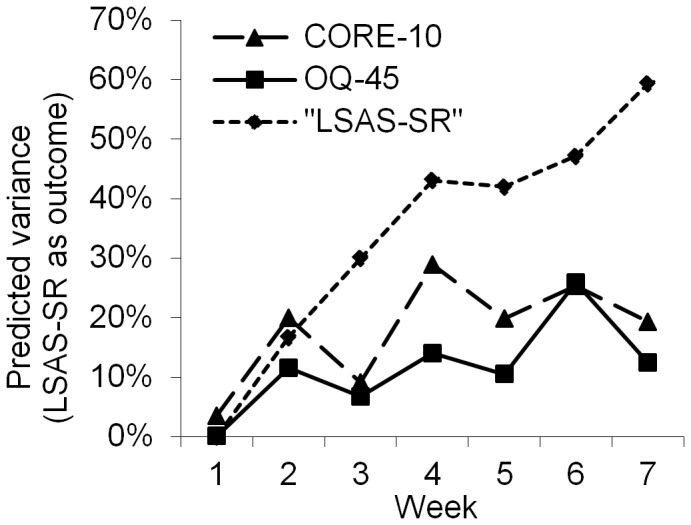
Early change can predict outcome of psychological treatment, especially in cognitive behavior therapy. However, the optimal operationalization of "early change" for maximizing its predictive ability, and differences in predictive ability of disorder-specific versus general mental health measures has yet to be clarified. This study aimed to investigate how well early change predicted outcome depending on the week it was measured, the calculation method (regression slope or simple subtraction), the type of measures used, and the target disorder. During 10-15 weeks of internet-based cognitive behavior therapy for depression, social anxiety disorder, or panic disorder, weekly ratings were collected through both disorder-specific measures and general measures (Outcome Questionnaire-45 (OQ-45) and Clinical Outcomes in Routine Evaluation-10 (CORE-10)). With outcome defined as the disorder-specific measure, change at week four was the optimal predictor. Slope and subtraction methods performed equally well. The OQ-45 explained 18% of outcome for depression, 14% for social anxiety disorder, and 0% for panic disorder. Corresponding values for CORE-10 were 23%, 29%, and 25%. Specific measures explained 41%, 43%, and 34% respectively: this exceeded the ability of general measures also when they predicted themselves. We conclude that a simple calculation method with a disorder-specific measure at week four seems to provide a good choice for predicting outcome in time-limited cognitive behavior therapy.
早期变化能够预测心理治疗的结果,尤其是在认知行为疗法中。然而,为了最大化其预测能力,“早期变化”的最佳操作化定义,以及特定障碍与一般心理健康测量指标在预测能力上的差异,仍有待阐明。本研究旨在探究早期变化如何根据测量的周数、计算方法(回归斜率或简单减法)、所使用测量指标的类型以及目标障碍来预测治疗结果。在针对抑郁症、社交焦虑症或恐慌症进行的为期10 - 15周的基于网络的认知行为治疗期间,通过特定障碍测量指标和一般测量指标(结果问卷 - 45(OQ - 45)和常规评估临床结果 - 10(CORE - 10))每周收集评分。将特定障碍测量指标定义为治疗结果时,第4周的变化是最佳预测指标。斜率法和减法在预测效果上表现相当。OQ - 45对抑郁症治疗结果的解释率为18%,对社交焦虑症为14%,对恐慌症为0%。CORE - 10的相应值分别为23%、29%和25%。特定测量指标分别解释了41%、43%和34%:即便一般测量指标用于预测自身时,特定测量指标的预测能力也超过了它们。我们得出结论,在第4周使用特定障碍测量指标的简单计算方法,似乎为预测限时认知行为治疗的结果提供了一个不错的选择。