Hentati Isacsson Nils, Ben Abdesslem Fehmi, Forsell Erik, Boman Magnus, Kaldo Viktor
Centre for Psychiatry Research, Department of Clinical Neuroscience, Karolinska Institutet, & Stockholm Health Care Services, Region Stockholm, Sweden.
Department of Computer Science, RISE Research Institutes of Sweden, Stockholm, Sweden.
Commun Med (Lond). 2024 Oct 10;4(1):196. doi: 10.1038/s43856-024-00626-4.
While psychological treatments are effective, a substantial portion of patients do not benefit enough. Early identification of those may allow for adaptive treatment strategies and improved outcomes. We aimed to evaluate the clinical usefulness of machine-learning (ML) models predicting outcomes in Internet-based Cognitive Behavioural Therapy, to compare ML-related methodological choices, and guide future use of these.
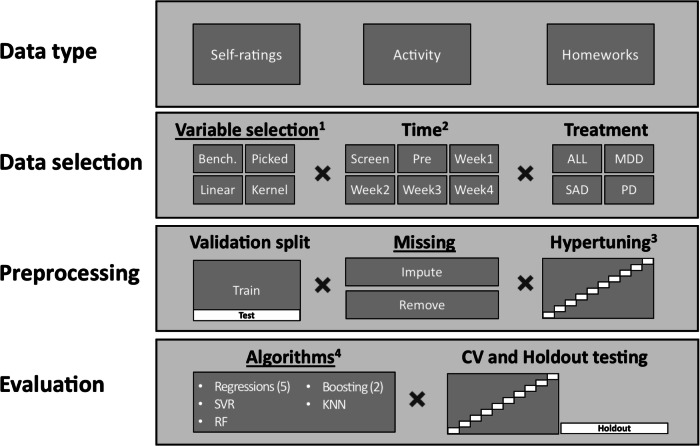
Eighty main models were compared. Baseline variables, weekly symptoms, and treatment activity were used to predict treatment outcomes in a dataset of 6695 patients from regular care.
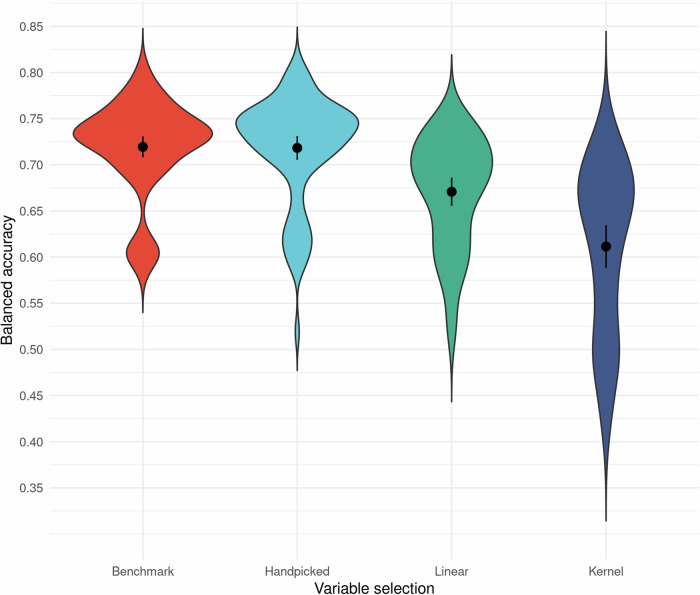
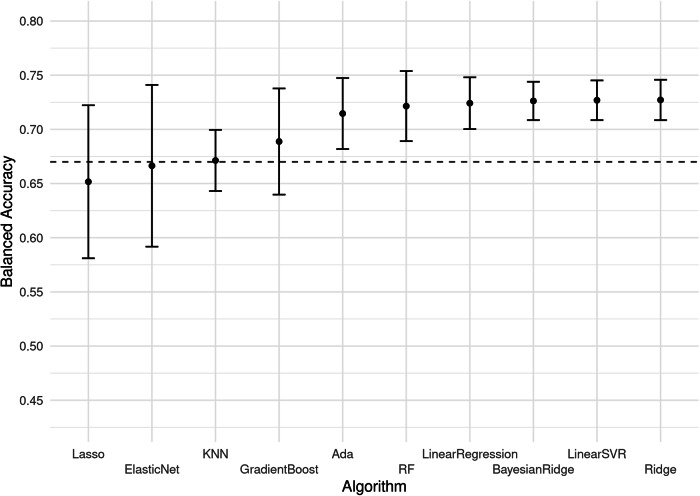
We show that the best models use handpicked predictors and impute missing data. No ML algorithm shows clear superiority. They have a mean balanced accuracy of 78.1% at treatment week four, closely matched by regression (77.8%).
ML surpasses the benchmark for clinical usefulness (67%). Advanced and simple models perform equally, indicating a need for more data or smarter methodological designs to confirm advantages of ML.
虽然心理治疗是有效的,但相当一部分患者获益不足。尽早识别这些患者可能有助于采取适应性治疗策略并改善治疗效果。我们旨在评估机器学习(ML)模型在基于互联网的认知行为疗法中预测治疗效果的临床实用性,比较与ML相关的方法选择,并为这些模型的未来应用提供指导。
比较了80个主要模型。在一个来自常规护理的6695例患者的数据集中,使用基线变量、每周症状和治疗活动来预测治疗效果。
我们发现最佳模型使用精选的预测因子并对缺失数据进行插补。没有一种ML算法显示出明显的优越性。在治疗第4周时,它们的平均平衡准确率为78.1%,与回归分析(77.8%)非常接近。
ML超过了临床实用性的基准(67%)。先进模型和简单模型表现相当,这表明需要更多数据或更智能的方法设计来证实ML的优势。