CNRS, UMR 8256, Laboratory of Neuronal Cell Biology and Pathology, Paris, France; Sorbonnes Universités, University Pierre and Marie Curie (UPMC) Univ Paris 06, Paris, France; INSERM, Unit 894, Paris, France; Assistance Publique-Hopitaux de Paris (AP-HP), Charles Foix Hospital, Functional Exploration Unit, Ivry-sur-Seine, France.
CNRS, UMR 8256, Laboratory of Neuronal Cell Biology and Pathology, Paris, France; Sorbonnes Universités, University Pierre and Marie Curie (UPMC) Univ Paris 06, Paris, France; INSERM, Unit 894, Paris, France.
PLoS Biol. 2014 Jun 24;12(6):e1001895. doi: 10.1371/journal.pbio.1001895. eCollection 2014 Jun.
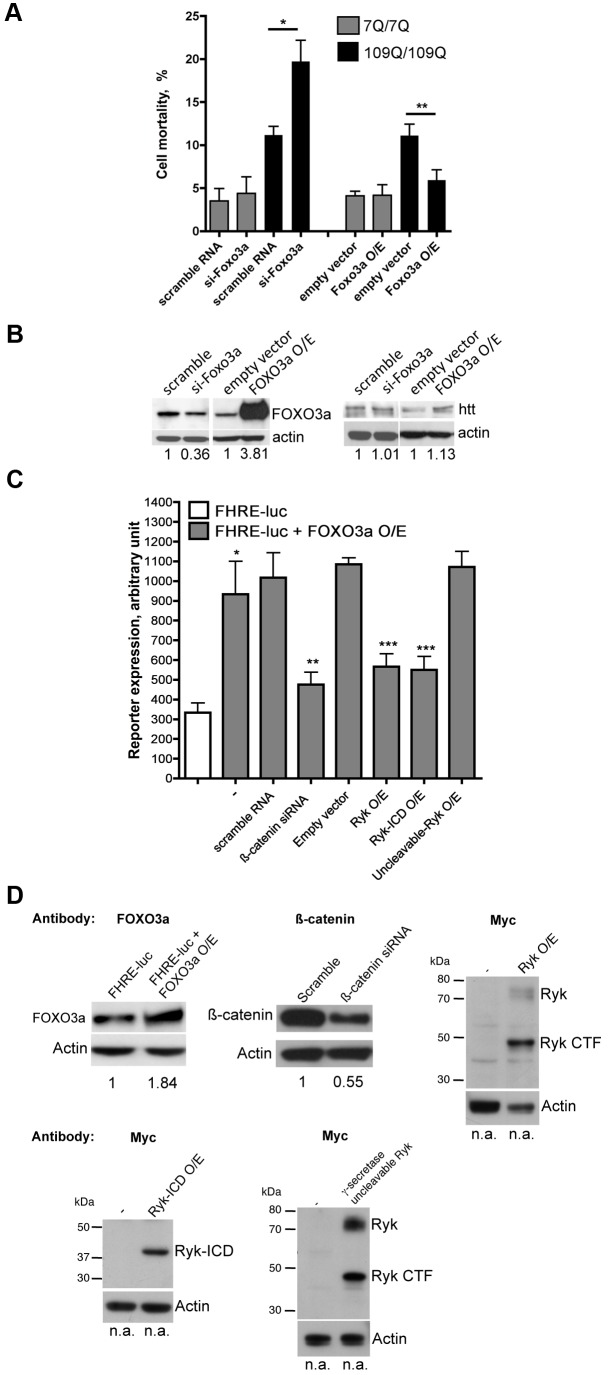
The Wnt receptor Ryk is an evolutionary-conserved protein important during neuronal differentiation through several mechanisms, including γ-secretase cleavage and nuclear translocation of its intracellular domain (Ryk-ICD). Although the Wnt pathway may be neuroprotective, the role of Ryk in neurodegenerative disease remains unknown. We found that Ryk is up-regulated in neurons expressing mutant huntingtin (HTT) in several models of Huntington's disease (HD). Further investigation in Caenorhabditis elegans and mouse striatal cell models of HD provided a model in which the early-stage increase of Ryk promotes neuronal dysfunction by repressing the neuroprotective activity of the longevity-promoting factor FOXO through a noncanonical mechanism that implicates the Ryk-ICD fragment and its binding to the FOXO co-factor β-catenin. The Ryk-ICD fragment suppressed neuroprotection by lin-18/Ryk loss-of-function in expanded-polyQ nematodes, repressed FOXO transcriptional activity, and abolished β-catenin protection of mutant htt striatal cells against cell death vulnerability. Additionally, Ryk-ICD was increased in the nucleus of mutant htt cells, and reducing γ-secretase PS1 levels compensated for the cytotoxicity of full-length Ryk in these cells. These findings reveal that the Ryk-ICD pathway may impair FOXO protective activity in mutant polyglutamine neurons, suggesting that neurons are unable to efficiently maintain function and resist disease from the earliest phases of the pathogenic process in HD.
Wnt 受体 Ryk 是一种进化上保守的蛋白质,在神经元分化过程中通过多种机制发挥重要作用,包括γ-分泌酶切割和其细胞内结构域(Ryk-ICD)的核转位。虽然 Wnt 途径可能具有神经保护作用,但 Ryk 在神经退行性疾病中的作用尚不清楚。我们发现,在几种亨廷顿病(HD)模型中,表达突变 huntingtin(HTT)的神经元中 Ryk 上调。在秀丽隐杆线虫和 HD 鼠纹状体细胞模型中的进一步研究提供了一个模型,其中 Ryk 的早期增加通过抑制长寿促进因子 FOXO 的神经保护活性来促进神经元功能障碍,这是一种非典型机制,涉及 Ryk-ICD 片段及其与 FOXO 辅助因子β-catenin 的结合。Ryk-ICD 片段通过 lin-18/Ryk 失活功能在扩展多聚谷氨酰胺线虫中抑制神经保护作用,抑制 FOXO 的转录活性,并消除β-catenin 对突变 htt 纹状体细胞免受细胞死亡脆弱性的保护。此外,Ryk-ICD 在突变 htt 细胞的核内增加,并且降低 γ-分泌酶 PS1 水平补偿了这些细胞中全长 Ryk 的细胞毒性。这些发现表明,Ryk-ICD 途径可能损害突变多聚谷氨酰胺神经元中的 FOXO 保护活性,表明神经元在 HD 致病过程的最早阶段无法有效地维持功能并抵抗疾病。