National Heart, Lung, and Blood Institute, National Institutes of Health, 9000 Rockville Pike, Bethesda, MD 20814, USA.
J Cardiovasc Magn Reson. 2014 Jun 24;16(1):46. doi: 10.1186/1532-429X-16-46.
Phase contrast (PC) measurements play an important role in several cardiovascular magnetic resonance (CMR) protocols but considerable variation is observed in such measurements. Part of this variation stems from the propagation of thermal noise from the measurement data through the image reconstruction to the region of interest analysis used in flow measurement, which limits the precision. The purpose of this study was to develop a method for direct estimation of the variation caused by thermal noise and to validate this method in phantom and in vivo data.
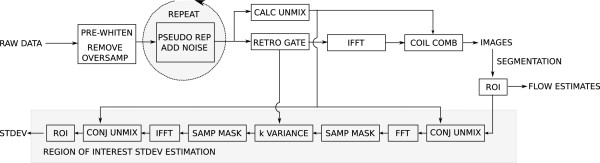
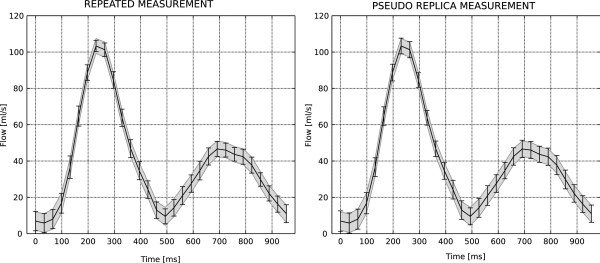
The estimation of confidence intervals in flow measurements is complicated by noise correlation among the image pixels and cardiac phases. This correlation is caused by sequence and reconstruction parameters. A method for the calculation of the standard deviation of region of interest measurements was adapted and expanded to accommodate typical clinical PC measurements and the region-of-interest analysis used for such measurements. This included the dependency between cardiac phases that arises due to retrospective cardiac gating used in such studies. The proposed method enables calculation of standard deviations of flow measurements without the need for repeated experiments or repeated reconstructions. The method was compared to repeated trials in phantom measurements and pseudo replica reconstructions of in vivo data. Three different flow protocols (free breathing and breath hold with various accelerations) were compared in terms of the confidence interval ranges caused by thermal noise in the measurement data.
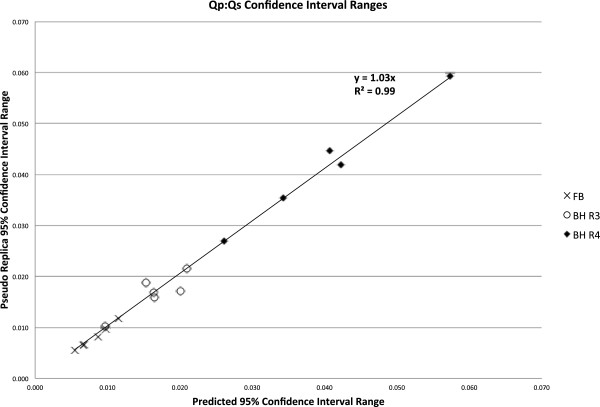
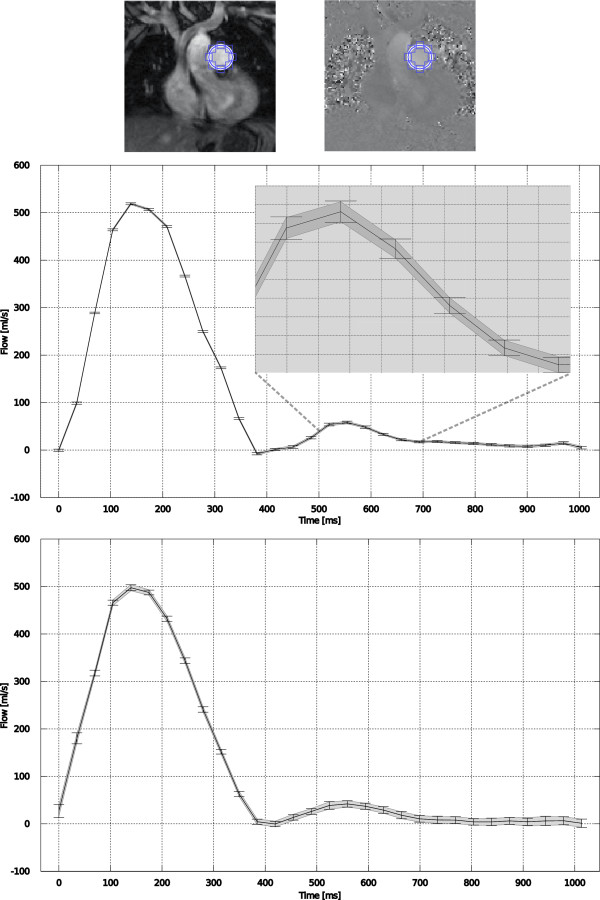
Using the proposed method it was possible to accurately predict confidence intervals for flow measurements. The method was in good agreement with repeated measurements in phantom experiments and there was also good agreement with confidence intervals predicted by pseudo replica reconstructions in both phantom and in vivo data. The proposed method was used to demonstrate that the variation in cardiac output caused by thermal noise is on the order of 1% in clinically used free breathing protocols, and on the order of 3-5% in breath-hold protocols with higher parallel imaging factors.
It is possible to calculate confidence intervals for Cartesian PC contrast flow measurements directly without the need for time-consuming pseudo replica reconstructions.
相衬(PC)测量在几个心血管磁共振(CMR)协议中起着重要作用,但在这些测量中观察到相当大的变化。这种变化的一部分源于从测量数据通过图像重建到用于流量测量的感兴趣区域分析的热噪声的传播,这限制了精度。本研究的目的是开发一种直接估计热噪声引起的变化的方法,并在体模和体内数据中验证该方法。
流量测量中的置信区间的估计受到图像像素和心脏相位之间的噪声相关性的影响。这种相关性是由序列和重建参数引起的。一种用于计算感兴趣区域测量标准偏差的方法被改编和扩展,以适应典型的临床 PC 测量和用于此类测量的感兴趣区域分析。这包括由于在这些研究中使用的回顾性心脏门控而产生的心脏相位之间的依赖性。所提出的方法能够在不需要重复实验或重复重建的情况下计算流量测量的标准偏差。该方法在体模测量和体内数据的伪复制重建中与重复试验进行了比较。在不同的流量协议(自由呼吸和不同加速度的呼吸暂停)方面比较了热噪声在测量数据中引起的置信区间范围。
使用所提出的方法,可以准确地预测流量测量的置信区间。该方法与体模实验中的重复测量吻合良好,并且在体模和体内数据中的伪复制重建中预测的置信区间也吻合良好。所提出的方法用于证明由热噪声引起的心输出量的变化在临床上使用的自由呼吸协议中约为 1%,在具有更高并行成像因子的呼吸暂停协议中约为 3-5%。
可以在不需要耗时的伪复制重建的情况下直接计算笛卡尔 PC 对比流量测量的置信区间。