School of City and Regional Planning, Georgia Institute of Technology, Atlanta, Georgia, United States of America.
Center for Sustainability and the Global Environment, University of Wisconsin-Madison, Madison, Wisconsin, United States of America.
PLoS One. 2014 Jun 25;9(6):e100852. doi: 10.1371/journal.pone.0100852. eCollection 2014.
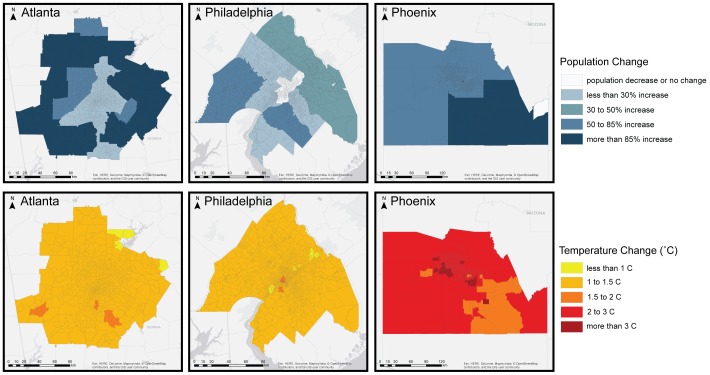
Heat-related mortality in US cities is expected to more than double by the mid-to-late 21st century. Rising heat exposure in cities is projected to result from: 1) climate forcings from changing global atmospheric composition; and 2) local land surface characteristics responsible for the urban heat island effect. The extent to which heat management strategies designed to lessen the urban heat island effect could offset future heat-related mortality remains unexplored in the literature. Using coupled global and regional climate models with a human health effects model, we estimate changes in the number of heat-related deaths in 2050 resulting from modifications to vegetative cover and surface albedo across three climatically and demographically diverse US metropolitan areas: Atlanta, Georgia, Philadelphia, Pennsylvania, and Phoenix, Arizona. Employing separate health impact functions for average warm season and heat wave conditions in 2050, we find combinations of vegetation and albedo enhancement to offset projected increases in heat-related mortality by 40 to 99% across the three metropolitan regions. These results demonstrate the potential for extensive land surface changes in cities to provide adaptive benefits to urban populations at risk for rising heat exposure with climate change.
到 21 世纪中叶至后期,美国城市因高温而导致的死亡人数预计将增加一倍以上。城市中不断上升的热暴露预计将源于:1)不断变化的全球大气成分引起的气候强迫;2)导致城市热岛效应的当地地表特征。在文献中,尚未探讨旨在减轻城市热岛效应的热管理策略在多大程度上可以抵消未来与热相关的死亡人数。我们使用耦合的全球和区域气候模型以及人类健康影响模型,估计了 2050 年由于对植被覆盖和地表反照率进行修改而导致的三个具有不同气候和人口特征的美国大都市区(佐治亚州的亚特兰大、宾夕法尼亚州的费城和亚利桑那州的凤凰城)中与热相关的死亡人数的变化。我们采用 2050 年平均温暖季节和热浪条件下的单独健康影响函数,发现植被和反照率增强的组合可以使这三个大都市区的与热相关的死亡人数减少 40%至 99%。这些结果表明,城市中广泛的土地表面变化有可能为面临气候变化导致的热暴露风险的城市人口提供适应效益。