Climate Change and Health Group, Centre for Radiation Chemical and Environmental Hazards, Public Health England, Chilton, Oxon OX11 0RQ, UK; School of Geography, Earth and Environmental Sciences, University of Birmingham, Edgbaston, Birmingham B15 2TT, UK.
Institute for Environmental Design and Engineering, University College London, Central House, 14 Woburn Place, London WC1H 0NN, UK.
Environ Int. 2021 Sep;154:106530. doi: 10.1016/j.envint.2021.106530. Epub 2021 Apr 23.
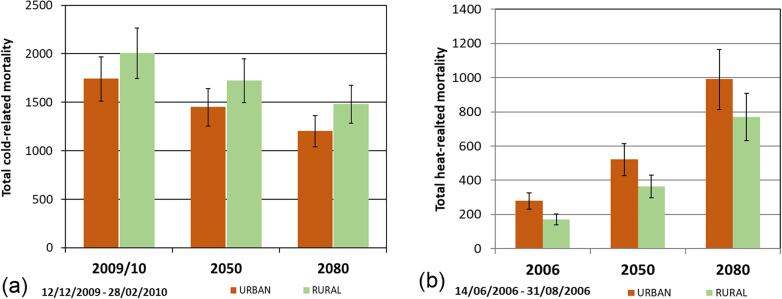
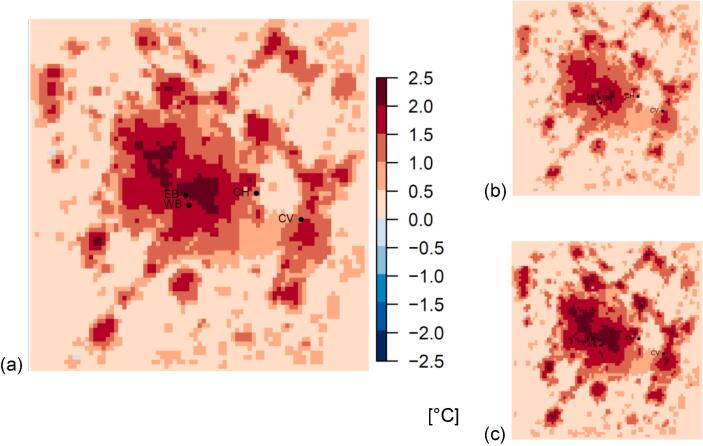
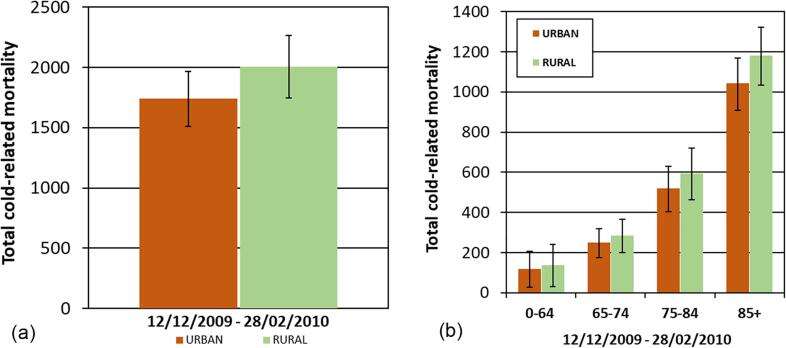
Exposure to heat has a range of potential negative impacts on human health; hot weather may exacerbate cardiovascular and respiratory illness or lead to heat stroke and death. Urban populations are at increased risk due to the Urban Heat Island (UHI) effect (higher urban temperatures compared with rural ones). This has led to extensive investigation of the summertime UHI and its effects, whereas far less research focuses on the wintertime UHI. Exposure to low temperature also leads to a range of illnesses, and in fact, in the UK, annual cold-related mortality outweighs heat-related mortality. It is not clearly understood to what extent the wintertime UHI may protect against cold related mortality. In this study we quantify the UHI intensity in wintertime for a heavily urbanized UK region (West Midlands, including Birmingham) using a regional weather model, and for the first time, use a health impact assessment (HIA) to estimate the associated impact on cold-related mortality. We show that the population-weighted mean winter UHI intensity was +2.3 °C in Birmingham city center, and comparable with that of summer. Our results suggest a potential protective effect of the wintertime UHI, equivalent to 266 cold-related deaths avoided (~15% of total cold-related mortality over ~11 weeks). When including the impacts of climate change, our results suggest that the number of heat-related deaths associated with the summer UHI will increase from 96 (in 2006) to 221 in the 2080s, based on the RCP8.5 emissions pathway. The protective effect of the wintertime UHI is projected to increase only slightly from 266 cold-related deaths avoided in 2009 to 280 avoided in the 2080s. The different effects of the UHI in winter and summer should be considered when assessing interventions in the built environment for reducing summer urban heat, and our results suggest that the future burden of temperature-related mortality associated with the UHI is likely to increase in summer relative to winter.
暴露在高温下会对人体健康产生一系列潜在的负面影响;炎热的天气可能会使心血管和呼吸道疾病恶化,或导致中暑和死亡。由于城市热岛(UHI)效应(城市温度比农村高),城市人口面临更大的风险。这导致了对夏季 UHI 及其影响的广泛研究,而对冬季 UHI 的研究则少得多。暴露在低温下也会导致一系列疾病,事实上,在英国,与寒冷相关的年死亡率超过了与热相关的死亡率。目前还不清楚冬季 UHI 在多大程度上可以预防与寒冷相关的死亡率。在这项研究中,我们使用区域气象模型量化了英国高度城市化地区(西米德兰兹,包括伯明翰)冬季的 UHI 强度,这是首次使用健康影响评估(HIA)来估计其对与寒冷相关的死亡率的相关影响。我们发现,伯明翰市中心的冬季人口加权平均 UHI 强度为+2.3°C,与夏季相当。我们的研究结果表明,冬季 UHI 可能具有保护作用,相当于避免了 266 例与寒冷相关的死亡(约 11 周内与寒冷相关的总死亡人数的 15%)。当包括气候变化的影响时,我们的研究结果表明,与夏季 UHI 相关的热相关死亡人数将从 2006 年的 96 人增加到 2080 年代的 221 人,这是基于 RCP8.5 排放路径。冬季 UHI 的保护作用预计只会略有增加,从 2009 年避免 266 例与寒冷相关的死亡增加到 2080 年代的 280 例。在评估减少夏季城市热的建筑环境干预措施时,应考虑冬季和夏季 UHI 的不同影响,我们的研究结果表明,与 UHI 相关的与温度相关的死亡率的未来负担在夏季相对于冬季可能会增加。