Neuroscience Institute Cavalieri Ottolenghi Orbassano, Italy ; Department of Life Sciences and System Biology, University of Turin Torino, Italy.
Neuroscience Institute Cavalieri Ottolenghi Orbassano, Italy ; Department of Veterinary Sciences, University of Turin Torino, Italy.
Front Neurosci. 2014 Jun 11;8:154. doi: 10.3389/fnins.2014.00154. eCollection 2014.
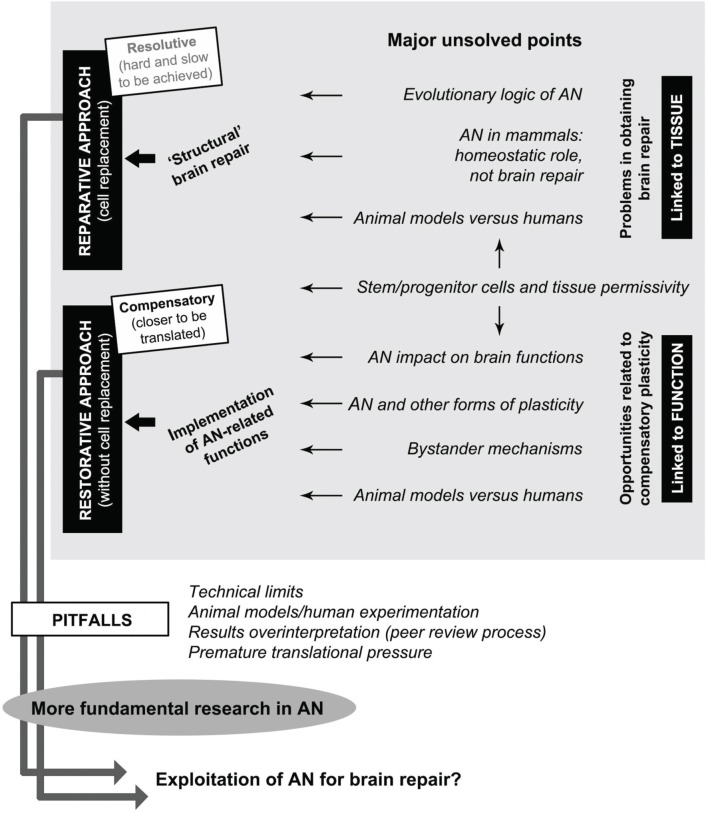
In spite of many data gathered during the last two decades on adult neurogenesis (AN) it is evident that such knowledge is not sufficient for granting translational outcomes in brain repair, especially if the ultimate goal is to promote cell replacement. Alternative strategies aimed at fostering AN physiological functions (restorative approaches) are still undefined. By asking the question whether AN research field has to be considered as a dead end in the context of brain repair, here we review some unresolved issues: multifaceted evolutionary constraints in mammals, stem/progenitor cell type/availability and tissue permissivity, impact on other brain functions, interplay with other forms of plasticity, and relevance in humans. We suggest that full understanding of AN biology is an essential step for its possible exploitation in brain repair, and that further fundamental, multidisciplinary research is required to reach translational outcomes. Scientist's attitude and their communication skills are also important. To avoid overestimation of AN reparative potential in a translational perspective, more distant goals of cell replacement should be kept clearly distinct from restorative approaches involving AN functional plasticity.
尽管在过去的二十年中收集了许多关于成人神经发生 (AN) 的数据,但显然这些知识不足以在大脑修复中获得转化成果,特别是如果最终目标是促进细胞替代。旨在促进 AN 生理功能(恢复方法)的替代策略仍未确定。通过询问 AN 研究领域在大脑修复的背景下是否被认为是死胡同,我们在这里回顾了一些未解决的问题:哺乳动物中多方面的进化限制、干细胞/祖细胞类型/可用性和组织允许性、对其他大脑功能的影响、与其他形式可塑性的相互作用以及在人类中的相关性。我们认为,充分了解 AN 生物学是将其可能应用于大脑修复的必要步骤,需要进一步进行基础的、多学科的研究以获得转化成果。科学家的态度和他们的沟通技巧也很重要。为了避免在转化视角下高估 AN 的修复潜力,应该更清楚地区分细胞替代的更长远目标与涉及 AN 功能可塑性的恢复方法。