Manca M, Ferraresi G, Cosma M, Cavazzuti L, Morelli M, Benedetti M G
Movement Analysis Laboratory, Neuroscience and Rehabilitation Department, Via della Fiera, 44124 Ferrara, Italy.
Physical Therapy and Rehabilitation Unit, Istituto Ortopedico Rizzoli, Via Pupilli 1, 40136 Bologna, Italy.
Biomed Res Int. 2014;2014:939316. doi: 10.1155/2014/939316. Epub 2014 Apr 22.
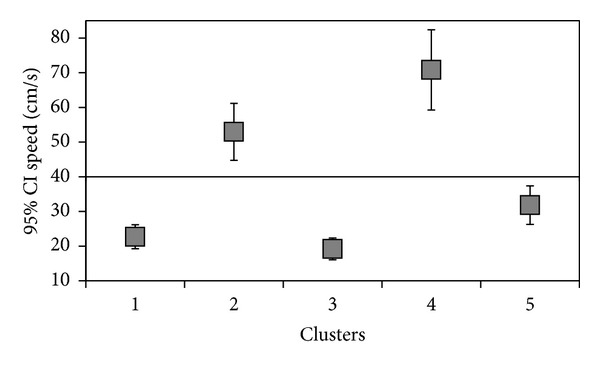
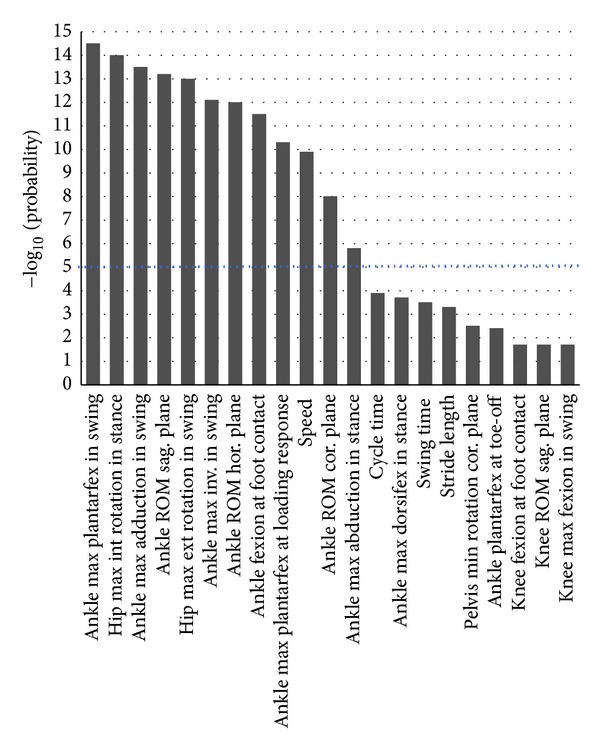
Equinus deformity of the foot is a common feature of hemiplegia, which impairs the gait pattern of patients. The aim of the present study was to explore the role of ankle-foot deformity in gait impairment. A hierarchical cluster analysis was used to classify the gait patterns of 49 chronic hemiplegic patients with equinus deformity of the foot, based on temporal-distance parameters and joint kinematic measures obtained by an innovative protocol for motion assessment in the sagittal, frontal, and transverse planes, synthesized by parametrical analysis. Cluster analysis identified five subgroups of patients with homogenous levels of dysfunction during gait. Specific joint kinematic abnormalities were found, according to the speed of progression in each cluster. Patients with faster walking were those with less ankle-foot complex impairment or with reduced range of motion of ankle-foot complex, that is with a stiff ankle-foot complex. Slow walking was typical of patients with ankle-foot complex instability (i.e., larger motion in all the planes), severe equinus and hip internal rotation pattern, and patients with hip external rotation pattern. Clustering of gait patterns in these patients is helpful for a better understanding of dysfunction during gait and delivering more targeted treatment.
马蹄内翻足畸形是偏瘫的常见特征,会损害患者的步态模式。本研究的目的是探讨踝足畸形在步态障碍中的作用。基于通过一种创新的运动评估方案获得的时间-距离参数和关节运动学测量结果,采用分层聚类分析对49例患有马蹄内翻足畸形的慢性偏瘫患者的步态模式进行分类,该方案通过参数分析在矢状面、额状面和横断面合成。聚类分析确定了五个亚组患者,他们在步态中具有相同水平的功能障碍。根据每个聚类中的进展速度发现了特定的关节运动学异常。行走速度较快的患者是那些踝足复合体损伤较小或踝足复合体活动范围减小的患者,即踝足复合体僵硬。行走缓慢是踝足复合体不稳定(即在所有平面上运动较大)、严重马蹄内翻和髋关节内旋模式以及髋关节外旋模式患者的典型特征。对这些患者的步态模式进行聚类有助于更好地理解步态中的功能障碍并提供更有针对性的治疗。