Department of Epidemiology, Johns Hopkins Bloomberg School of Public Health, Baltimore, Maryland, United States of America.
Department of Virology, Armed Forces Research Institute of Medical Sciences, Bangkok, Thailand.
PLoS Negl Trop Dis. 2014 Jun 26;8(6):e2952. doi: 10.1371/journal.pntd.0002952. eCollection 2014 Jun.
Accurate determination of neutralization antibody titers supports epidemiological studies of dengue virus transmission and vaccine trials. Neutralization titers measured using the plaque reduction neutralization test (PRNT) are believed to provide a key measure of immunity to dengue viruses, however, the assay's variability is poorly understood, making it difficult to interpret the significance of any assay reading. In addition there is limited standardization of the neutralization evaluation point or statistical model used to estimate titers across laboratories, with little understanding of the optimum approach.
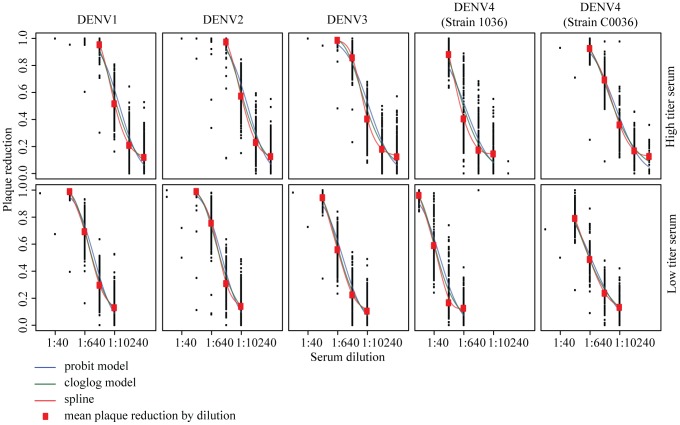
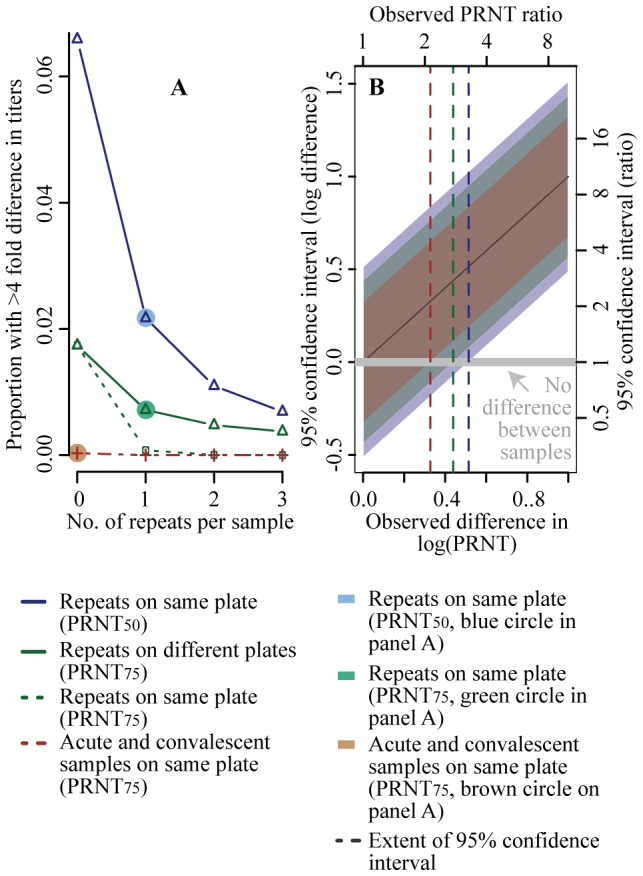
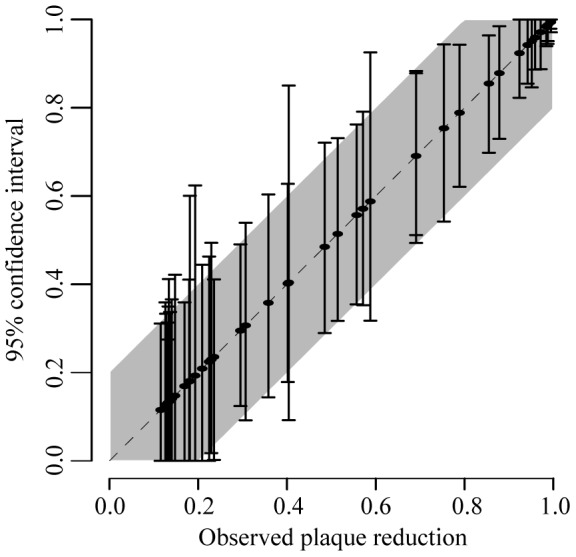
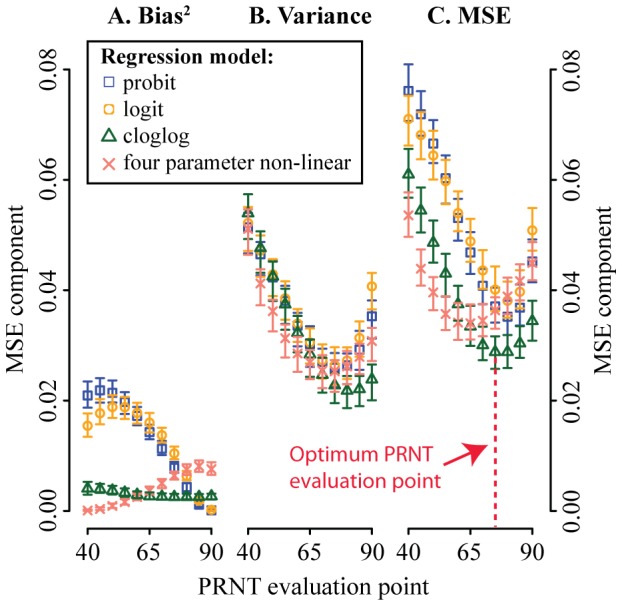
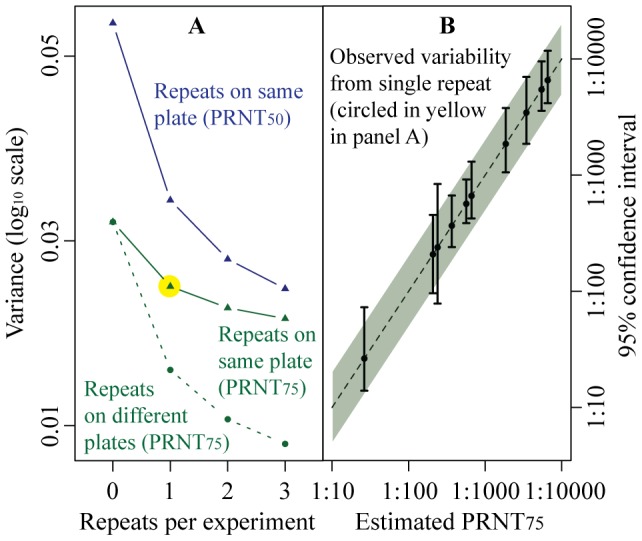
METHODOLOGY/PRINCIPAL FINDINGS: We used repeated assays on the same two pools of serum using five different viruses (2,319 assays) to characterize the variability in the technique under identical experimental conditions. We also assessed the performance of multiple statistical models to interpolate continuous values of neutralization titer from discrete measurements from serial dilutions. We found that the variance in plaque reductions for individual dilutions was 0.016, equivalent to a 95% confidence interval of 0.45-0.95 for an observed plaque reduction of 0.7. We identified PRNT75 as the optimum evaluation point with a variance of 0.025 (log10 scale), indicating a titer reading of 1∶500 had 95% confidence intervals of 1∶240-1∶1000 (2.70±0.31 on a log10 scale). The choice of statistical model was not important for the calculation of relative titers, however, cloglog regression out-performed alternatives where absolute titers are of interest. Finally, we estimated that only 0.7% of assays would falsely detect a four-fold difference in titers between acute and convalescent sera where no true difference exists.
Estimating and reporting assay uncertainty will aid the interpretation of individual titers. Laboratories should perform a small number of repeat assays to generate their own variability estimates. These could be used to calculate confidence intervals for all reported titers and allow benchmarking of assay performance.
准确测定中和抗体效价有助于登革热病毒传播的流行病学研究和疫苗试验。使用蚀斑减少中和试验(PRNT)测量的中和效价被认为是提供对登革病毒免疫力的关键衡量标准,然而,该检测的变异性尚不清楚,使得难以解释任何检测结果的意义。此外,在实验室之间,中和评估点或用于估计效价的统计模型的标准化程度有限,对最佳方法的理解也很少。
方法/主要发现:我们使用相同的两种血清池进行了五次不同病毒的重复检测(2319 次检测),以在相同的实验条件下对该技术的变异性进行特征描述。我们还评估了多种统计模型的性能,以从连续稀释的离散测量值中内插中和效价的连续值。我们发现,个体稀释度的蚀斑减少方差为 0.016,相当于观察到的蚀斑减少 0.7 时的 95%置信区间为 0.45-0.95。我们确定 PRNT75 为最佳评估点,方差为 0.025(对数尺度),表明效价读数为 1∶500 时,95%置信区间为 1∶240-1∶1000(对数尺度上为 2.70±0.31)。对于相对效价的计算,统计模型的选择并不重要,但是,对数回归优于对数几率回归,因为对数几率回归更适用于需要计算绝对效价的情况。最后,我们估计,在不存在真实差异的情况下,只有 0.7%的检测会错误地检测到急性和恢复期血清之间效价的四倍差异。
估计和报告检测不确定性将有助于解释个体效价。实验室应进行少量重复检测以生成自己的变异性估计值。这些可以用于计算所有报告效价的置信区间,并允许对检测性能进行基准测试。