Batenburg Wendy W, Verma Amrisha, Wang Yunyang, Zhu Ping, van den Heuvel Mieke, van Veghel Richard, Danser A H Jan, Li Qiuhong
Division of Pharmacology, Vascular and Metabolic Diseases, Department of Internal Medicine, rasmus MC, GE Rotterdam, The Netherlands.
Department of Ophthalmology, College of Medicine, University of Florida, Gainesville, Florida, United States of America.
PLoS One. 2014 Jun 26;9(6):e100954. doi: 10.1371/journal.pone.0100954. eCollection 2014.
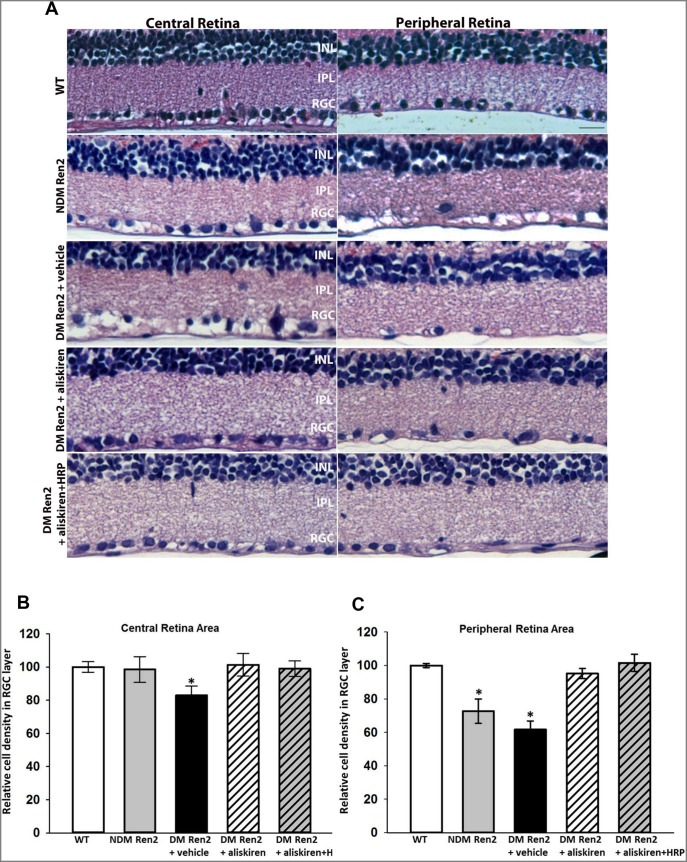
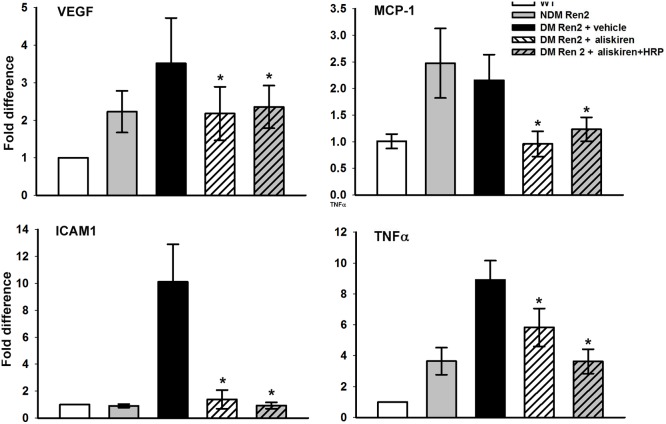
Dysfunction of renin-angiotensin system (RAS) contributes to the pathogenesis of diabetic retinopathy (DR). Prorenin, the precursor of renin is highly elevated in ocular fluid of diabetic patients with proliferative retinopathy. Prorenin may exert local effects in the eye by binding to the so-called (pro)renin receptor ((P)RR). Here we investigated the combined effects of the renin inhibitor aliskiren and the putative (P)RR blocker handle-region peptide (HRP) on diabetic retinopathy in streptozotocin (STZ)-induced diabetic transgenic (mRen2)27 rats (a model with high plasma prorenin levels) as well as prorenin stimulated cytokine expression in cultured Müller cells. Adult (mRen2)27 rats were randomly divided into the following groups: (1) non-diabetic; (2) diabetic treated with vehicle; (3) diabetic treated with aliskiren (10 mg/kg per day); and (4) diabetic treated with aliskiren+HRP (1 mg/kg per day). Age-matched non-diabetic wildtype Sprague-Dawley rats were used as control. Drugs were administered by osmotic minipumps for three weeks. Transgenic (mRen2)27 rat retinas showed increased apoptotic cell death of both inner retinal neurons and photoreceptors, increased loss of capillaries, as well as increased expression of inflammatory cytokines. These pathological changes were further exacerbated by diabetes. Aliskiren treatment of diabetic (mRen2)27 rats prevented retinal gliosis, and reduced retinal apoptotic cell death, acellular capillaries and the expression of inflammatory cytokines. HRP on top of aliskiren did not provide additional protection. In cultured Müller cells, prorenin significantly increased the expression levels of IL-1α and TNF-α, and this was completely blocked by aliskiren or HRP, their combination, (P)RR siRNA and the AT1R blocker losartan, suggesting that these effects entirely depended on Ang II generation by (P)RR-bound prorenin. In conclusion, the lack of effect of HRP on top of aliskiren, and the Ang II-dependency of the ocular effects of prorenin in vitro, argue against the combined application of (P)RR blockade and renin inhibition in diabetic retinopathy.
肾素 - 血管紧张素系统(RAS)功能障碍参与了糖尿病视网膜病变(DR)的发病机制。肾素原,即肾素的前体,在患有增殖性视网膜病变的糖尿病患者眼液中高度升高。肾素原可能通过与所谓的(前)肾素受体((P)RR)结合而在眼部发挥局部作用。在此,我们研究了肾素抑制剂阿利吉仑和假定的(P)RR阻断剂柄区肽(HRP)对链脲佐菌素(STZ)诱导的糖尿病转基因(mRen2)27大鼠(一种血浆肾素原水平高的模型)糖尿病视网膜病变的联合作用,以及肾素原对培养的 Müller 细胞中细胞因子表达的刺激作用。成年(mRen2)27大鼠随机分为以下几组:(1)非糖尿病组;(2)用载体处理的糖尿病组;(3)用阿利吉仑(每天10mg/kg)处理的糖尿病组;(4)用阿利吉仑 + HRP(每天1mg/kg)处理的糖尿病组。年龄匹配的非糖尿病野生型Sprague - Dawley大鼠用作对照。通过渗透微型泵给药三周。转基因(mRen2)27大鼠视网膜显示视网膜内层神经元和光感受器的凋亡细胞死亡增加、毛细血管损失增加以及炎性细胞因子表达增加。糖尿病进一步加剧了这些病理变化。对糖尿病(mRen2)27大鼠用阿利吉仑治疗可预防视网膜胶质增生,并减少视网膜凋亡细胞死亡、无细胞毛细血管和炎性细胞因子的表达。在阿利吉仑基础上加用HRP并未提供额外的保护作用。在培养的 Müller 细胞中,肾素原显著增加白细胞介素 - 1α和肿瘤坏死因子 - α的表达水平,而阿利吉仑或HRP、它们的组合、(P)RR小干扰RNA和AT1R阻断剂氯沙坦可完全阻断这种增加,这表明这些作用完全依赖于与(P)RR结合的肾素原产生的血管紧张素II。总之,在阿利吉仑基础上加用HRP无效,以及肾素原在体外眼部作用对血管紧张素II的依赖性,反对在糖尿病视网膜病变中联合应用(P)RR阻断和肾素抑制。