Division of Health Policy & Management, School of Public Health, University of Minnesota, Minneapolis, MN 55455, USA.
Endocrine Research Unit, Mayo Clinic, Rochester, MN 55905, USA.
Int J Environ Res Public Health. 2014 Jun 25;11(7):6653-65. doi: 10.3390/ijerph110706653.
This study was conducted to determine whether installation of sit-stand desks (SSDs) could lead to decreased sitting time during the workday among sedentary office workers.
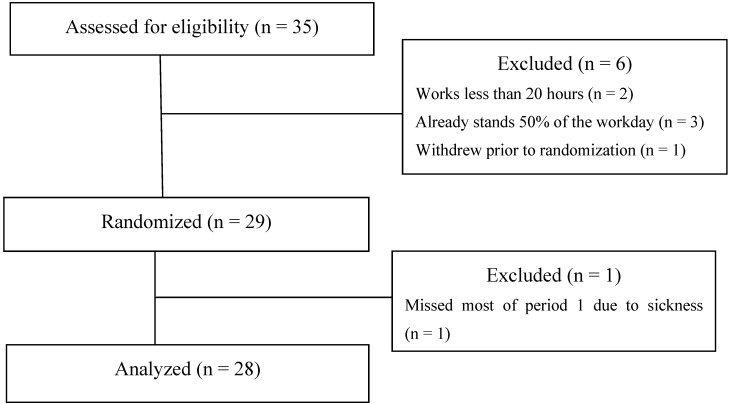
A randomized cross-over trial was conducted from January to April, 2012 at a business in Minneapolis. 28 (nine men, 26 full-time) sedentary office workers took part in a 4 week intervention period which included the use of SSDs to gradually replace 50% of sitting time with standing during the workday. Physical activity was the primary outcome. Mood, energy level, fatigue, appetite, dietary intake, and productivity were explored as secondary outcomes.
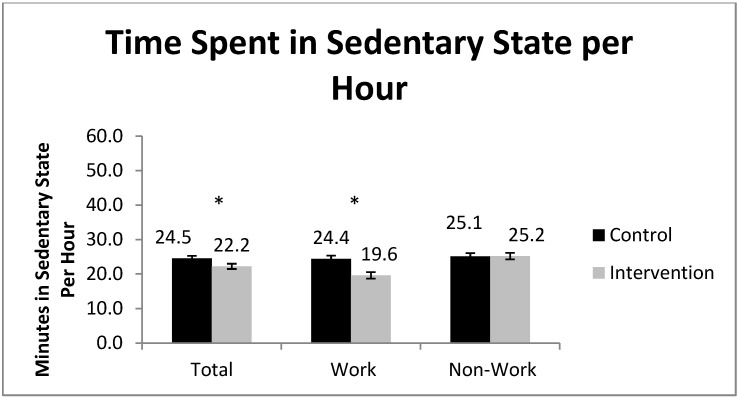
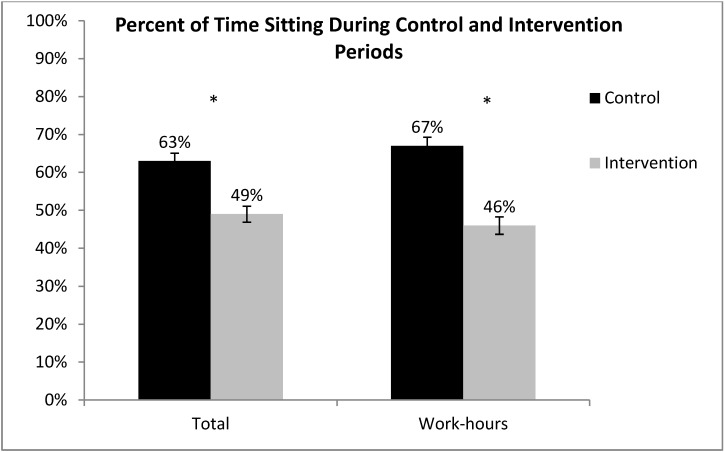
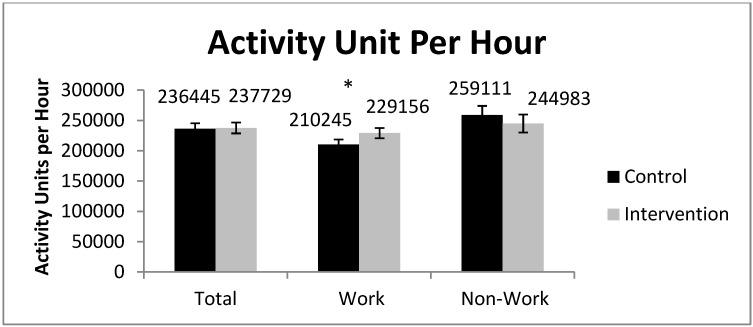
The intervention reduced sitting time at work by 21% (95% CI 18%-25%) and sedentary time by 4.8 min/work-hr (95% CI 4.1-5.4 min/work-hr). For a 40 h work-week, this translates into replacement of 8 h of sitting time with standing and sedentary time being reduced by 3.2 h. Activity level during non-work hours did not change. The intervention also increased overall sense of well-being, energy, decreased fatigue, had no impact on productivity, and reduced appetite and dietary intake. The workstations were popular with the participants.
The SSD intervention was successful in increasing work-time activity level, without changing activity level during non-work hours.
本研究旨在确定在久坐的办公室工作人员中,安装可调节高度办公桌(SSDs)是否可以减少工作日的久坐时间。
2012 年 1 月至 4 月,在明尼阿波利斯的一家企业进行了一项随机交叉试验。28 名(9 名男性,26 名全职)久坐的办公室工作人员参加了为期 4 周的干预期,在此期间,他们使用 SSD 逐渐将工作日的 50%的坐姿时间替换为站立。身体活动是主要结果。情绪、能量水平、疲劳、食欲、饮食摄入和生产力被探索为次要结果。
干预措施将工作时的久坐时间减少了 21%(95%CI 18%-25%),减少了 4.8 分钟/工作小时(95%CI 4.1-5.4 分钟/工作小时)。对于每周工作 40 小时,这相当于用站立代替 8 小时的坐姿,减少了 3.2 小时的久坐时间。非工作时间的活动水平没有变化。该干预措施还提高了整体幸福感、能量,降低了疲劳感,对生产力没有影响,并且降低了食欲和饮食摄入。参与者对工作站非常满意。
SSDs 干预成功地增加了工作时间的活动水平,而不会改变非工作时间的活动水平。