Lam Juleen, Koustas Erica, Sutton Patrice, Johnson Paula I, Atchley Dylan S, Sen Saunak, Robinson Karen A, Axelrad Daniel A, Woodruff Tracey J
Oak Ridge Institute for Science and Education (ORISE) Postdoctoral Fellow, National Center for Environmental Economics, Office of Policy, U.S. Environmental Protection Agency, Washington, DC, USA.
Environ Health Perspect. 2014 Oct;122(10):1040-51. doi: 10.1289/ehp.1307923. Epub 2014 Jun 25.
The Navigation Guide is a novel systematic review method to synthesize scientific evidence and reach strength of evidence conclusions for environmental health decision making.
Our aim was to integrate scientific findings from human and nonhuman studies to determine the overall strength of evidence for the question "Does developmental exposure to perfluorooctanoic acid (PFOA) affect fetal growth in humans?"
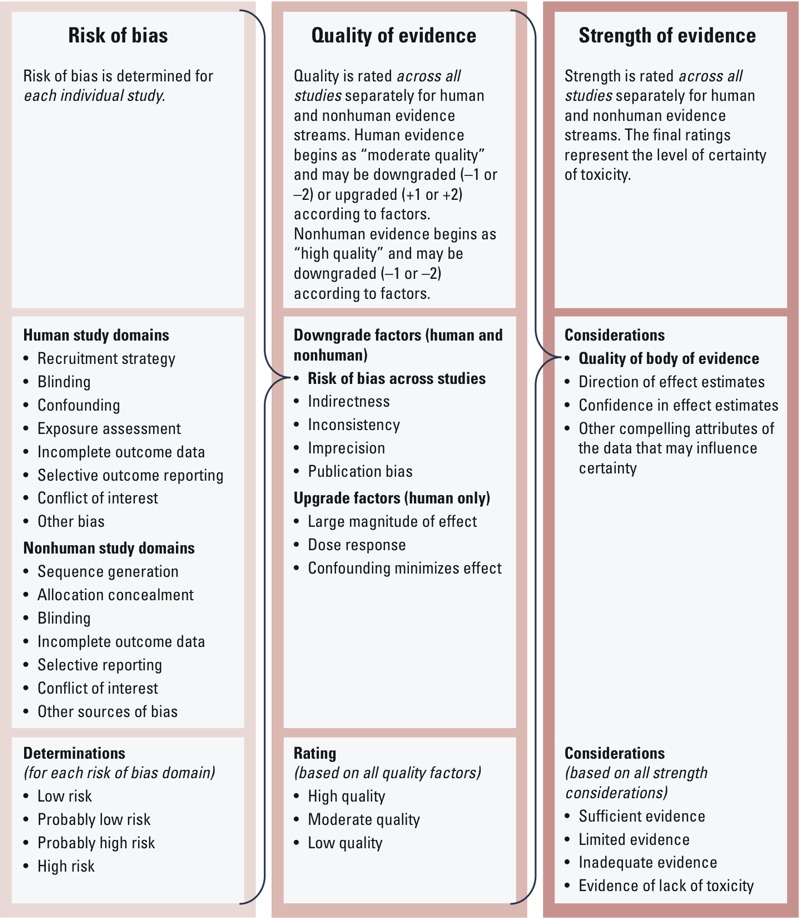
We developed and applied prespecified criteria to systematically and transparently a) rate the quality of the scientific evidence as "high," "moderate," or "low"; b) rate the strength of the human and nonhuman evidence separately as "sufficient," "limited," "moderate," or "evidence of lack of toxicity"; and c) integrate the strength of the human and nonhuman evidence ratings into a strength of the evidence conclusion.
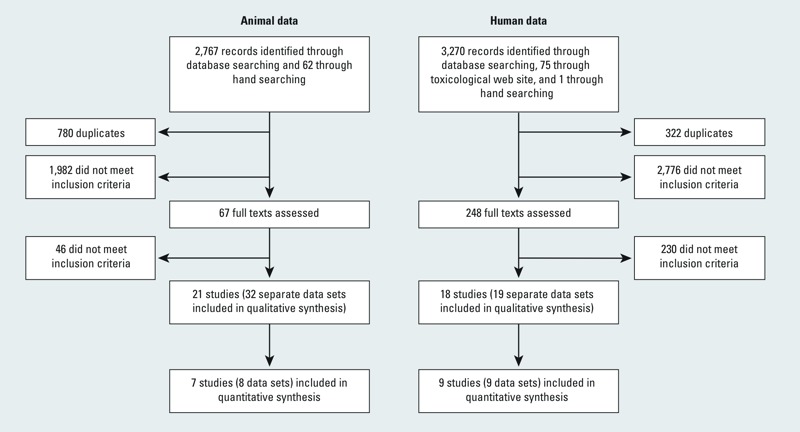
We identified 18 epidemiology studies and 21 animal toxicology studies relevant to our study question. We rated both the human and nonhuman mammalian evidence as "moderate" quality and "sufficient" strength. Integration of these evidence ratings produced a final strength of evidence rating in which review authors concluded that PFOA is "known to be toxic" to human reproduction and development based on sufficient evidence of decreased fetal growth in both human and nonhuman mammalian species.
We concluded that developmental exposure to PFOA adversely affects human health based on sufficient evidence of decreased fetal growth in both human and nonhuman mammalian species. The results of this case study demonstrate the application of a systematic and transparent methodology, via the Navigation Guide, for reaching strength of evidence conclusions in environmental health.
《导航指南》是一种新颖的系统评价方法,用于综合科学证据并得出环境卫生决策的证据强度结论。
我们的目的是整合来自人类和非人类研究的科学发现,以确定“发育过程中接触全氟辛酸(PFOA)是否会影响人类胎儿生长?”这一问题的总体证据强度。
我们制定并应用预先设定的标准,以系统且透明的方式:a)将科学证据的质量评定为“高”“中”或“低”;b)分别将人类和非人类证据的强度评定为“充分”“有限”“中等”或“无毒性证据”;c)将人类和非人类证据强度的评定整合为证据强度结论。
我们确定了18项流行病学研究和21项动物毒理学研究与我们的研究问题相关。我们将人类和非人类哺乳动物证据的质量评定为“中等”,强度评定为“充分”。这些证据评定的整合得出了最终的证据强度评定,综述作者据此得出结论,基于人类和非人类哺乳动物物种胎儿生长均下降的充分证据,PFOA对人类生殖和发育“已知具有毒性”。
基于人类和非人类哺乳动物物种胎儿生长均下降的充分证据,我们得出结论,发育过程中接触PFOA会对人类健康产生不利影响。本案例研究结果展示了通过《导航指南》应用系统且透明的方法来得出环境卫生证据强度结论的过程。